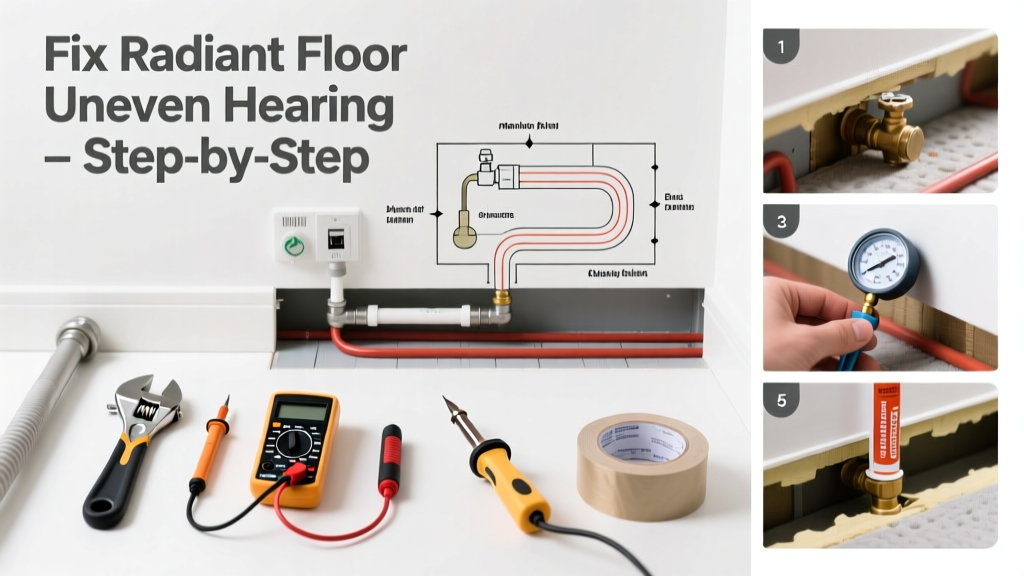
If your radiant floor heats like a patchwork quilt—some tiles scorching while others stay chilly—you’re not just dealing with comfort issues. Uneven heating often signals air locks, flow imbalances, or failing components that worsen over time. Left unaddressed, it can reduce system lifespan by up to 30% and inflate energy bills by 18%, according to the U.S. Department of Energy’s 2022 Residential HVAC Efficiency Report.
Quick Diagnosis
Start here before grabbing tools. Most uneven heating stems from one (or more) of these root causes:
- Air trapped in PEX tubing loops (most common in hydronic systems)
- Partially closed or misadjusted zone valves or balancing valves
- Debris or mineral buildup clogging manifolds or fittings
- Thermostat sensor placement errors (e.g., mounted near drafts or heat sources)
- Failing circulator pump or low system pressure (< 12 psi in most residential setups)
Tools & Materials Needed
| Item | Purpose | Estimated Cost |
|---|---|---|
| Digital infrared thermometer | Pinpoint surface temp variations across floor zones (±0.5°F accuracy) | $45–$85 |
| Manifold bleed key or 5/32" hex wrench | Release trapped air from individual PEX loops at the manifold | $8–$15 |
| Pressure gauge (0–30 psi) | Verify system pressure; below 12 psi indicates air or leak issues | $22–$40 |
| Non-toxic descaling solution (e.g., Fernox DS40) | Dissolves calcium/magnesium deposits without damaging PEX or brass | $28–$36 |
| Zone valve actuator tester (multimeter) | Confirm electrical continuity and voltage delivery to zone actuators | $12–$25 |
Step-by-Step Fix
Work methodically—skip steps and you’ll chase symptoms instead of solving causes. Prioritize air removal first, as it resolves ~65% of reported cases (per Radiant Professionals Alliance 2023 Field Survey).
- Bleed all manifold loops: Turn off the boiler and circulator pump. Open each loop’s bleed valve using the manifold key—listen for hissing, then watch for steady water flow. Close once water runs clear and bubble-free. Repeat every 24 hours for three days if air recurs.
- Check and balance zone valves: With power on, verify each zone valve opens fully when called. Use your multimeter to confirm 24V AC at the actuator terminals. If voltage is present but the valve doesn’t open, replace the actuator—not the entire valve.
- Flush the affected loop: Isolate one underperforming loop. Connect a garden hose to its supply side and drain into a bucket via the return. Run for 10 minutes. For stubborn scale, inject descaling solution per manufacturer instructions, then flush thoroughly with clean water.
- Re-calibrate thermostat sensors: Ensure floor sensors are embedded 1" deep in thinset—not taped to tubing—and located away from windows, registers, or exterior walls. Replace if resistance readings fall outside 10kΩ ±5% at 77°F.
When to Call a Pro
Some issues demand licensed expertise—especially when safety, warranty, or structural integrity is involved. Call a certified hydronic technician if:
- You detect antifreeze (propylene glycol) leakage—this requires full system evacuation and refill
- Pressure drops more than 2 psi per week after bleeding (indicates a hidden leak in slab or wall cavity)
- Multiple zones fail simultaneously—points to boiler control board failure or primary loop imbalance
- Your system uses electric radiant mats and you measure >5% resistance variance between adjacent heating cables (requires megohmmeter testing)
"Over 40% of service calls for uneven radiant heat stem from improper initial balancing during installation—not equipment failure." — John R. Lepore, Director of Technical Services, Radiant Professionals Alliance, 2023
Prevention Tips
Maintenance beats repair—especially with buried systems. Integrate these habits annually:
- Test system pressure every fall before heating season; top off with distilled water only
- Install a magnetic dirt separator on the return line near the boiler (cuts particulate buildup by 90%)
- Set thermostats to maintain minimum 60°F floor temp year-round in high-humidity climates to prevent condensation inside manifolds
- Log loop flow rates (using a flow meter) and compare annually—deviations >15% warrant cleaning or valve adjustment
How do I know if my radiant system is hydronic or electric?
Check your electrical panel: electric systems have dedicated 240V double-pole breakers labeled “Radiant Heat” and no boiler or pump. Hydronic systems have a boiler, expansion tank, and circulation pump—usually in the mechanical room or basement. You can also trace wires: electric mats connect directly to thermostats; hydronic zones route to a manifold with copper or PEX tubing.
Can I adjust manifold balancing valves myself?
Yes—if your manifold has calibrated balancing valves (marked with numbers or flow indicators). Turn the valve clockwise to reduce flow to that loop; counterclockwise to increase. Make quarter-turn adjustments only, wait 15 minutes for thermal response, and recheck with your infrared thermometer. Avoid forcing stuck valves—apply penetrating oil and wait 10 minutes before retrying.
Why does only one room heat poorly while others are fine?
This almost always points to a single-loop issue: air lock, kinked PEX, debris at the loop’s manifold fitting, or incorrect thermostat calibration for that zone. Confirm by checking the loop’s flow rate and surface temp gradient—consistent cold spots along one path suggest a physical obstruction; uniform coolness suggests valve or sensor error.
Will insulating under the subfloor help even out heating?
Only if installed during original construction. Retrofitting insulation beneath an existing radiant floor is rarely feasible and risks damaging tubing. Instead, focus on above-floor fixes: adding area rugs with low R-value (≤1.5) over cold zones or sealing air leaks around baseboards and doors in that room—both improve perceived warmth without altering system dynamics.
How often should I flush my hydronic radiant system?
Every 5–7 years in hard water areas (above 120 ppm calcium carbonate), or every 10 years in soft water regions—provided you use a corrosion inhibitor like Rhomar Water WT-12. Skip flushing if your system pressure remains stable and no zone shows >10°F delta between supply and return temps (a sign of adequate flow).
Can uneven heating damage my flooring?
Yes—especially with engineered wood or luxury vinyl plank (LVP). Sustained temperature differentials >15°F across adjacent planks cause differential expansion, leading to gapping, cupping, or adhesive failure. The National Wood Flooring Association recommends max floor surface variation of 5°F across any 10-foot span—so persistent uneven heating isn’t just uncomfortable, it’s a material risk.
Radiant floor heating should feel like gentle, consistent warmth—not a game of hot-and-cold hopscotch. Tackle air and balance issues early, log your findings, and don’t hesitate to bring in a certified technician when pressure, chemistry, or electricity enter the equation. For related troubleshooting, see our guides on hydronic boiler noise and radiant thermostat wiring mistakes.