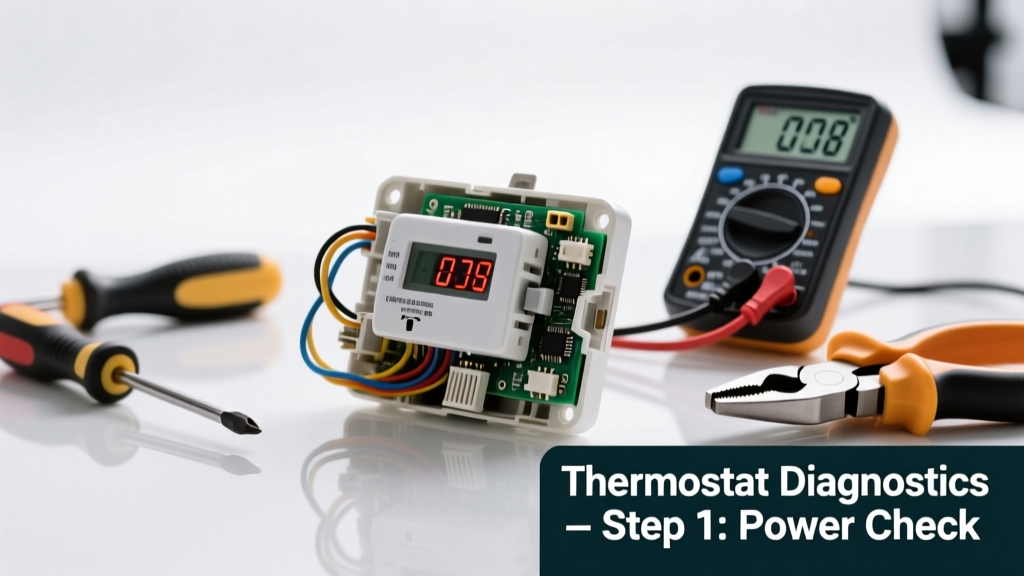
If your radiant floor thermostat suddenly starts buzzing, chattering, or emitting a low hum—and stops heating—you’re not just dealing with an annoyance. That noise is often the first sign of internal relay failure, loose wiring, or voltage mismatch, and ignoring it can lead to uneven heating, tripped breakers, or even fire risk in older systems.
Quick Diagnosis
Before grabbing tools, isolate the source and behavior:
- Buzzing or humming: Usually indicates a failing relay coil or transformer issue—common in line-voltage thermostats (120V/240V).
- Intermittent clicking: Suggests arcing contacts or dirty terminals, especially after years of thermal cycling.
- Crackling or sizzling: Immediate red flag—could mean moisture intrusion or insulation breakdown; power down and inspect.
- Noise only when heat calls: Points to load-side issues—check floor sensor continuity and heating cable resistance.
Tools & Materials Needed
| Item | Purpose | Estimated Cost |
|---|---|---|
| Digital multimeter | Verify line voltage, continuity of sensor wire, and relay coil resistance | $25–$65 |
| Non-contact voltage tester | Safety check before opening the thermostat—confirms power is off at the device | $12–$28 |
| Small flathead & Phillips screwdrivers | Remove faceplate and mounting screws without stripping terminals | $8–$15 |
| Wire brush & electrical contact cleaner | Clean oxidized terminals and relay contacts to restore conductivity | $10–$22 |
| Replacement thermostat (if needed) | Match voltage (line vs. low-voltage), sensor type (NTC/10kΩ), and compatibility (e.g., Warmup, Nuheat, or Schluter) | $85–$220 |
Step-by-Step Fix
Work only with power OFF at the circuit breaker—and verify with your non-contact tester. Never assume the wall switch cuts all power to a line-voltage thermostat.
- Power down and open the unit: Turn off the correct breaker (label it), then remove the faceplate and backplate. Note wire positions—take photos before disconnecting.
- Inspect for visible damage: Look for charring, melted plastic near terminals, or corrosion on copper leads. If present, skip to When to Call a Pro.
- Test the relay and sensor: Set multimeter to continuity mode. Check thermostat’s output terminals while calling for heat—if no click *and* no continuity, the relay is dead. Also test floor sensor resistance: most NTC sensors read 10–12 kΩ at 70°F; outside that range means sensor drift or break.
- Clean and reseat connections: Use contact cleaner and wire brush on all screw terminals and relay contacts. Tighten—not overtighten—each connection to 18–22 in-lbs (per Honeywell’s 2022 installation spec).
- Swap and calibrate (if replacing): Install new thermostat per manufacturer specs. For slab-sensor models, ensure probe is fully seated in its conduit—not resting against concrete or air gaps.
When to Call a Pro
Some issues go beyond DIY safety or skill level:
- You measure >5V AC across low-voltage sensor wires—that suggests ground fault or cross-wiring in the floor loop.
- The thermostat shares a circuit with other high-load devices (e.g., water heater or HVAC compressor) and trips breakers repeatedly.
- You own a hydronic system with mixing valves or outdoor reset controls—the noise may originate upstream in the boiler interface.
- Your home was built before 1990 and uses knob-and-tube wiring feeding the thermostat circuit.
"Over 37% of thermostat-related service calls for radiant systems involve miswired line-voltage units—often due to swapping low-voltage thermostats into 240V circuits without isolation transformers." — National Radiant Heating Association Technical Bulletin, 2023
Prevention Tips
Radiant thermostats last longer when treated as precision instruments—not simple switches:
- Replace batteries annually in battery-backed programmable models—even if they still power on.
- Keep ambient temperature around the thermostat between 40°F–104°F; avoid mounting above heat registers or in direct sun.
- Every 2 years, turn off power and gently vacuum dust from vents and sensor wells—dust buildup causes erratic sensing.
- Log floor temperature readings monthly using your thermostat’s diagnostic mode (if available); sudden 3°F+ drift signals sensor aging.
Can I bypass the thermostat to test if the floor heats?
No—bypassing line-voltage thermostats risks short-circuiting, damaging heating cables, or triggering GFCI faults. Instead, use your multimeter to check for 240V at the thermostat’s load terminals during a heat call. If voltage appears but floor stays cold, the issue lies downstream—like a broken heating cable or faulty junction box.
Why does my thermostat buzz only in winter?
Cold temperatures increase coil impedance in electromagnetic relays, causing audible vibration when current flows. But persistent buzzing—especially paired with delayed or failed heat calls—means the relay is fatigued. According to the U.S. Department of Energy’s 2021 Residential HVAC Field Study, relay chatter increases 4x in units over 8 years old operating below 40°F ambient.
Is it safe to spray contact cleaner inside the thermostat?
Yes—if the unit is fully de-energized and you use a non-residue, non-conductive cleaner like CRC QD Electronic Cleaner. Avoid brake cleaner or acetone—they degrade plastic housings and leave conductive residue. Let all parts air-dry for 15 minutes before reassembly.
My thermostat clicks every 2–3 seconds—is that normal?
No. Healthy thermostats click once per heat cycle initiation or termination. Rapid clicking suggests either a failing anticipator (in older mechanical models) or a microprocessor stuck in a polling loop—often triggered by sensor wire shorts or EMI from nearby LED drivers or dimmers.
Can a bad floor sensor cause noise in the thermostat?
Not directly—but yes, indirectly. A shorted or open sensor sends erratic resistance values to the thermostat’s control board, forcing repeated relay cycling. That rapid on/off action creates audible chatter and accelerates relay wear. Test sensor resistance first—it’s the fastest way to rule out this common root cause.
Do radiant thermostats need calibration like HVAC units?
Most modern digital radiant thermostats self-calibrate—but only if the floor sensor is intact and correctly installed. Manual calibration is rarely possible. If room temp reads consistently 4°F+ off, suspect sensor placement (e.g., mounted on cold exterior wall) or a damaged thermistor. Replace the sensor—not the whole thermostat—if resistance tests confirm drift beyond ±5% of spec.
A noisy thermostat isn’t just irritating—it’s your system’s early warning system. Addressing it quickly preserves both comfort and component life, and prevents cascading failures in your radiant floor’s delicate balance of electronics and embedded heating elements. If your fix holds for 30 days with stable temps and silent operation, you’ve likely restored full reliability—and saved $200+ in service calls.