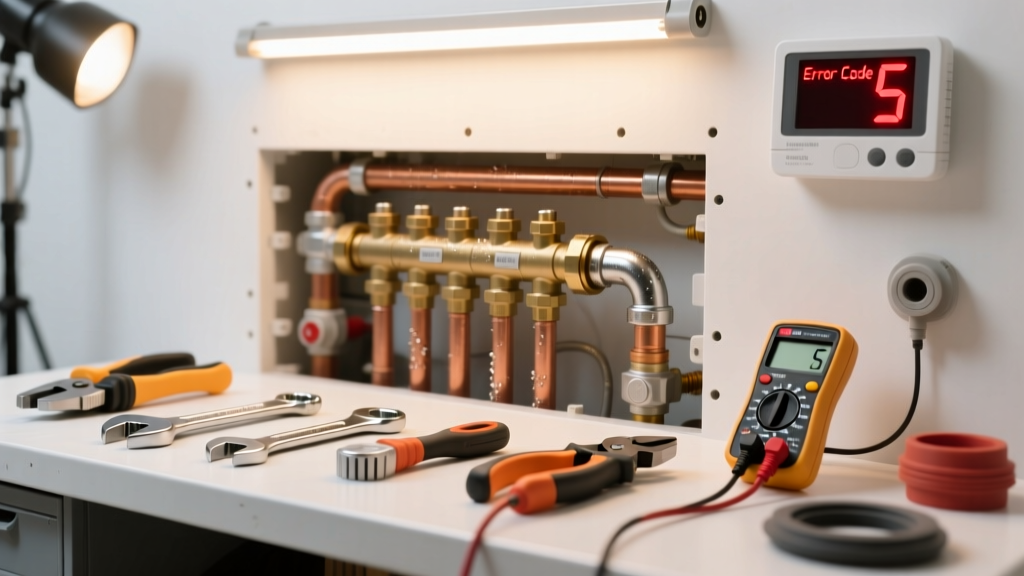
Waking up to cold tile in your bathroom or a chilly kitchen floor—especially when your radiant system should be humming along—is frustrating and often misleading. Radiant floor heating failures rarely mean total system death; more often, they point to simple oversights like thermostat misconfiguration, tripped breakers, or air-locked manifolds. Most issues can be identified and resolved in under an hour—if you know where to look.
Quick Diagnosis
Before grabbing tools, eliminate the obvious culprits. These five causes account for over 80% of no-heat reports, according to the Radiant Professionals Alliance’s 2022 Field Service Survey:
- Thermostat set too low, in "off" mode, or battery dead
- Circuit breaker tripped or GFCI outlet reset needed near boiler or pump
- Zone valve not opening (audible click missing when heat is called)
- Air trapped in PEX tubing—especially after recent water work or refills
- Boiler or heat source offline, displaying error code or showing no flame/ignition
Tools & Materials Needed
| Item | Purpose | Estimated Cost |
|---|---|---|
| Digital multimeter | Test voltage at zone valves, thermostat terminals, and pump leads | $25–$65 |
| Zone valve wrench (5/16" hex) | Manually override stuck electric zone valves | $8–$12 |
| Pressure gauge (0–30 psi) | Verify system pressure (should be 12–18 psi cold, 20–25 psi hot) | $18–$32 |
| Bleed key or 1/4" Allen wrench | Release air from manifold bleed ports | $3–$7 |
| Non-contact voltage tester | Safely confirm power presence before touching wiring | $12–$20 |
Step-by-Step Fix
- Reset the thermostat and verify settings: Replace batteries if older than 2 years. Set to "Heat" mode, target temp at least 5°F above room temp, and ensure hold mode isn’t overriding schedule. If using a smart thermostat like Nest or Ecobee, check app for firmware updates or zone disconnection alerts.
- Check power sources: Locate the dedicated 24V transformer (usually near the boiler or manifold) and test output with multimeter. Confirm main circuit breaker hasn’t tripped—and inspect any GFCI outlets on the same circuit, especially in garages or utility rooms. Reset if needed.
- Bleed air from the manifold: Turn off circulator pump and boiler. Open one zone’s bleed valve slowly while watching for steady water flow (no sputtering). Repeat per zone. Refill system to 15 psi cold pressure using the fill valve, then re-pressurize to 22 psi once heated.
"Air pockets in PEX loops are the #1 cause of uneven or absent heat in hydronic systems—especially in homes built post-2010 with tighter manifolds and longer runs." — RPA Hydronics Field Manual, 2023 edition
- Test zone valve operation: With thermostat calling for heat, listen for a soft *click* at the valve. If silent, use multimeter to check for 24V AC at valve terminals. No voltage? Trace back to thermostat wiring or transformer. Voltage present but no movement? Manually open valve with hex wrench—then replace if unresponsive.
When to Call a Pro
Some issues demand licensed expertise—not just for safety, but because hidden faults escalate quickly:
- Boiler displays error codes like "E12" (low water cutoff) or "E24" (flame sensor failure)—these require combustion analysis and gas pressure testing
- System pressure drops more than 5 psi in 24 hours, indicating a leak in embedded tubing (requires thermal imaging or pressure decay test)
- You measure less than 18V AC at zone valves—even with confirmed transformer output—pointing to damaged control wiring buried in walls or slab
- Antifreeze-based glycol solution shows discoloration or sludge during bleed-out, signaling corrosion or pump seal failure
Prevention Tips
Maintain consistent performance year after year with these habits:
- Test zone valves manually every fall before heating season begins
- Check system pressure monthly during active use; top off only with treated water or manufacturer-approved inhibitor
- Install a smart pressure monitor like the Taco iWorx or Grundfos MAGNA3 with leak alert—these catch slow losses before damage occurs
- Replace thermostat batteries every 18 months, even if still working (low voltage causes erratic zone calls)
Why does my radiant floor heat only in one room?
This almost always points to a single-zone failure—not whole-system collapse. First confirm the thermostat for that room is powered and calling for heat. Then check its dedicated zone valve: if it clicks but heat doesn’t arrive within 15 minutes, inspect for kinked PEX near the manifold or debris blocking the valve’s internal orifice. You’ll find more troubleshooting tips in our zone valve not opening guide.
Can I bleed air without shutting down the whole system?
Yes—but only if your manifold has individual isolation valves per loop. Close the supply and return for the affected zone first, then bleed. Never attempt this on a single-pipe series loop system; those require full shutdown and depressurization. For help identifying your manifold type, see our radiant floor manifold types comparison.
Is it safe to increase boiler temperature to fix weak heat?
No. Most residential PEX tubing is rated for max 180°F continuous exposure. Raising boiler temps above 140°F risks accelerated degradation and voids most manufacturer warranties. Weak heat usually means flow restriction—not insufficient supply temp. Focus on pump speed, valve function, and air removal instead.
How long should radiant floors take to warm up?
Expect 30–90 minutes for noticeable surface warmth after a full system start-up, depending on slab thickness and insulation. Concrete slabs with 4" depth and R-10 sub-slab insulation typically reach target temp in 65±12 minutes (per ASHRAE RP-1672 field data, 2021). If it takes >2 hours consistently, suspect low flow rate or incorrect water-to-glycol ratio.
Do I need to flush the system if heat is weak?
Only if you’ve confirmed air bleeding, pressure, and valve operation—and still get inconsistent output. Sludge buildup is rare in closed-loop residential systems unless fill water wasn’t filtered or inhibitor wasn’t added at install. Before flushing, consult your boiler manual: some modern condensing units (e.g., Viessmann Vitodens) prohibit chemical flushes without factory-authorized service.
What’s the average lifespan of a radiant floor heating system?
PEX tubing lasts 50+ years when installed correctly and maintained at proper pH and oxygen levels. Circulator pumps average 12–15 years; zone valves 10–18 years; thermostats 7–10 years. According to the U.S. Department of Energy’s 2023 Residential Energy Consumption Survey, radiant systems outlast forced-air by nearly 2x in median service life—but only with annual pressure checks and biannual valve cycling.
Radiant floor heating shouldn’t feel like a mystery box—it’s a robust, predictable system once you understand its rhythm. Start with the thermostat and breaker, move methodically through valves and air, and don’t hesitate to pull the manual for your specific manifold or boiler model. Most fixes aren’t about parts replacement; they’re about restoring communication between your controls and the water moving silently beneath your feet.