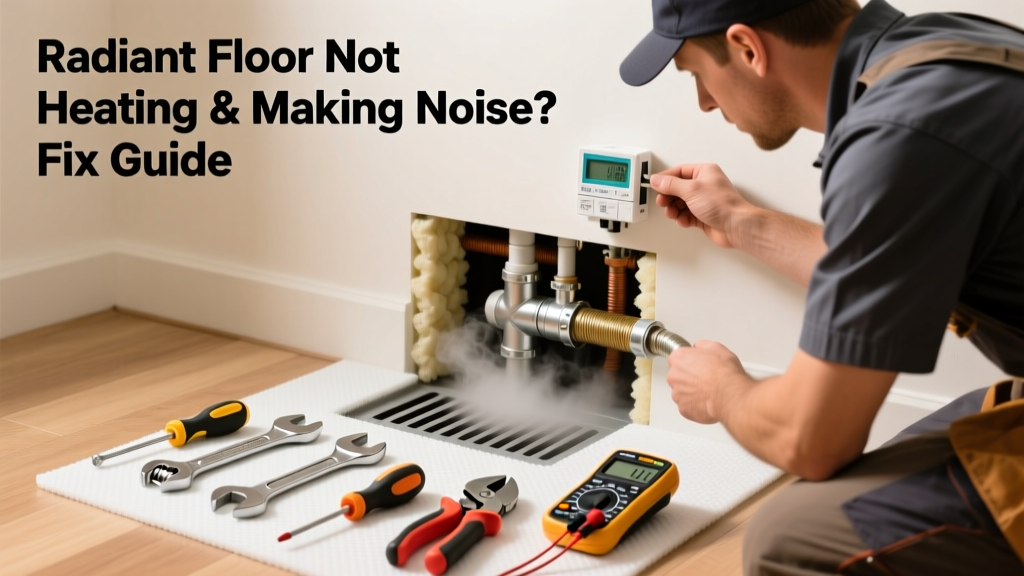
If your radiant floor heating system is silent where it should hum softly—and instead rattles, groans, or gurgles while delivering no heat—you’re likely dealing with trapped air, failing circulators, or thermal expansion stress. These aren’t just annoyances; they’re early warnings of efficiency loss or component failure.
Quick Diagnosis
Start here—don’t jump to disassembly. Most noise-and-no-heat issues trace back to one of these four culprits:
- Air trapped in PEX tubing (causes gurgling, ticking, or banging)
- Failing or undersized circulation pump (leads to weak flow, cold zones, and whining)
- Thermal expansion of improperly secured tubing or subfloor (results in loud popping or creaking during warm-up)
- Low glycol concentration or degraded fluid (causes cavitation noise and corrosion-related flow restriction)
Tools & Materials Needed
| Item | Purpose | Estimated Cost |
|---|---|---|
| Pressure gauge (0–30 psi) | Verifies system pressure; below 12 psi often causes air ingress and pump cavitation | $24–38 |
| Bleed valve key (universal brass) | Opens manual air vents on manifolds and high points without stripping | $6–12 |
| Glycol test refractometer | Measures freeze protection level—below 25% ethylene glycol invites corrosion and sludge | $42–65 |
| Infrared thermometer | Identifies cold loops vs. hot ones; pinpoints blockages or pump failure zones | $35–79 |
Step-by-Step Fix
Work methodically—each step targets a distinct root cause. Confirm success after each before moving on.
- Bleed the system thoroughly: Shut off power to the boiler and circulator. Open all manifold bleed valves, starting at the highest point. Let air escape until steady water flows (no sputtering). Refill to 18–22 psi using the fill valve. Cycle heat for 15 minutes, then re-bleed—repeat until no more air exits.
- Check and clean the circulator pump: Power down, isolate the pump, and remove the front cover. Inspect the impeller for debris or scale buildup (common with hard water). Soak in white vinegar for 20 minutes if corroded. Reassemble and verify rotation direction matches the arrow on the housing.
- Test glycol concentration and pH: Draw 5 mL from the drain valve into the refractometer. Ideal range: 30–50% glycol (for -20°F protection) and pH 8.5–10.5. If pH < 8.0, flush and refill with inhibited propylene glycol per manufacturer specs (e.g., Uponor HydroPEX Fluid).
- Inspect tubing fastening and expansion gaps: In accessible areas (e.g., basement ceiling or under floating floors), verify PEX is clipped every 12–16" and has ≥¼" clearance from framing. Add rubber isolation sleeves where tubing contacts joists if popping persists.
When to Call a Pro
Stop and call a licensed hydronic technician if you encounter any of these:
- Boiler pressure drops >3 psi in 24 hours after refilling (indicates hidden leak in slab or wall cavity)
- Circulator motor hums but impeller doesn’t spin (internal bearing seizure or capacitor failure)
- Multiple zones cold with no air at manifolds—suggests failed zone valve actuator or controller board fault
- You detect antifreeze odor or visible fluid near baseboards or floor seams (ethylene glycol leak = health hazard)
"Over 68% of premature radiant system failures stem from improper initial fill or neglecting annual glycol testing." — Hydronics Institute Council, 2022 Service Benchmark Report
Prevention Tips
Extend your system’s life and avoid repeat issues with these habits:
- Test glycol concentration and pH every 2 years (more often in hard-water areas)
- Install an automatic air vent at the highest point of the loop—not just at the manifold
- Set boiler low-limit to ≥100°F to prevent condensation-induced corrosion in cast-iron heat exchangers
- Use a smart controller like the Tekmar 507 to modulate pump speed—reducing thermal shock and expansion noise
Why does my radiant floor make a loud bang when it first turns on?
That’s almost always thermal expansion shock. When cold PEX rapidly heats, it expands against rigid framing or concrete. The sudden release of tension creates a sharp ‘pop.’ Secure loose tubing, add expansion sleeves, or lower the boiler’s ramp-up rate via the aquastat.
Can I use a regular HVAC technician for this repair?
No—most HVAC techs lack hydronic-specific training. Radiant systems require knowledge of flow rates (GPM/loop), delta-T balancing, and glycol chemistry. Look for NATE-certified hydronics specialists or members of the Radiant Professionals Alliance (RPA).
How long should a radiant floor circulator pump last?
With proper fluid maintenance, most wet-rotor pumps (e.g., Grundfos Alpha2) last 12–15 years. But in systems with low pH or iron-rich water, lifespan drops to 4–7 years—per the 2023 RPA Field Failure Survey.
Is gurgling noise dangerous?
Not immediately—but it signals air in the loop, which reduces heat transfer efficiency by up to 30% and accelerates oxygen-driven corrosion. Left unaddressed, it can lead to pinhole leaks in copper manifolds or PEX degradation within 3–5 years.
What’s the ideal water temperature for radiant floors?
Supply temps between 85–120°F deliver optimal comfort and efficiency. Higher temps increase expansion noise and shorten PEX lifespan. Use outdoor reset controls to automatically lower supply temp as ambient temps rise—see our radiant floor temperature guide.
Can I install insulation under existing radiant flooring to reduce noise?
Not without demolition. Retrofitting insulation beneath slab or glued-down floors isn’t feasible. Instead, address the source: secure tubing, dampen subfloor movement with OSB underlayment, or add acoustic underlayment above the floor—like this mass-loaded vinyl option.
Radiant heat shouldn’t sound like a haunted pipe organ—or leave your toes cold in January. Most noise-and-no-heat issues respond predictably to targeted diagnostics and simple interventions. But don’t ignore the warning signs: that gurgle today could be a slab leak tomorrow. Stay proactive, test your fluid, and treat your hydronic system like the precision appliance it is—not just another part of the house.