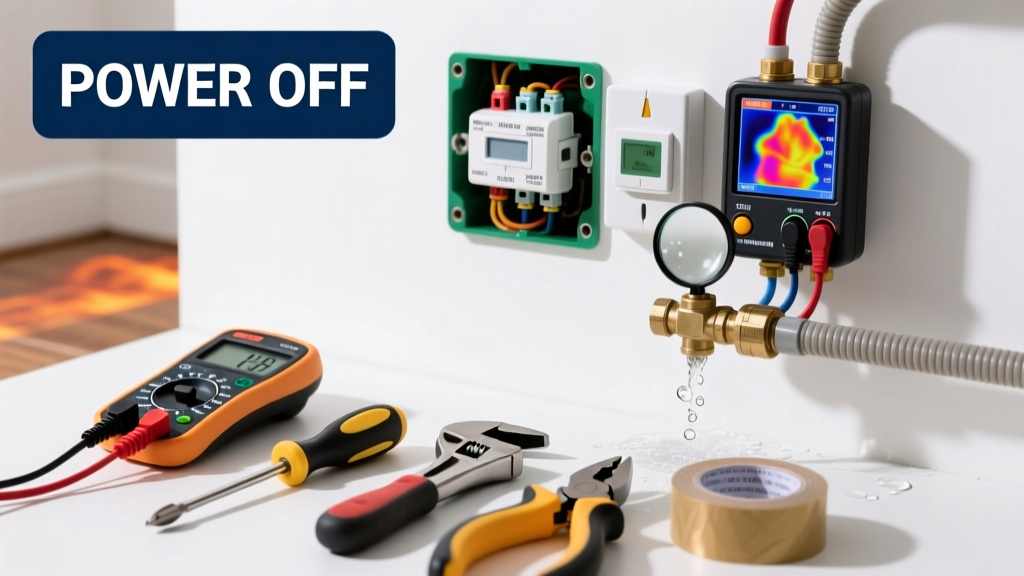
That chill underfoot on a cold morning isn’t just annoying—it’s a red flag. If your radiant floor heating system has gone quiet, the cause could be as simple as a tripped breaker or as serious as a cracked PEX tube buried in concrete. Most issues are solvable in under two hours—if you know where to look first.
Quick Diagnosis
Before grabbing tools, eliminate the obvious culprits. Radiant floor systems fall into two categories: electric (mats or cables) and hydronic (hot water through tubing). The failure points differ significantly.
- Thermostat not calling for heat—or set below room temperature
- Tripped circuit breaker (electric) or boiler shutdown (hydronic)
- Zone valve stuck closed or actuator failed
- Low water pressure or air lock in hydronic loops
- Broken heating cable or shorted wire (electric only)
Tools & Materials Needed
| Item | Purpose | Estimated Cost |
|---|---|---|
| Multimeter (digital) | Test voltage at thermostat, relay, and heating cable continuity | $25–$65 |
| Boiler pressure gauge (hydronic) | Verify system pressure is 12–25 psi; low pressure = no flow | $12–$30 |
| Zone valve wrench & screwdriver set | Manually override stuck zone valves; access actuators | $8–$22 |
| Non-contact voltage tester | Safely confirm power presence before touching wires | $15–$40 |
| Hydronic air purge kit | Bleed trapped air from manifolds without draining entire system | $35–$85 |
Step-by-Step Fix
Work methodically—start with controls, then move toward the floor itself. Never skip verifying power and settings first.
- Check thermostat & power: Confirm it’s set to “Heat” mode, temperature above ambient, and receiving power. Use a non-contact tester at the thermostat base and transformer terminals.
- Inspect the boiler or breaker panel: For hydronic systems, verify boiler status light is green and error codes are cleared. For electric, check both the main panel and any dedicated subpanel breakers—reset if tripped.
- Test zone valves (hydronic only): Locate the zone valve(s) tied to the cold room. Listen for a faint click when thermostat calls for heat. If silent, manually rotate the lever to “open” position using the wrench. If it moves freely but heat still doesn’t come on, the actuator may need replacement.
- Bleed air from the loop: Attach an air purge kit to the manifold’s bleed port. Open slowly while monitoring pressure gauge. Stop when water flows steadily—no sputtering. Re-pressurize boiler to 18 psi if it drops below 12 psi.
- Test heating cable continuity (electric only): Turn off power, disconnect cable leads, and use multimeter in ohms mode. Compare reading to manufacturer’s spec (e.g., 12 Ω per 100 ft). Infinite resistance = broken cable; near-zero = short.
When to Call a Pro
Some failures require specialized equipment, licensing, or structural access—and attempting them risks injury, flooding, or voiding warranties.
- You detect burning smells, melted wire insulation, or scorch marks at junction boxes
- Boiler displays persistent error codes (e.g., “E127” on Viessmann units) after reset
- Pressure drops >5 psi within 24 hours—indicating a leak in embedded PEX
- Thermostat wiring shows corrosion or damaged sheathing in wet areas like bathrooms
- You own a slab-on-grade home and suspect a ruptured tube—repair requires concrete coring and certified PEX fusion
"Over 62% of hydronic radiant failures stem from air entrapment or low system pressure—not faulty boilers or tubing," according to the Radiant Professionals Alliance’s 2022 Field Service Survey.
Prevention Tips
Annual maintenance prevents 80% of common radiant floor heating issues. Keep records of pressure readings, thermostat calibrations, and zone valve operation.
- Test boiler pressure every 3 months—refill to 18 psi if below 12 psi
- Replace thermostat batteries yearly (even hardwired models often have backup batteries)
- Install a smart thermostat with freeze protection—prevents pipe bursts during winter outages
- Label all zone valves and manifolds with room names and loop numbers using waterproof tape
Why does my radiant floor heat unevenly?
Uneven heating usually points to flow imbalance in hydronic systems—often caused by one zone valve opening slower than others, or debris clogging a manifold port. Try balancing valves manually: close all except the coldest zone, run heat for 15 minutes, then gradually open adjacent zones while checking floor surface temps with an infrared thermometer. How to measure radiant floor surface temperature gives exact placement tips.
Can I add insulation under existing radiant flooring?
No—not without removing the floor. Retrofitting insulation beneath an installed radiant system is structurally impractical and risks damaging tubing or cables. Instead, improve heat retention above: install R-3.8+ carpet padding or engineered hardwood with low thermal resistance (best flooring for radiant heat explains material ratings).
Is it safe to run radiant heat 24/7?
Yes—and often more efficient than cycling. Modern systems modulate output based on outdoor reset curves and indoor demand. Running continuously avoids thermal lag and reduces stress on components. Just ensure your thermostat uses adaptive recovery and setback scheduling to avoid overheating unused rooms.
How long should radiant floor heating last?
Hydronic tubing (PEX-AL-PEX or oxygen-barrier PEX) lasts 50+ years when installed correctly and maintained. Electric heating cables average 25–35 years. Boiler life spans 15–20 years; circulator pumps 10–15. Radiant floor warranty checklist helps track component expiration dates.
What temperature should radiant floor water be?
Supply water should stay between 85°F and 140°F—never exceed 140°F to prevent flooring damage or scald risk. Most systems operate optimally at 95–115°F supply temp with 10–15°F delta-T across the loop. Use a digital IR thermometer on the manifold supply line to verify.
Can I repair a punctured PEX tube myself?
Only if it’s accessible in a crawlspace or basement—not embedded in concrete or thinset. For exposed tubing, cut out the damaged section and use a brass compression coupling (not a crimp ring) rated for radiant use. But if the leak is under tile or slab, call a licensed hydronic technician: improper repair can cause catastrophic flooding or void insurance coverage.
A warm floor shouldn’t feel like a luxury—it should feel like reliability. Most radiant floor heating problems aren’t mysterious; they’re mechanical, electrical, or procedural oversights that respond well to careful, sequential troubleshooting. Keep your boiler manual handy, log pressure checks in a notebook, and treat your thermostat like the control center it is—not just a wall-mounted gadget. When warmth returns, you’ll know exactly why—and how to keep it steady for years.