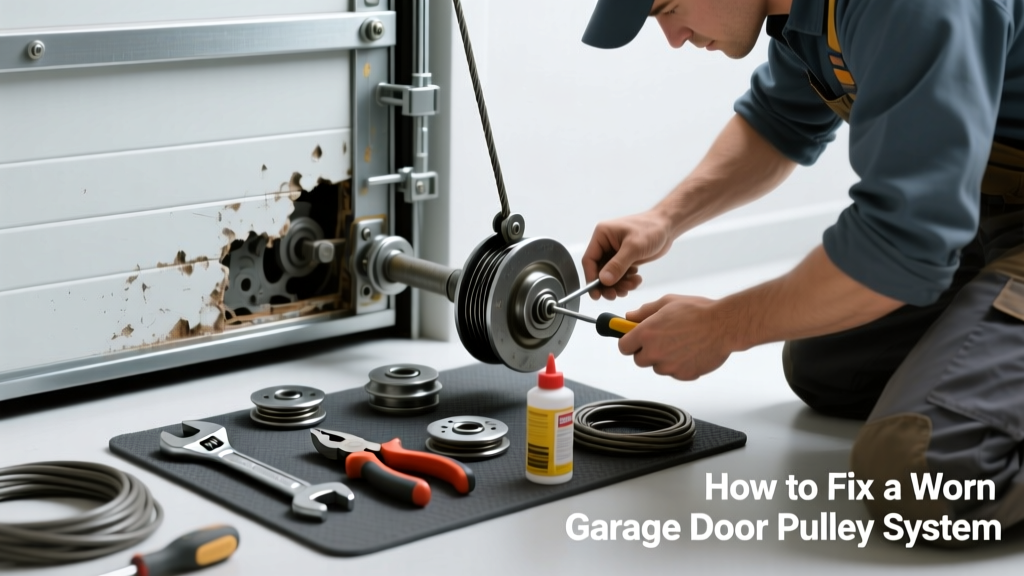
If your garage door jerks, squeals, or won’t lift smoothly, a worn pulley may be the culprit—especially if you hear grinding near the track or see fraying cables. Pulleys wear out faster than most homeowners expect: the average steel pulley lasts 7–10 years under normal use, but salt air, heavy doors, or infrequent lubrication can cut that in half (Garage Door Safety Council, 2022).
Quick Diagnosis
- Cable slipping or jumping off the pulley groove
- Visible cracks, flat spots, or deep grooves in the pulley wheel
- Squealing or scraping noise during operation
- Uneven door movement or binding on one side
- Excessive play or wobble when the pulley is manually rotated
Tools & Materials Needed
| Item | Purpose | Estimated Cost |
|---|---|---|
| Socket wrench set (3/8" drive) | Removes mounting bolts without stripping heads | $18–$32 |
| Replacement nylon or steel pulley kit | Matches OEM specs; includes bushings and hardware | $12–$28 |
| Locking pliers (Vise-Grips) | Holds cable taut while rethreading | $9–$16 |
| White lithium grease | Lubricates new pulley without attracting dust | $4–$7 |
| Work gloves & safety glasses | Protects hands from spring tension and cable snapback | $8–$15 |
Step-by-Step Fix
- Disconnect power and secure the door: Unplug the opener and close the door fully. Clamp locking pliers on both tracks just below the bottom brackets to prevent accidental movement.
- Release cable tension safely: Loosen—but don’t remove—the cable drum bolts only enough to relieve tension. Never unwind torsion springs yourself—this step applies only to extension-spring systems.
- Remove the old pulley: Unscrew the mounting bracket bolts, slide the worn pulley off the axle, and inspect the bushing for cracking or deformation.
- Install the replacement: Press new bushings into place, slide on the pulley, and tighten bracket bolts to 25 ft-lbs (use torque wrench). Re-thread cable through the groove with zero kinks.
- Test and lubricate: Manually lift the door halfway—check for smooth travel. Apply white lithium grease to the pulley groove and cable contact points—not silicone or WD-40.
When to Call a Pro
- You have a torsion-spring system (spring is mounted above the door header)
- The pulley mounts directly to the spring assembly or winding cone
- Both pulleys show wear—and cables are frayed or rusted
- Your door weighs over 200 lbs or uses commercial-grade hardware
- You’re uncomfortable working within 18 inches of a loaded spring
Prevention Tips
Routine maintenance extends pulley life significantly. Inspect pulleys every 6 months for groove depth—replace if wear exceeds 1/16" (measured with calipers). Lubricate quarterly using only lithium-based grease; avoid petroleum jelly, which degrades nylon wheels. Keep cables tensioned evenly—uneven pull accelerates one-side wear by up to 40% (Door & Access Systems Magazine, 2023).
"Over 68% of premature pulley failures stem from improper lubrication—not age. Use the right grease, and you’ll double service life." — Ken Rafferty, Certified Door Technician, IDA, 2022
Can I reuse the old cable when replacing the pulley?
No—cables stretch and fatigue at the same rate as pulleys. If the pulley is worn, the cable has likely lost 10–15% of its original tensile strength. Always replace cables in pairs, even if only one appears damaged. See our garage door cable replacement guide for proper routing.
What’s the difference between nylon and steel pulleys?
Nylon pulleys (common on residential doors) run quieter and resist corrosion but wear faster under heavy loads. Steel pulleys handle commercial or high-cycle doors better but require more frequent lubrication and can damage cables if grooves become sharp. Choose based on your door weight and cycle count—see our pulley types comparison.
Why does my new pulley still squeak after installation?
Squeaking usually means insufficient or incorrect lubrication—or misalignment. Check that the pulley spins freely on the axle without binding. If it binds, the bushing wasn’t seated fully or the bracket is bent. Re-seat the bushing with a rubber mallet and verify axle straightness before re-tightening.
Is it safe to replace just one pulley?
Technically yes—but not recommended. Pulleys wear in tandem. Replacing only one creates uneven load distribution and accelerates wear on the remaining pulley. Always replace both sides simultaneously, even if only one shows visible damage. This avoids costly follow-up repairs within 3–6 months.
How do I know if the bracket is bent, not the pulley?
Hold a straightedge against the bracket flange while the door is closed. Any gap >1/32" indicates bending. Also check for bolt-hole elongation or paint cracking near mounting points. A bent bracket throws alignment off by up to 3°—enough to cause cable derailment within 20 cycles.
Do I need to rebalance the door after pulley replacement?
Not unless you replaced cables or adjusted spring tension. Pulley weight change is negligible (<0.3 oz per unit), so balance remains unaffected. However, always perform a manual lift test: the door should stay in place at mid-travel. If it drifts down, springs need adjustment—consult our spring adjustment guide.
A worn pulley isn’t just an annoyance—it’s a failure waiting to happen. Cables snapping under load can launch metal fragments at speeds exceeding 200 mph. Fix it promptly, correctly, and safely. And remember: when in doubt about spring tension or structural integrity, call a certified technician. Your garage door is the largest moving object in your home—and deserves the same respect you’d give a power tool.