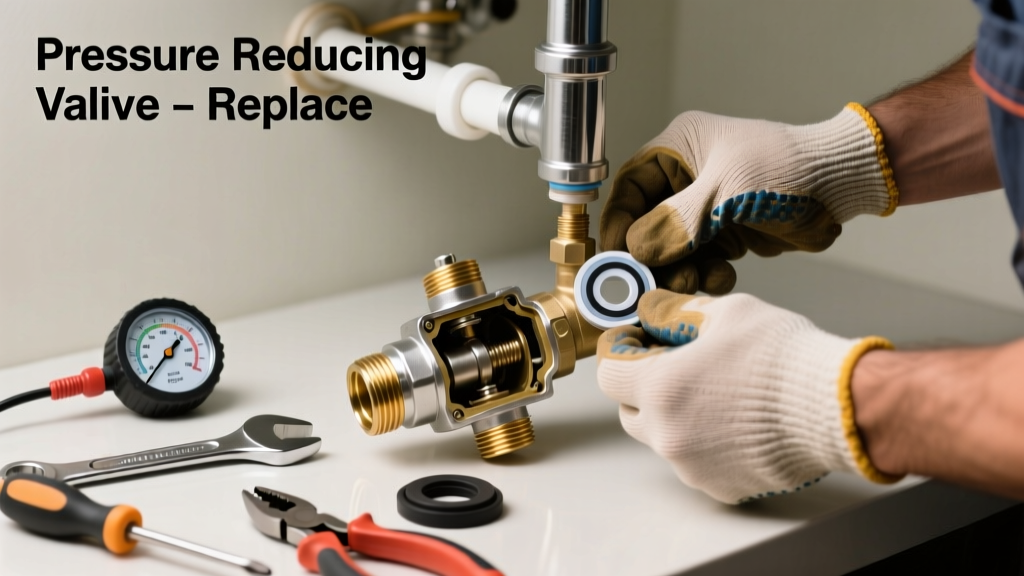
If your faucets are sputtering, pipes are banging, or your water heater’s relief valve is dripping constantly, your pressure reducing valve (PRV) may have failed. A malfunctioning PRV can send household water pressure soaring past the safe 80 psi limit — risking leaks, burst hoses, and premature appliance failure. Don’t wait for a catastrophic failure: this guide walks you through real-world diagnosis and repair.
Quick Diagnosis
Before replacing anything, confirm the PRV is actually the problem. These are the most common signs and root causes:
- Water pressure over 80 psi at any faucet (verified with a gauge)
- No pressure drop after adjusting the PRV’s screw — indicates internal diaphragm rupture
- Visible corrosion or mineral buildup on the valve body or outlet side
- Leaking from the valve’s weep hole or bonnet — often means failed O-rings or cracked seat
- Age over 10–15 years — PRVs wear out silently, per the American Society of Plumbing Engineers' 2022 lifecycle data
Tools & Materials Needed
| Item | Purpose | Estimated Cost |
|---|---|---|
| 3/4" brass PRV (e.g., Watts 270A or Apollo 600) | Direct replacement; matches most residential main lines | $45–$75 |
| Pressure test gauge (0–160 psi) | Verifies inlet/outlet pressure before and after repair | $12–$22 |
| Adjustable wrench & pipe wrench (12") | Secures hex nuts and prevents fitting rotation during disassembly | $18–$32 |
| Teflon tape & pipe dope (non-toxic, NSF-61 rated) | Ensures leak-free threaded joints without contaminating potable water | $4–$9 |
| Bucket & shop towels | Catches residual water and absorbs drips during shutdown | $3–$8 |
Step-by-Step Fix
Most PRV failures require full replacement — cleaning or rebuilding rarely restores reliable function. Follow these steps carefully:
- Shut off main water supply and open the lowest faucet in your home (e.g., basement utility sink) to relieve pressure and drain residual water from the line upstream of the PRV.
- Verify no pressure remains using your test gauge on a downstream faucet — if it reads above 5 psi, wait longer or check for cross-connections.
- Unthread the old PRV using two wrenches: one to hold the pipe nipple steady, the other to loosen the valve body. Expect some mineral scale — soak threads in white vinegar for 10 minutes if stuck.
- Install the new PRV with fresh Teflon tape (wrap clockwise, 5–6 wraps), hand-tighten, then snug with wrench — do not overtighten; torque specs are typically 35–45 ft-lbs per Watts’ 2023 installation manual.
- Test operation: slowly reopen main shutoff, check for leaks at both ends, then measure downstream pressure at multiple fixtures. Adjust the top screw (¼ turn = ~5 psi change) until stable at 50–70 psi.
When to Call a Pro
DIY isn’t safe or practical in several scenarios:
- Your PRV is soldered (not threaded) into a copper main — cutting and re-soldering requires torch work and flood risk
- You detect pressure fluctuations >15 psi between morning and evening — points to municipal supply issues beyond your valve
- The valve sits inside a concrete slab or behind finished drywall with no access panel
- Your home has polybutylene piping (common in homes built 1978–1995) — disturbing connections risks sudden joint failure
"Over 62% of PRV-related insurance claims involve secondary damage from undetected high-pressure conditions lasting more than 72 hours." — Insurance Institute for Business & Home Safety, 2023 Residential Water Damage Report
Prevention Tips
A well-maintained PRV lasts 12–15 years — but only if monitored. Add these habits to your annual home maintenance routine:
- Test water pressure every 6 months using a calibrated gauge — log readings to spot gradual creep
- Inspect the PRV’s weep hole annually for moisture; a single drop means internal seal fatigue
- Install a whole-house sediment filter upstream of the PRV if your water source is well or high in iron/manganese
- Never adjust the PRV more than 2 full turns from factory setting (usually pre-set to 50 psi) — excessive tension accelerates diaphragm stress
How do I know if my PRV is adjustable or non-adjustable?
Look for a slotted or hex-head adjustment screw on top of the valve body. Adjustable models (like Watts LF25 or Zurn ZP-100) have visible screws; non-adjustable units (e.g., some Apollo 500 series) are sealed and marked "factory preset." If unsure, check the model number stamped on the valve body and search the manufacturer’s spec sheet — how to read plumbing valve model numbers.
Can high water pressure damage my water heater?
Yes — consistently over 80 psi stresses tank seams, accelerates anode rod depletion, and forces the temperature/pressure relief (TPR) valve to lift prematurely. The U.S. Department of Energy warns that sustained pressure above 75 psi reduces average water heater lifespan by 3–5 years. Always verify PRV function before diagnosing water heater issues — water heater leaking from relief valve is often misdiagnosed as a tank problem.
Why does my PRV make a hissing or humming noise?
Hissing usually means the valve is struggling to regulate — often due to debris lodged under the seat or a failing spring. Humming or vibration suggests turbulent flow from oversized piping upstream or undersized PRV for your home’s GPM demand. Measure flow rate with a bucket-and-timer test: if you get >12 gallons in 60 seconds at a full-open cold faucet, your PRV may be too small — upgrade to a 1" model for homes over 3,000 sq ft or with irrigation systems.
Do I need a permit to replace my PRV?
In most jurisdictions, yes — PRV replacement is considered a 'change of fixture' under the International Plumbing Code (IPC 2021 §607.3). Permits ensure proper sizing, orientation (arrow must point toward house), and pressure testing. Skip it, and you risk denied insurance claims after water damage — home repair permits what you need to know.
Can I install a second PRV downstream for extra protection?
No — stacking PRVs creates unstable cascade regulation and increases failure risk. Instead, add a thermal expansion tank on your water heater’s cold inlet if you have a closed-loop system (check by closing main shutoff and opening a hot faucet — if pressure rises rapidly, you need one). Expansion tanks absorb surges without confusing the primary PRV’s feedback loop.
What’s the difference between a PRV and a pressure regulator?
None — they’re identical devices. "Pressure reducing valve" is the technical term used in plumbing codes; "pressure regulator" is common industry slang. Both reduce incoming municipal pressure (often 100–125 psi) to a safe 50–70 psi for household use. Confusingly, some HVAC thermostats use "regulator" for gas control — but in plumbing contexts, the terms are fully interchangeable.
A failed PRV isn’t just an inconvenience — it’s a slow-motion threat to your pipes, fixtures, and wallet. Replacing it takes under 90 minutes for most homeowners with basic tools, and pays for itself in avoided repair bills within 18 months. Keep your pressure gauge in an easy-to-find drawer, test twice yearly, and treat your PRV like the silent guardian it is — because when it fails, everything downstream pays the price.