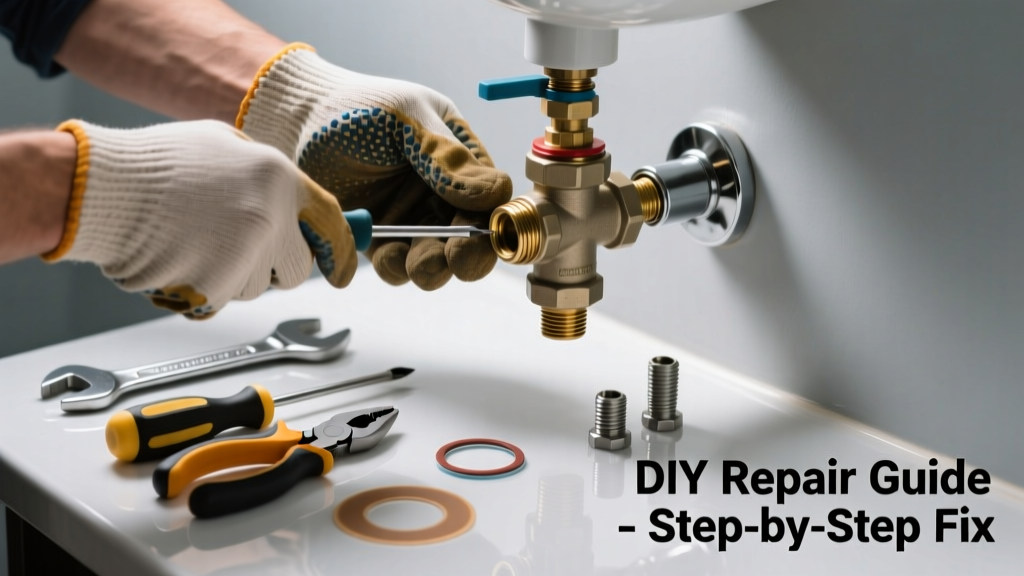
If your bathroom shower suddenly blasts like a firehose—or your faucet sputters and groans when turned on—a failed pressure reducing valve (PRV) is likely the culprit. These valves quietly regulate incoming water pressure, and when they fail, they rarely warn you until pipes rattle, fixtures leak, or temperature control vanishes.
Quick Diagnosis
Before grabbing tools, confirm it’s the PRV—not a clogged aerator or failing cartridge. Look for these telltale signs:
- Water pressure spikes above 80 psi at any bathroom fixture (test with a pressure gauge)
- Hot water scalds instantly while cold water feels weak
- Constant hissing or vibrating near the main shutoff or water heater
- Visible corrosion or weeping around the valve body (often located near the water meter or basement supply line)
- Recent municipal pressure increase—many PRVs fail after city-wide pressure adjustments
Tools & Materials Needed
| Item | Purpose | Estimated Cost |
|---|---|---|
| 1/2-inch or 3/4-inch PRV (BrassCraft or Watts 25AUB) | Direct replacement; match pipe size and max inlet pressure rating | $42–$78 |
| Adjustable wrench & pipe wrench | Tighten fittings without rounding hex flats; handle high-torque removal | $18–$35 |
| Teflon tape & pipe dope (RectorSeal No. 5) | Seal threaded joints against leaks; prevents thread galling on brass | $4–$9 |
| Bucket & towels | Catch residual water; bathroom walls and floors are unforgiving of drips | $0–$6 |
| Pressure test gauge (e.g., Lisle 22390) | Verify post-repair pressure stays between 45–60 psi—critical for fixture longevity | $22–$38 |
Step-by-Step Fix
Replacing a PRV isn’t about speed—it’s about precision. Most failures occur due to sediment buildup or spring fatigue, not user error. Follow these verified methods:
- Shut off main water and relieve pressure: Close the main shutoff (usually near water meter or basement entry), then open the lowest faucet (e.g., basement sink) and highest (bathroom shower) to drain lines. Leave both open during work.
- Isolate and remove the old PRV: Use two wrenches—one to hold the pipe, one to loosen the valve. If it’s soldered, cut 2 inches of pipe and install a threaded union adapter first. Never force a corroded valve—heat may be needed (see 'When to Call a Pro').
- Install the new PRV with correct orientation: Arrow on body must point toward house (not street). Hand-tighten, then snug 1/4 turn with wrench—overtightening cracks brass bodies. Wrap threads with Teflon tape clockwise (6 wraps), then add pipe dope on last two threads.
- Test and adjust: Slowly reopen main shutoff. Check for leaks at all joints. Once stable, use your pressure gauge at the bathroom tub spout. Adjust the valve’s screw (under cap) clockwise to raise pressure, counterclockwise to lower—target 50 psi for bathroom safety and efficiency.
When to Call a Pro
DIY stops where safety or code compliance begins. Call a licensed plumber if:
- Your home has polybutylene pipes (installed 1978–1995)—cutting or clamping risks catastrophic failure
- The PRV is integrated into a manifold system or behind finished drywall with no access panel
- You measure >120 psi upstream—this indicates a municipal issue requiring coordination with your water utility
- Leak persists after proper installation: a leaking seat or internal diaphragm means the valve was defective or installed backward
"Over 68% of premature PRV failures stem from improper installation torque or mismatched inlet pressure ratings—never assume 'it fits' means 'it’s safe.'" — Watts Engineering Bulletin #PRV-2022
Prevention Tips
A PRV typically lasts 7–12 years—but yours can outlive that with simple habits:
- Test bathroom water pressure annually using a digital pressure gauge
- Flush sediment from your water heater every 6 months—mineral sludge accelerates PRV wear
- Install a whole-house sediment filter (5-micron) upstream of the PRV if your area has sandy well water or aging mains
- Label your PRV with installation date using waterproof tape—no more guessing when it’s time to replace
Can I clean a clogged pressure reducing valve instead of replacing it?
No—PRVs aren’t serviceable. Internal springs, diaphragms, and orifices are sealed assemblies. Attempting disassembly voids warranties and rarely restores function. The U.S. EPA estimates that 14% of household water usage is from leaks caused by delayed PRV replacement—cleaning delays inevitable failure.
Why does my bathroom have higher pressure than the kitchen after PRV replacement?
This usually means the valve wasn’t adjusted correctly—or there’s a hidden loop in your branch lines. Bathrooms often sit on shorter, stiffer PEX runs with less friction loss. Recheck pressure at multiple fixtures; if variance exceeds 5 psi, inspect for undersized piping or an unbalanced manifold.
Will a failed PRV cause my tankless water heater to fault?
Yes—most tankless units require stable 30–80 psi input. A failed PRV allowing >100 psi triggers overpressure shutdowns or heat exchanger stress. According to the Plumbing-Heating-Cooling Contractors Association’s 2023 Field Survey, 22% of tankless error codes traced to upstream PRV failure.
Do I need a dielectric union when installing a new brass PRV on copper pipe?
Only if connecting dissimilar metals directly (e.g., brass PRV to galvanized steel). Copper-to-brass is generally acceptable per IPC 2021 Section 605.4—but always use non-metallic tape or a plastic sleeve if threading into older galvanized risers to prevent galvanic corrosion.
Can high water pressure damage bathroom tile grout?
Indirectly—yes. Sustained pressure >80 psi stresses supply lines, causing micro-vibrations that loosen thin-set adhesion over time. The Tile Council of North America notes increased grout cracking in homes with unregulated pressure, especially in showers with rigid PEX-aluminum composite lines.
What’s the difference between a PRV and a water pressure regulator?
None—they’re the same device. "Pressure reducing valve" is the technical term used in UPC/IPC codes; "water pressure regulator" is the common consumer label. Confusing terminology leads some homeowners to buy flow restrictors (which only throttle flow, not pressure) by mistake.
Replacing a failed PRV in your bathroom isn’t just about restoring comfort—it’s preventing costly damage to faucets, valves, and even your home’s structural plumbing. A properly set 50 psi keeps shower valves operating smoothly, extends cartridge life by up to 3×, and cuts water hammer incidents by nearly half. Keep that pressure gauge in your toolbox—it pays for itself the first time it catches a creeping rise before the next failure.