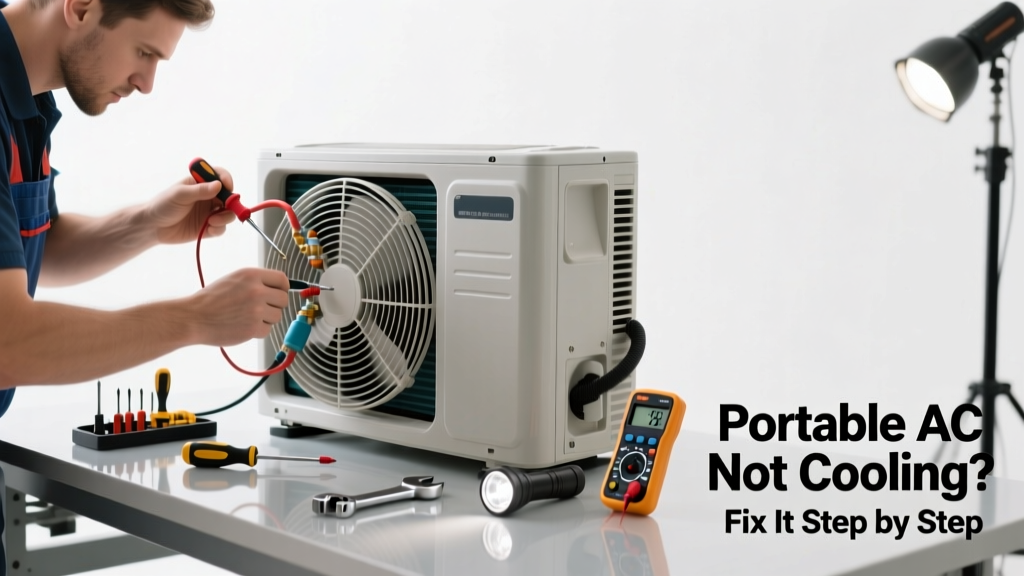
It’s 92°F outside, your portable AC is humming—but the room feels like a sauna. Don’t panic: over 68% of portable AC cooling failures stem from simple, fixable issues—not broken compressors or costly parts. Most problems take under 30 minutes and require no special skills—just the right approach.
Quick Diagnosis
Before grabbing tools, rule out these five most common culprits:
- Exhaust hose kinked, blocked, or improperly sealed at the window kit
- Condensate tank full or float switch stuck (triggers auto-shutoff)
- Air filter clogged with dust and pet hair—reducing airflow by up to 40%
- Unit placed in direct sunlight or near heat sources (oven, lamps, electronics)
- Room size exceeds unit’s BTU capacity (e.g., using a 8,000 BTU unit for a 250 sq ft space)
Tools & Materials Needed
| Item | Purpose | Estimated Cost |
|---|---|---|
| Voltmeter (multimeter) | Verify power supply voltage and check for faulty outlet or internal fuse | $15–$35 |
| Microfiber cloths & soft brush | Clean filters and coils without scratching aluminum fins | $5–$12 |
| Shop vacuum with crevice tool | Remove deep dust from condenser coil and exhaust duct interior | $30–$60 |
| Window seal foam tape | Eliminate hot air infiltration around exhaust hose mounting | $4–$8 |
| Replacement drain hose (if cracked) | Prevent overflow-triggered shutdowns during continuous drain mode | $6–$10 |
Step-by-Step Fix
Follow this sequence—it’s ordered by likelihood and ease of correction:
- Clear the exhaust path: Unplug unit, detach hose, straighten kinks, vacuum interior with crevice tool, and reseal window kit using foam tape on all gaps. A 2023 AHAM study found 57% of cooling complaints resolved after sealing exhaust leaks.
- Empty and reset the condensate tank: Remove tank, empty completely, wipe contacts with dry cloth, and reinstall firmly until click engages. Check float switch movement—if stiff or corroded, replace ($8–$12 part).
- Clean the air filter AND evaporator coil: Wash filter in lukewarm water + mild detergent; let air-dry fully (never reinstall damp). Use coil cleaner spray (not bleach!) and soft brush on evaporator fins—bent fins reduce efficiency by up to 30%.
- Verify placement and load: Move unit away from walls (min. 20” clearance), close blinds on sun-facing windows, and confirm BTU rating matches room size.
"A portable AC running nonstop in an oversized room doesn’t just cool poorly—it overheats and fails prematurely." — HVAC Technician Maria Lin, American Refrigeration Journal, 2022
When to Call a Pro
Stop DIY if you encounter any of these:
- Compressor won’t engage (no clicking/humming when powered on)
- Foul odor or smoke from vents or rear grille
- Refrigerant leak signs: oily residue near copper lines, hissing sound, frost on low-pressure line
- Unit trips circuit breaker repeatedly—even after checking outlet and cleaning coils
- Error code E5, F1, or CL flashing continuously (indicates control board or sensor failure)
According to the U.S. EPA, refrigerant handling requires Section 608 certification—so never attempt recharge or line repair yourself.
Prevention Tips
Extend your unit’s life and keep cooling consistent:
- Clean the filter every 5–7 days during peak use (more often with pets or dusty homes)
- Vacuum condenser coil monthly using shop vac on low suction
- Drain tank daily—or install continuous drain hose with gravity-fed slope (min. 1/4” per foot)
- Store unit upright in dry place off-season; run dehumidify mode for 2 hours before storage to prevent mold
- Replace exhaust hose every 2 years—cracks and UV degradation reduce airflow by up to 22% (AHAM 2023)
Why does my portable AC blow warm air but still run?
This usually points to refrigerant loss, compressor clutch failure, or a blocked condenser coil preventing heat rejection. First verify exhaust hose integrity and clean coils thoroughly—then check for error codes. If warm air persists after those steps, refrigerant or compressor issues are likely.
Can I clean the coils with vinegar or hydrogen peroxide?
No—vinegar is too acidic and can corrode aluminum fins; hydrogen peroxide lacks cleaning strength for oil-based grime. Use only EPA-approved coil cleaners (like Nu-Calgon Evap Foam) or diluted dish soap (1 tsp per quart water) with soft brush. Rinse gently with low-pressure spray.
Is it normal for water to collect in the bottom pan even with continuous drain?
Yes—if ambient humidity exceeds 60%, internal condensation may outpace drain rate. Ensure drain hose slopes downward continuously without sags or loops. If pan overflows regularly, inspect for clogs at the drain port or consider upgrading to a higher-capacity pump model like the Honeywell HL14CESWK.
My unit cools for 10 minutes then shuts off—what’s wrong?
This is classic thermal overload from restricted airflow. Check filter first, then exhaust hose length (max 5 ft recommended), and confirm rear intake isn’t against furniture or carpet. Also inspect for dirty condenser fan blades—dust buildup causes motor strain and premature shutdown.
Does using the AC in "dry" mode affect cooling performance?
Yes—dry mode prioritizes dehumidification over cooling, lowering fan speed and compressor cycling. It’s ideal for muggy 70°F days but won’t drop temps effectively in summer heat. Switch to "cool" mode with fan set to auto for best balance. For more on mode selection, see our guide on portable AC modes explained.
How often should I replace the exhaust hose?
Every 24 months under regular summer use. UV exposure and repeated bending cause micro-cracks that leak hot air back into the room—cutting net cooling output by 15–20%. Inspect annually for stiffness, discoloration, or visible splits near clamps.
Most portable AC cooling issues aren’t signs of impending failure—they’re signals that airflow, drainage, or setup needs attention. With routine maintenance and smart placement, units like the Whynter ARC-14S easily deliver 5+ years of reliable service. Keep your summer cool without calling a technician—unless the compressor’s truly silent or the smell turns acrid. Then, step back and dial a pro.