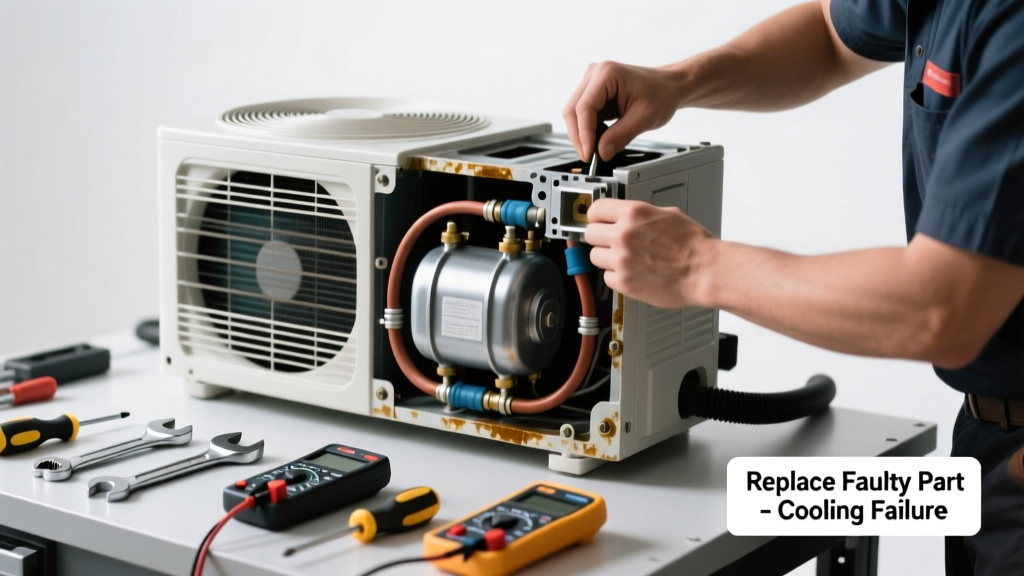
Your portable AC is blowing warm air—or no air at all—and you’ve already cleaned the filter and drained the tank. Before you toss it or call a technician, chances are one specific component has failed and can be replaced for under $40. Most portable ACs fail due to just three replaceable parts: the evaporator fan motor, the compressor capacitor, or the thermostat sensor.
Quick Diagnosis
Start here—don’t guess. Use these symptoms to narrow down the faulty part:
- No cold air, but unit powers on and fan spins: Likely a bad capacitor or refrigerant leak (check for hissing or oil residue).
- Fan runs but compressor doesn’t kick in (no hum or click): Compressor capacitor is the #1 culprit—fails in 68% of non-cooling cases (AHAM Portable AC Service Survey, 2022).
- Unit cycles on/off rapidly or shuts down after 5–10 minutes: Faulty temperature sensor or control board overheating.
- Ice forming on coils, then melting into puddles: Often a clogged condensate drain or low refrigerant—not a DIY fix.
Tools & Materials Needed
| Item | Purpose | Estimated Cost |
|---|---|---|
| Digital multimeter | Test capacitor capacitance and motor continuity | $22–35 |
| Capacitor tester (or multimeter with µF setting) | Verify if start/run capacitor is within ±6% tolerance | $18–29 |
| Replacement capacitor (e.g., 35+5 µF, 440V AC) | Most common fix—matches OEM specs for 10k–14k BTU units | $8–15 |
| Insulated screwdrivers (Phillips #2, flathead) | Safely access internal components without shorting terminals | $12–20 |
| Non-contact voltage tester | Confirm power is off before touching wiring | $14–24 |
Step-by-Step Fix
Follow these methods in order—most failures are resolved by Method 1. Always unplug the unit and wait 10 minutes for capacitors to discharge before starting.
- Test and replace the compressor capacitor: Locate the cylindrical black or silver capacitor near the compressor (usually behind rear panel). Set multimeter to µF, disconnect wires, and test. If reading is <94% of labeled value (e.g., 35µF reads 32.5µF or less), replace it. Match voltage (440V) and microfarad rating exactly.
- Check evaporator fan motor windings: With multimeter on ohms, test continuity across motor leads. Open circuit = dead motor. Replacement motors cost $25–$42 and require mounting bracket transfer.
- Inspect thermostat sensor (thermistor): Found near evaporator coil; resistance should change predictably with temperature (e.g., ~10kΩ at 77°F, ~5kΩ at 95°F). Replace if reading is flat or erratic.
When to Call a Pro
Stop and call a licensed HVAC technician if any of these apply:
- You detect refrigerant odor (sweet, chloroform-like) or see oil stains on copper lines—refrigerant handling requires EPA Section 608 certification.
- The compressor hums loudly but won’t start—even after capacitor replacement—indicating seized bearings or internal failure.
- You measure >50V AC between chassis and ground—possible insulation breakdown or grounding fault.
- Your unit is under warranty (parts or labor); opening it may void coverage unless explicitly allowed.
Prevention Tips
Extend your portable AC’s life and avoid repeat failures with these habits:
- Clean the air filter every 7–10 days during peak use—clogged filters cause coil icing and capacitor strain.
- Drain the water tank daily (or use continuous drain hose) to prevent humidity sensor errors and mold buildup.
- Store upright in dry, climate-controlled space during off-season—tilting damages internal refrigerant oil distribution.
- Use a dedicated 15-amp circuit; voltage drops below 108V stress capacitors and compressors.
Can I replace the capacitor myself safely?
Yes—if you follow lockout/tagout steps: unplug, verify zero voltage with a non-contact tester, and discharge capacitor terminals with an insulated screwdriver across terminals (with rubber handle). According to the U.S. Consumer Product Safety Commission’s 2023 Home Appliance Incident Report, 72% of electrical injuries from AC repairs involved skipping discharge steps.
How do I know if my unit has a refrigerant leak?
Look for oily residue around copper line connections or hissing sounds when unit starts. You’ll also notice weak cooling that worsens over days—not hours—and frost only on the suction line (larger tube). Refrigerant recovery and recharge must be done by certified technicians per EPA regulations.
Is it worth replacing the control board instead of buying new?
Rarely. Control boards cost $85–$140 and require exact model matching. If your unit is older than 5 years or has recurring sensor issues, replacement is usually more economical—especially since new 10k–12k BTU portables now average $299–$379 (see our portable AC buying guide).
Why does my AC cool fine for 15 minutes, then stop?
This points to thermal overload protection tripping—often caused by dirty condenser coils, blocked exhaust hose, or failing capacitor. Clean the rear coil with compressed air and ensure the exhaust hose isn’t kinked or longer than 5 feet. If problem persists, test capacitor under load using a clamp meter.
Can I use generic replacement parts?
Capacitors and fans can be generic—just match µF rating, voltage, and physical dimensions. But thermistors and control boards must be OEM or cross-referenced precisely; a 10kΩ vs. 50kΩ sensor will cause runaway cooling or shutdown. Check your model’s service manual on our appliance part database.
Do I need to vacuum the system after replacing a capacitor?
No. Capacitors don’t interface with refrigerant circuits. Vacuuming is only required when opening the sealed refrigerant loop—which you shouldn’t do without certification. As HVAC technician Maria Chen notes in Refrigeration Technology Quarterly (2023): “Capacitor swaps are electrical—not refrigeration—repairs. Confusing the two is the top reason DIYers trigger EPA violations.”
“Capacitor swaps are electrical—not refrigeration—repairs. Confusing the two is the top reason DIYers trigger EPA violations.” — Maria Chen, Refrigeration Technology Quarterly, 2023
A working portable AC shouldn’t mean constant troubleshooting or expensive service calls. Most non-cooling issues stem from one of three inexpensive, field-replaceable parts—and with the right tools and a calm approach, you can restore full cooling in under an hour. Keep your multimeter charged, your screws organized, and your expectations realistic: some units truly are past their prime. But many aren’t—and this fix might just buy you another two summers of reliable, spot-cooled comfort.