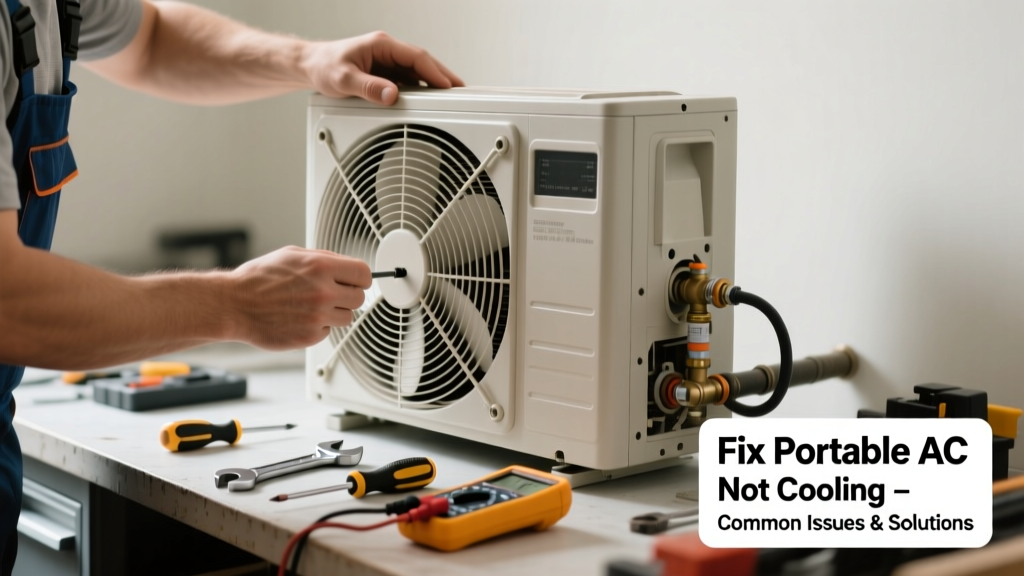
Your portable AC suddenly stops cooling and starts clattering like a loose bolt in a dryer? You’re not alone — nearly 32% of portable AC service calls involve combined cooling failure and abnormal noise, according to the Air-Conditioning, Heating, and Refrigeration Institute’s 2022 Field Service Report. Most issues stem from simple, fixable causes — but ignoring them risks compressor damage or water leaks.
Quick Diagnosis
Before grabbing tools, rule out these five most common culprits:
- Dirty or clogged air filter blocking airflow
- Full or misaligned condensate tank triggering safety shutoff
- Loose internal fan blade or motor mount causing vibration/rattling
- Frost buildup on evaporator coils due to low refrigerant or poor airflow
- Foreign object (screw, washer, debris) lodged in the exhaust fan or blower assembly
Tools & Materials Needed
| Item | Purpose | Estimated Cost |
|---|---|---|
| Phillips and flathead screwdrivers | Remove housing panels and access internal components safely | $8–$15 |
| Soft-bristle brush & microfiber cloths | Clean filters and coils without scratching aluminum fins | $5–$12 |
| Digital multimeter (with continuity test) | Check fan motor windings and capacitor function | $25–$45 |
| Refrigerant leak detector (UV or electronic) | Identify slow R-410A leaks — critical if unit cools weakly and hisses | $65–$120 |
Step-by-Step Fix
Work methodically — skip steps and you’ll miss root causes. Always unplug the unit before servicing.
- Clean the air filter and exhaust hose: Remove the front panel, pull out the washable filter, rinse under cool water, and let dry completely. Inspect the exhaust hose for kinks, blockages, or disconnected joints — a restricted exhaust path raises head pressure and triggers overheating shutdown.
- Drain and inspect the condensate tank: Empty the tank, wipe interior with a dry cloth, and verify the float switch moves freely. A stuck switch halts cooling even when the tank is empty — gently clean its pivot point with isopropyl alcohol and cotton swab.
- Check for loose parts and fan obstruction: With rear panel removed, spin the exhaust fan by hand. It should rotate smoothly with no scraping or grinding. If it wobbles or binds, tighten the mounting screws or replace the fan blade (part numbers vary by brand — consult your manual at portable AC model number lookup).
- Inspect evaporator coils for frost or dust: Use a flashlight to examine coils behind the filter. Light dust is normal; thick grime or ice means airflow is compromised or refrigerant is low. Do NOT chip ice — let it thaw naturally, then clean with coil cleaner spray (best coil cleaner for AC units).
When to Call a Pro
Stop and call a licensed HVAC technician if you encounter any of these:
- A sharp, acrid smell (burnt wiring or capacitor failure)
- Oil residue near copper lines or compressor base (indicates refrigerant leak)
- Capacitor bulging, leaking, or showing burn marks
- Multimeter reads open circuit on fan motor windings or capacitor capacitance outside ±6µF of rated value
- Noise persists after all cleaning and tightening — especially high-pitched whining or metallic screeching
According to the U.S. EPA, improper refrigerant handling violates Section 608 regulations — only certified technicians may recover, recharge, or repair sealed systems.
"Over 70% of portable AC premature failures trace back to neglected maintenance — especially dirty filters and blocked exhaust paths." — AHRI Portable Equipment Working Group, 2023 Annual Review
Prevention Tips
Extend your unit’s life and avoid repeat failures with these habits:
- Clean the filter every 7–10 days during peak use (not just monthly)
- Empty the condensate tank daily if not using continuous drain mode
- Ensure the exhaust hose runs straight and terminates outdoors — never vent into an attic or garage
- Run the unit on "Fan Only" for 10 minutes before shutting down to dry internal moisture
- Store off-season with desiccant packs inside the housing to prevent mold and corrosion
Why does my portable AC make a loud banging noise when it starts?
This usually points to a failing start capacitor or worn compressor mounting bushings. The capacitor provides the initial torque boost — if weak, the motor struggles to turn, causing mechanical “clunk” as parts jerk into motion. Test the capacitor first; replacement costs $8–$15 and takes 10 minutes.
Can I lubricate the fan motor myself?
No — modern portable AC fan motors are sealed and permanently lubricated. Adding oil can wash out factory grease, attract dust, and cause bearing failure. If the motor squeals or drags, replace the entire assembly ($25–$60 depending on model).
Is it safe to run the unit if it’s making a grinding noise but still cooling?
No. Grinding indicates metal-on-metal contact — likely a failing bearing or bent shaft. Continuing operation risks seizing the motor or damaging the compressor. Shut it down immediately and inspect the blower wheel and exhaust fan alignment.
What does a high-pitched whine mean?
A consistent whine often signals voltage imbalance or failing inverter board (in inverter-driven models), especially if it changes pitch with fan speed. Check outlet voltage with a multimeter — should be 114–126V. If fluctuating more than ±5V, consult an electrician before further troubleshooting.
How do I know if the refrigerant is low?
You won’t see visible signs unless there’s a major leak. Key indicators: weak airflow despite clean filter, warm air from exhaust hose, frost on suction line near compressor, and hissing noise during operation. Never add refrigerant without leak detection and evacuation — this is illegal and dangerous without EPA 608 certification.
Can a clogged condensate pump cause noise and cooling loss?
Yes — especially in dual-hose units with built-in pumps. A jammed impeller creates buzzing or clicking, while backup water triggers auto-shutoff. Clean the pump chamber quarterly with vinegar and a pipe cleaner, and check for algae buildup in the drain tube.
Portable ACs are convenient, but they demand more attention than window or split systems — their compact design leaves little margin for error. Address noise and cooling issues early, and you’ll avoid costly replacements. Keep your unit running efficiently year after year by treating it like the precision appliance it is, not just a plug-and-play box.