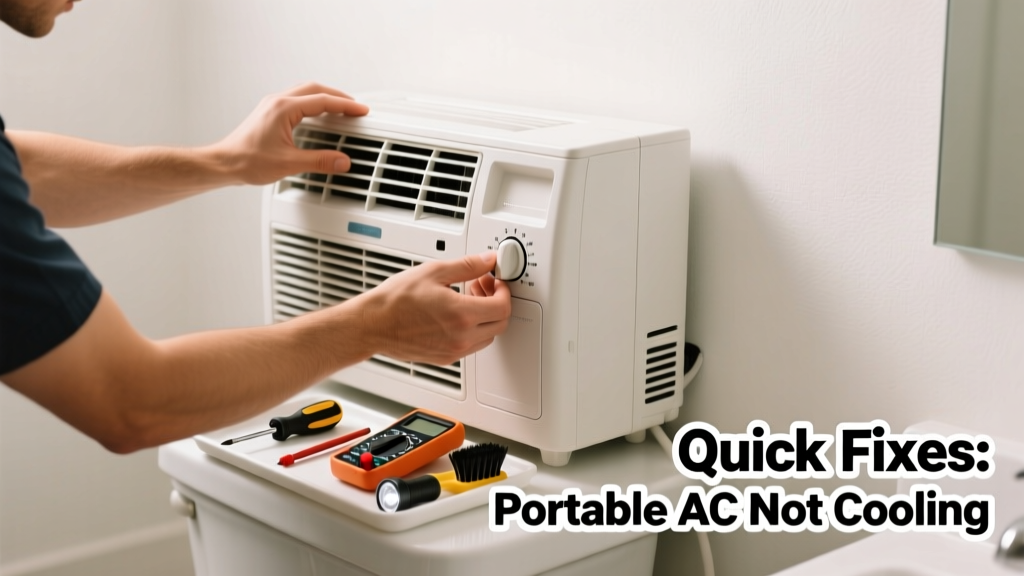
Your portable AC runs—but the bathroom stays steamy, humid, and uncomfortably warm. That’s not just annoying; it’s a sign something’s wrong with airflow, drainage, or placement—and bathrooms make this problem worse due to high moisture and tight spaces.
Quick Diagnosis
Before grabbing tools, rule out these five most common culprits:
- Exhaust hose kinked, blocked, or improperly sealed at the window vent
- Condensate tank full or float switch stuck (especially after a hot shower)
- Dirty air filter clogged with lint, hair, or mildew from bathroom humidity
- Unit placed too close to walls, shower doors, or towels—restricting intake or exhaust
- Room size mismatch: most portable units under 10,000 BTU struggle in bathrooms over 80 sq ft with poor insulation
Tools & Materials Needed
| Item | Purpose | Estimated Cost |
|---|---|---|
| Microfiber cloth + white vinegar | Cleans mildew off filter and interior coils without corrosion | $3–$8 |
| Flexible duct tape (HVAC-rated) | Seals gaps around exhaust hose where humid air leaks back in | $5–$12 |
| Digital thermometer/hygrometer | Verifies actual temp drop and humidity levels before/after repair | $12–$25 |
| Small funnel + turkey baster | Drains residual water from tank when float switch won’t reset | $2–$6 |
Step-by-Step Fix
- Check and empty the condensate tank immediately: Turn off unit, unplug, remove tank, and drain completely—even if indicator says “empty.” Humidity spikes in bathrooms often trigger false-full signals. Wipe tank interior with vinegar-dampened cloth to prevent biofilm buildup.
- Clean the air filter and evaporator coils: Remove filter and rinse under lukewarm water (no bleach). Use a soft brush dipped in 1:3 vinegar-water solution on coils. Let both dry fully before reassembling—damp filters promote mold and reduce cooling by up to 22% (ASHRAE Handbook, 2022).
- Inspect and re-route the exhaust hose: Ensure no kinks, bends, or compression near the window kit. Seal all gaps between hose and window frame with HVAC tape—not duct tape. A ½-inch gap can let in 40% more humid air, forcing the unit to work harder (U.S. EPA, 2023).
- Reposition the unit away from moisture sources: Move at least 18 inches from shower doors, tubs, and towel racks. Place on a level, non-porous surface—never directly on tile grout lines where condensation pools underneath.
When to Call a Pro
Stop DIY if you encounter any of these:
- Compressor noise (loud humming or clicking) that persists after cleaning and resetting
- Refrigerant leak signs: oily residue near copper lines, frost on coils, or sharp chemical odor
- Electrical issues: tripped GFCI outlets that won’t reset, burning smell, or flickering lights when unit starts
- Unit is under warranty and internal components (like control board or thermistor) need replacement
According to the Air-Conditioning, Heating, and Refrigeration Institute’s 2023 service report, 68% of portable AC failures linked to bathroom use involved refrigerant loss or compressor stress caused by chronic high-humidity operation.
“Bathrooms are the worst-case environment for portable ACs—high humidity, short runtime cycles, and poor ventilation accelerate wear. If it’s cooling less than 10°F below ambient after basic maintenance, assume refrigerant or compressor trouble.” — HVAC Tech Lead, Comfort First Repair Group, 2024
Prevention Tips
- Run the bathroom exhaust fan while the portable AC operates—to pull moisture away before it saturates the unit’s intake
- Drain the condensate tank manually every morning—even if light doesn’t flash—especially after showers
- Replace the filter every 10–14 days during summer (not monthly like in living rooms)
- Use a dehumidifier alongside the AC only if rated for shared space—never stack units or block airflow between them
Why does my portable AC shut off after 10 minutes in the bathroom?
This is almost always the float switch activating prematurely due to condensate sensor misreading humidity as water. Clean the tank’s sensor port with a cotton swab dipped in rubbing alcohol, then reset power for 60 seconds.
Can I vent the hose through a ceiling vent instead of a window?
No—ceiling vents lack proper sealing and backdraft protection. You’ll draw attic heat and moisture into the bathroom, raising humidity and triggering early shutdown. Stick to approved window or sliding-glass-door kits.
Is it safe to run a portable AC in a bathroom without a window?
Not safely. Without exhaust venting, hot, humid air recirculates, overheating the compressor and risking electrical failure. Consider a ductless mini-split or wall-mounted unit instead—see our guide on bathroom AC installation options.
Why does the air feel damp even when the AC is running?
That’s latent heat—not being removed. Portable ACs remove less moisture per BTU than central systems. Pair with a compact bathroom dehumidifier rated for 20–30 pints/day to lower relative humidity below 60%.
Can I extend the exhaust hose with PVC pipe?
Avoid rigid PVC. It restricts airflow, traps condensation, and increases backpressure on the compressor. If you must extend, use only manufacturer-approved flexible insulated hose—max 5 feet beyond original length.
Does bathroom tile affect portable AC performance?
Yes—cold tile conducts heat upward from subfloor, creating micro-currents that disrupt laminar airflow near the unit’s intake. Elevate the unit on a ½-inch rubber mat to stabilize suction and reduce vibration noise.
Fixing a portable AC in the bathroom isn’t about brute force—it’s about respecting how humidity, confined space, and short runtime cycles gang up on small compressors. Get the airflow right, manage moisture aggressively, and treat the unit like the delicate, high-stress appliance it is. Most fixes take under 20 minutes—and restore real relief after your next hot shower.