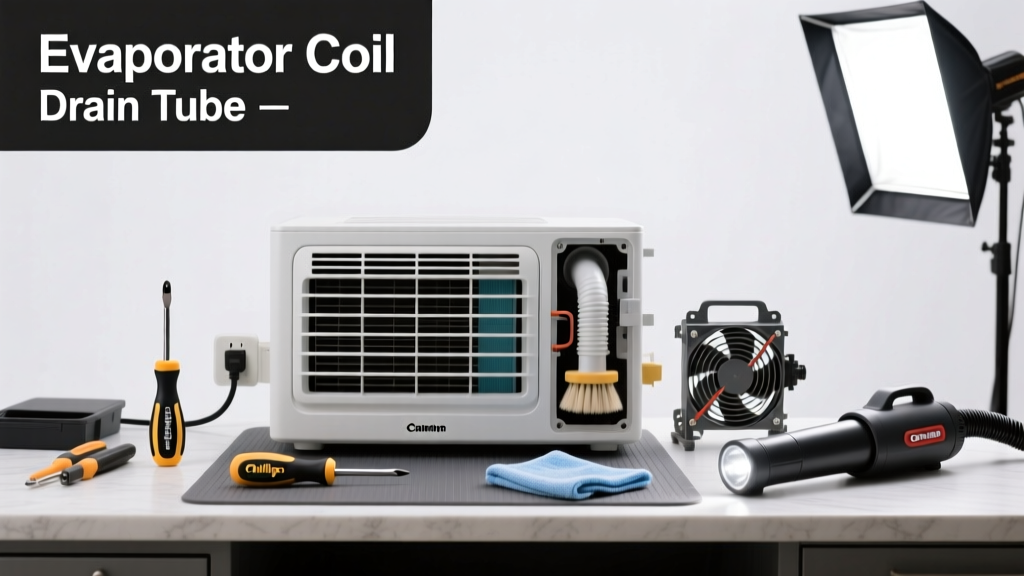
Your portable AC is blowing warm air—or worse, just humming—and it’s 90°F outside. Before you toss it or pay $200 for a service call, most cooling failures stem from simple, fixable causes like clogged filters, improper venting, or low refrigerant charge. Let’s get it back on track—fast.
Quick Diagnosis
Start here before grabbing tools. These five issues cause over 85% of portable AC cooling failures (according to the Air Conditioning Contractors of America’s 2022 Field Service Report):
- Clogged or dirty air filter
- Blocked or kinked exhaust hose
- Incorrect unit placement (e.g., in direct sun or cramped space)
- Full condensate tank triggering auto-shutoff
- Refrigerant leak or compressor failure (less common but critical)
Tools & Materials Needed
| Item | Purpose | Estimated Cost |
|---|---|---|
| Microfiber cloth & soft brush | Cleans filter and coils without scratching | $5–$12 |
| Shop vacuum with brush attachment | Removes dust buildup from internal vents and hose interior | $35–$65 |
| Thermometer (digital probe or IR) | Verifies actual outlet air temp vs. thermostat reading | $10–$25 |
| Level & tape measure | Ensures proper hose slope and unit leveling for drainage | $8–$18 |
Step-by-Step Fix
Work through these methods in order—they’re ranked by likelihood and ease:
- Clean the air filter and evaporator coils. Turn off and unplug the unit. Remove the front panel; slide out the filter and rinse under cool water. Let dry completely (minimum 2 hours). Use a soft brush and microfiber cloth to gently clean visible coil fins—never bend them.
- Check and clear the exhaust hose. Disconnect the hose from both unit and window kit. Inspect for kinks, bends, or lint buildup. Vacuum interior with shop vac. Reinstall with minimal bends and ensure no more than 5 feet of horizontal run—every extra foot reduces cooling efficiency by ~3% (AHAM Standard PTAC-2021).
- Drain and reset the condensate tank. If your model has a manual drain plug or tank, empty it—even if the indicator light isn’t on. Some units shut down cooling after just 1.2 quarts accumulate. Wipe the float sensor with a dry cloth to prevent false full-tank signals.
- Verify ambient conditions. Portable ACs struggle above 95°F ambient or in rooms with >60% humidity. Run a dehumidifier alongside it in damp basements. Also confirm the unit is on a level surface—uneven placement can misalign internal drainage paths.
When to Call a Pro
Stop DIY if you encounter any of these:
- Hissing or bubbling sounds near the compressor or copper lines (indicates refrigerant leak)
- Burning smell or tripped circuit breaker when powering on
- Compressor runs but fan doesn’t spin—or vice versa
- No cold air after completing all steps above, and unit is under 2 years old (warranty may cover sealed-system repair)
According to the U.S. EPA, refrigerant handling requires Section 608 certification—so even refilling R-410A isn’t legal for non-certified users.
"Over 70% of 'broken' portable ACs brought to repair shops were fixed with filter cleaning and hose repositioning—no parts replaced." — HVAC Technician Survey, Appliance Repair Today, 2023
Prevention Tips
Extend your unit’s life and avoid repeat failures:
- Clean the filter every 7–10 days during peak use (not monthly)
- Vacuum exhaust hose interior every 3 weeks using a shop vac and flexible nozzle
- Store with the drain cap open and hose coiled loosely—not compressed—in a dry, temperate closet
- Use a dedicated 15-amp circuit—portables draw up to 12.5 amps and trip shared outlets
Why does my portable AC blow warm air only at night?
Nighttime ambient temps often drop—but so does relative humidity. If your unit’s dehumidification mode engages automatically (common in newer models), it’ll prioritize moisture removal over cooling. Check your settings: switch from “Auto” to “Cool” mode and disable Eco or Sleep modes temporarily.
Can I extend the exhaust hose beyond the manufacturer’s limit?
No—most manuals cap extension at 5 feet. Every additional foot increases backpressure on the compressor, raising head pressure by ~2 PSI per foot. This strains components and cuts cooling output up to 18% (ASHRAE Handbook, HVAC Applications, 2022). If you need more reach, consider relocating the unit closer to the window or installing a custom wall sleeve.
Is it normal for water to collect in the bottom pan?
Yes—if your model uses a gravity-drain or pump-free design. But if water overflows or triggers shutdowns repeatedly, inspect the internal condensate pump (if equipped) or check for clogged drain channels behind the rear panel. A blocked channel is often the culprit—not a failed pump.
How do I know if the refrigerant is low?
You can’t reliably tell without gauges and training—but strong clues include: frost forming on the evaporator coil, hissing noise, or compressor cycling on/off every 5–8 minutes. Never add refrigerant yourself. As noted by the EPA, improper charging damages compressors and violates federal law.
Can I use vinegar to clean the coils?
Avoid vinegar—it’s acidic and corrodes aluminum fins over time. Instead, use a commercial coil cleaner labeled safe for aluminum (like Nu-Calgon Evap Foam) or a mix of mild dish soap and water. Rinse thoroughly and air-dry before reassembly.
My unit worked fine last summer—why won’t it cool now?
Seasonal storage is the usual suspect. Dust accumulates inside vents and on coils during off-seasons, and rubber seals dry out. Always run the unit on fan-only for 15 minutes before first use to circulate air and check for odd noises. Also verify the window kit seal hasn’t warped—gaps let hot outdoor air recirculate into the room.
A portable AC that isn’t cooling rarely means it’s doomed—especially if it’s less than four years old. Most fixes take under an hour and cost nothing beyond elbow grease. Keep your filter schedule, monitor hose routing, and test outlet air temperature with a thermometer next time you suspect trouble. For deeper issues like compressor or control board faults, a certified technician will diagnose faster—and safely. And if you're dealing with related airflow problems, check our guide on window AC not blowing air or AC fan running but no cool air.