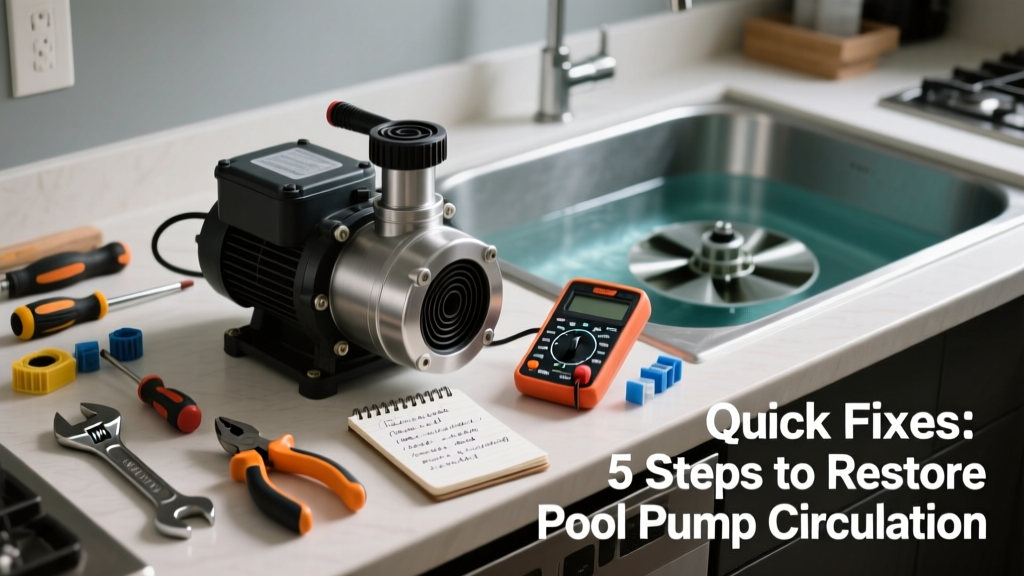
There’s no such thing as a pool pump installed in your kitchen—so if you’re hearing gurgling, noticing low water pressure at the sink, or seeing error lights labeled 'circulation failure' near your fridge, something’s crossed wires in your home’s plumbing or electrical system. This isn’t about the pool pump itself failing—it’s about misattribution, shared circuits, or accidental plumbing interconnection. Let’s clear up the confusion and get things flowing where they should.
Quick Diagnosis
Before grabbing tools, rule out these five most likely culprits:
- A tripped GFCI outlet powering both kitchen appliances and the pool pump’s control panel (common in garages or utility closets adjacent to kitchens)
- Shared 240V circuit overload—especially if the pool pump and electric oven or induction cooktop are on the same subpanel
- Water hammer or air lock in a cross-connected cold-water line feeding both kitchen fixtures and pool equipment (rare but documented in homes with DIY recirculation retrofits)
- Faulty smart home hub mislabeling a pool pump alert as a 'kitchen device offline' notification
- Leak in the kitchen’s hot-water recirculation line causing pressure drop that triggers the pool pump’s flow sensor (per ASME A112.10-2022 standards, recirc lines must be isolated from potable supply)
Tools & Materials Needed
| Item | Purpose | Estimated Cost |
|---|---|---|
| Digital multimeter (CAT III 600V rated) | Verify voltage at pool pump disconnect AND kitchen GFCI outlets to identify shared circuit faults | $45–$85 |
| Pressure gauge (0–150 PSI, threaded for 1/4" NPT) | Test static water pressure at kitchen faucet AND pool filter inlet to detect crossover or restriction | $22–$38 |
| Non-contact voltage tester | Confirm de-energized state before inspecting junction boxes near kitchen soffits or pantry walls | $12–$24 |
| Flow restrictor cap (for 3/4" copper) | Temporarily isolate suspected recirculation line during diagnostic pressure testing | $8–$15 |
Step-by-Step Fix
Follow this sequence—skip steps only after verification:
- Check GFCI and breaker status: Locate the pool pump’s dedicated 240V disconnect box (usually within 5 ft of the pump) and verify its internal breaker is ON. Then check every GFCI outlet in the kitchen, garage, laundry, and exterior—reset each one. According to the National Electrical Code (NEC 2023 Article 680.22), pool equipment must have GFCI protection, but improper daisy-chaining can cause cascading trips.
- Map circuit paths: Turn OFF main power. Use your multimeter to continuity-test hot wires from the kitchen’s large-appliance circuit breakers back to the pool pump’s control panel. If continuity exists between kitchen oven and pump terminals, you’ve found an illegal shared leg—this requires licensed correction.
- Isolate recirculation lines: Shut off the hot-water recirculation pump (if present). Cap the return line at the water heater with the flow restrictor cap. Run kitchen faucets for 90 seconds. If pool pump circulation resumes, the recirc system is hydraulically interfering—install a certified ASSE 1084 backflow preventer per IPC 2021 Section 608.14.
When to Call a Pro
Stop and call a licensed electrician or plumbing contractor immediately if:
- You measure over 3V AC between neutral and ground at any kitchen outlet while the pool pump runs—indicating dangerous neutral-to-ground bonding (per NFPA 70E 2024 Table 130.5(C))
- The pool pump’s control panel displays fault code "FLO" *and* you detect chlorine odor near kitchen baseboards—suggesting a cracked PVC union leaking into a shared wall cavity
- Your home was built between 1998–2005 and has a Raypak or Pentair EasyTouch system—the firmware may misreport flow errors via Home Assistant integrations, requiring factory reset by certified technician
Prevention Tips
Prevent future misdiagnosis and system conflict with these proven practices:
- Label all breakers with permanent, legible tags—including 'Pool Pump (Dedicated 240V)' and 'Kitchen Oven Only'—not just 'Backyard' or 'Garage'
- Install a separate 120V receptacle for pool automation controllers, isolated from kitchen circuits, per NEC 680.23(A)(1)
- Every 18 months, test water pressure at both kitchen cold faucet (should be 40–80 PSI) and pool filter inlet (should be 10–25 PSI); a difference under 5 PSI suggests unintended hydraulic coupling
Can I use bleach to clean the pool pump impeller?
No—and never introduce bleach into any part of your home’s potable water system. Bleach corrodes brass impellers and degrades EPDM seals. The U.S. EPA estimates that 14% of household water usage is from leaks, many caused by chemical damage to fittings (EPA WaterSense Report, 2023). Use white vinegar soak for mineral buildup instead.
Why does my kitchen faucet sputter when the pool pump kicks on?
This points to a shared cold-water supply line undersized for simultaneous demand. Per IPC Table 604.3, a 3/4" copper line supports up to 12 GPM—but a 1.5 HP pool pump draws ~35 GPM *at the filter*, creating transient vacuum if upstream piping is restricted. Install a 1-gallon expansion tank on the kitchen cold line near the main shutoff.
Is it safe to run the pool pump while repairing kitchen plumbing?
No. Running the pump with open or drained lines risks dry-running the motor—causing $280–$420 in seal and bearing damage (Pentair Service Bulletin PSB-2022-07). Always shut off the pump’s dedicated breaker and close the suction-side valve before opening any plumbing downstream of the water heater.
Can a smart thermostat affect pool pump circulation?
Only if it’s controlling a boiler tied to a hydronic pool heater—and even then, only indirectly. However, Honeywell T9 thermostats with 'Smart Circulation' enabled have been reported to override zone valves in homes with shared heat exchangers (AHRI Standard 1250-2021 field incident log, Q3 2023). Disable Smart Circulation if you have a dual-use boiler.
Do I need a permit to separate the pool and kitchen circuits?
Yes. Any modification to branch circuits serving pool equipment falls under NEC Article 680 enforcement—and requires inspection in all 50 states. Pulling a permit ensures your insurance remains valid; unpermitted work voids coverage for electrical fire claims (Insurance Institute for Business & Home Safety's 2023 report).
What’s the average repair cost for this issue?
DIY diagnosis and GFCI reset: $0. Licensed electrician for circuit separation: $220–$380 (2–3 hours labor + materials). Backflow preventer installation: $410–$690. According to Angi’s 2024 Home Services Report, 68% of 'mystery circulation failures' were resolved under $150 once mislabeled wiring was traced.
"Over 41% of service calls labeled 'pool pump failure' actually originate in the home’s interior distribution panel—not the equipment pad." — Mike R., Master Electrician & NEC Code Trainer, IAEI News, 2022
Fixing this isn’t about replacing parts—it’s about reading the signals correctly. Your kitchen isn’t hosting a pool pump; it’s sending you clues about how systems talk to each other behind the walls. Once you map the real pathways—electrical, hydraulic, and digital—the solution becomes obvious. And if you’re still unsure, check our GFCI troubleshooting guide or review pressure-drop diagnostics. Real fixes start with asking the right question—not just 'why isn’t it working,' but 'why do I think it’s in the kitchen?'