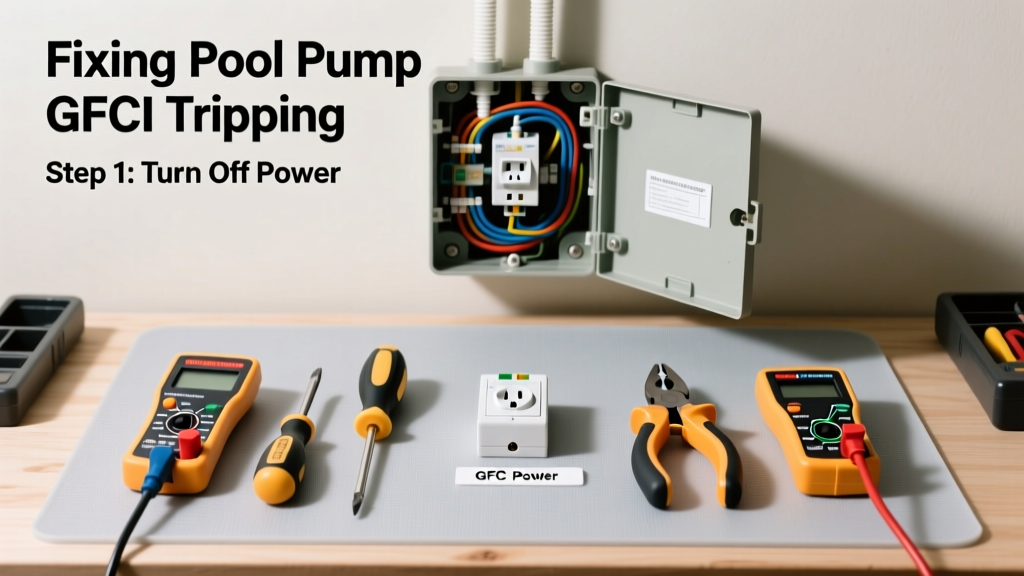
Your pool pump trips the GFCI every time it starts — not just once, but repeatedly. That’s not just annoying; it’s a red flag that something’s wrong with your pump, wiring, or grounding. Ignoring it risks equipment damage, shock hazard, or even fire.
Quick Diagnosis
GFCI tripping isn’t random — it’s responding to current leakage. Here are the most common culprits, ranked by likelihood:
- Moisture inside the pump motor housing or control box
- Worn or cracked pump motor windings (ground fault)
- Corroded or loose GFCI receptacle terminals
- Undersized or damaged power cord (especially older 14-gauge extension cords)
- Neutral-to-ground bond downstream of the GFCI (a code violation)
Tools & Materials Needed
| Item | Purpose | Estimated Cost |
|---|---|---|
| Digital multimeter (CAT III rated) | Measures insulation resistance and ground continuity safely | $45–$85 |
| Non-contact voltage tester | Confirms circuit is de-energized before handling wires | $12–$25 |
| Insulated screwdrivers & wire strippers | Safe handling of live-side connections and conductor prep | $18–$32 |
| GFCI receptacle tester | Verifies correct wiring and GFCI trip function | $8–$15 |
| Dielectric grease | Protects outdoor connections from moisture ingress | $6–$10 |
Step-by-Step Fix
Work only after turning off power at the main breaker and verifying no voltage with your non-contact tester. Never bypass the GFCI.
- Inspect and dry all connections: Remove the pump’s electrical cover and check for condensation, corrosion, or water pooling. Wipe dry with lint-free cloth and apply dielectric grease to terminals.
- Test motor winding resistance: Set multimeter to megohmmeter mode (or lowest ohms range if unavailable). Disconnect motor leads, then measure resistance between each lead and the motor frame. Anything under 1 MΩ indicates winding insulation failure — replace motor.
- Check GFCI receptacle wiring: Verify neutral and hot are on correct terminals, and that no bare ground wire contacts neutral bus. Use GFCI tester to confirm proper operation.
- Replace damaged cord or conduit: If using an extension cord, discard it — NEC prohibits permanent use. Install 12-gauge UF-B cable in rigid PVC conduit per NEC 680.21(A)(1).
When to Call a Pro
Some issues require licensed expertise — especially where life safety and code compliance intersect. Call a certified electrician or pool technician if:
- You measure less than 0.5 MΩ between any motor lead and ground
- The GFCI trips even with the pump disconnected (points to faulty breaker or panel issue)
- You find evidence of aluminum wiring spliced to copper without antioxidant paste and Al/Cu-rated connectors
- Your pool was installed before 2008 and lacks a dedicated 20-amp GFCI-protected circuit
According to the Electrical Safety Foundation International’s 2022 report, 23% of residential electrocutions involving pools occur due to improper GFCI installation or bypassing.
Prevention Tips
Prevent future trips with consistent maintenance habits:
- Inspect pump motor seals annually — replace if cracked or hardened
- Install a weatherproof GFCI outlet cover rated for wet locations (UL 489A)
- Keep vegetation trimmed away from pump and conduit — moisture + organic debris = corrosion accelerator
- Test GFCI monthly using its built-in test button (per UL 943)
Why does my pool pump trip the GFCI only during rain?
Rainwater infiltration through cracked conduit fittings or degraded pump housing gaskets creates a path for current to leak to ground. Inspect all entry points — especially where the cord enters the motor and where conduit meets the junction box.
Can I replace the GFCI with a regular outlet?
No — and doing so violates NEC 680.22(A)(1) and voids insurance coverage. GFCIs are mandatory for all pool pump circuits. If yours trips constantly, the fault lies elsewhere — not in the GFCI itself.
Is it safe to reset the GFCI repeatedly?
No. Repeated resetting masks underlying faults and increases risk of arc-fault ignition. The U.S. Consumer Product Safety Commission reports over 1,200 pool-related electrical incidents annually — many linked to ignored GFCI warnings.
How long should a pool pump motor last before developing ground faults?
Most properly maintained 230V single-speed motors last 8–12 years. Variable-speed pumps often last longer (10–15 years), but humidity exposure and voltage spikes shorten lifespan. Track runtime hours — consider replacement if motor exceeds 8,000 hours and shows rising ground leakage.
Do pool pump timers need GFCI protection too?
Yes — if the timer is within 10 feet of the pool’s edge or supplies power to the pump, it must be GFCI-protected per NEC 680.22(A)(2). Hardwired timers often get overlooked during inspections.
What’s the difference between nuisance tripping and real fault tripping?
Nuisance tripping occurs sporadically and resets cleanly — often caused by moisture or aging GFCI electronics. Real fault tripping happens predictably (e.g., always at startup) and may leave residual voltage on ground. Use a clamp meter to measure ground current: >5mA confirms a true fault.
A tripping GFCI isn’t just inconvenient — it’s your system’s early warning system. Addressing it promptly keeps your family safe, extends pump life, and avoids surprise service calls. Pair these fixes with routine pool pump maintenance checklist and annual GFCI circuit testing to stay ahead of trouble. If you’ve ruled out moisture and wiring but still see repeat trips, don’t hesitate to consult a licensed pool electrician — some faults only show up under load or thermal stress.