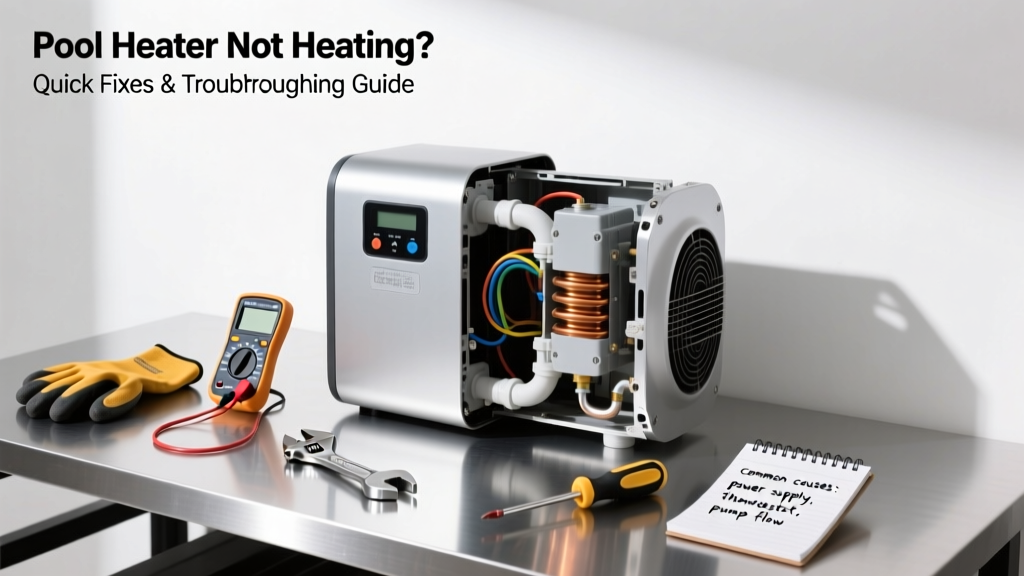
Nothing kills summer pool fun faster than turning on the heater and watching the water stay icy cold. If your pool heater fires up but delivers lukewarm or no heat—or won’t ignite at all—you’re likely dealing with one of several common, often fixable issues.
Quick Diagnosis
Before grabbing tools, eliminate the obvious culprits first. Most pool heater failures fall into these categories:
- Low water flow from clogged filters, dirty skimmer baskets, or closed valves
- Thermostat set too low or in incorrect mode (e.g., 'standby' instead of 'heat')
- Gas supply interruption (shut-off valve closed, low propane tank, or gas line leak)
- Tripped circuit breaker or blown fuse for electric ignition or control board
- Faulty pressure switch preventing burner activation due to insufficient water pressure
Tools & Materials Needed
| Item | Purpose | Estimated Cost |
|---|---|---|
| Multimeter | Test voltage at control board, igniter, and gas valve solenoids | $25–$65 |
| Pool filter wrench | Remove and clean filter cartridges or DE grids without damaging seals | $12–$28 |
| Manometer (0–12" WC) | Verify gas pressure meets manufacturer specs (critical for safe operation) | $45–$90 |
| Soft-bristle brush & garden hose | Clean heat exchanger fins and combustion chamber debris | $0–$15 |
| Replacement pressure switch (if needed) | Fixes failure-to-fire caused by worn or misadjusted switches | $35–$75 |
Step-by-Step Fix
Work through these methods in order—most issues resolve before reaching Step 4:
- Check water flow and filtration: Shut off power and gas. Clean the filter, skimmer basket, and pump strainer. Verify all valves are fully open and the pump is running at proper RPM. Reboot the system and wait 2 minutes—low flow is the #1 cause of heater shutdowns (per Hayward’s 2022 Service Manual).
- Verify thermostat and control settings: Ensure the thermostat is set 5°F above current pool temperature and in "Heat" mode—not "Solar," "Economy," or "Standby." Confirm the heater’s digital display shows "Ready" or "Call Heat," not "Low Flow" or "Flame Sensor Fault."
- Inspect gas supply and ignition: For gas heaters: confirm the main shutoff valve is open, check propane tank level (>20% full), and listen for the click-hiss of the gas valve engaging. If you hear clicking but no flame, inspect the igniter electrode for carbon buildup or misalignment (gap should be 1/8" from burner port). Clean gently with emery cloth—never sandpaper.
- Test pressure switch and flame sensor: With power off, disconnect wires from the pressure switch. Use a multimeter on continuity mode: close the switch manually (with pliers) while blowing gently into the tube—it should click and show continuity. For the flame sensor, wipe the stainless rod with fine steel wool; resistance should read 0.5–2 ohms when grounded to the heat exchanger.
When to Call a Pro
Some repairs require licensing, specialized equipment, or gas-certified expertise. Call a certified pool technician if:
- You smell gas (rotten egg odor) at any point—evacuate and call your utility immediately
- The heater displays error codes like "E05" (high-limit switch open) or "E12" (flame rollout) that persist after cleaning and resetting
- You measure gas pressure outside the range specified on the heater’s nameplate (typically 3.5–4.0" WC for natural gas, 10–11" WC for propane)
- There’s visible corrosion on the heat exchanger or burners—this indicates advanced wear and potential carbon monoxide risk
"Over 68% of premature pool heater failures stem from neglected filtration and improper water chemistry—not component defects." — Pentair Technical Bulletin #HT-2023-07
Prevention Tips
Extend your heater’s life and avoid repeat failures with these habits:
- Backwash or clean filters every 2 weeks during peak season—and always before heater startup
- Maintain balanced pool water: keep calcium hardness between 200–400 ppm to prevent scale buildup inside the heat exchanger
- Install a flow meter or pressure gauge on the heater inlet to catch low-flow issues early
- Shut off gas and power before winterizing—and drain all water from the heater body and bypass lines
Why does my pool heater ignite but shut off after 30 seconds?
This points to flame sensing failure or high-limit shutdown. A dirty flame sensor is the most common cause—clean it with steel wool and verify tight grounding to the heat exchanger. Also check for blocked exhaust vents or a failing high-limit switch; both trigger rapid shutdown to prevent overheating.
Can I bypass the pressure switch to test the heater?
No—bypassing the pressure switch disables a critical safety feature. Doing so risks flash fire, explosion, or severe damage to the heat exchanger. Always test the switch properly with a multimeter and manometer, or replace it if faulty.
Is it safe to clean the heat exchanger with vinegar?
Vinegar is too weak for heavy scale and can corrode aluminum components in some models. Use only manufacturer-approved descaling solutions (like Aqua Chem Scale Away) diluted per label instructions—and never let acid sit longer than 15 minutes. Rinse thoroughly with fresh water afterward.
My heater works fine in morning but fails by afternoon—what’s wrong?
This often signals air intrusion in the suction side—leaking gaskets on the pump lid, drain plugs, or union fittings. Air bubbles disrupt consistent water flow, causing intermittent pressure switch trips. Inspect all wet-end connections while the pump runs; look for tiny streams or foam in the strainer basket.
How often should I replace the thermistor or temperature sensor?
Most thermistors last 5–7 years under normal conditions. Replace them if the heater cycles erratically, reads temperatures 5°F+ off from a calibrated pool thermometer, or displays inconsistent readings across multiple startups. Always match OEM part numbers—aftermarket sensors often drift out of spec.
What’s the difference between a millivolt and electronic ignition heater?
Millivolt systems use a standing pilot light to generate voltage for the gas valve—no external power required. Electronic ignition uses 24V AC power to spark the pilot on demand. Millivolt heaters fail more often from pilot tube blockages; electronic ones commonly trip from voltage drops or capacitor failure. Both require different diagnostic approaches.
A working pool heater shouldn’t feel like a mystery box—but it does demand attention to detail, clean water, and respect for gas and electrical hazards. Most no-heat issues clear up with methodical checks and simple maintenance. When in doubt, document what you see (error codes, sounds, timing), cross-check with your heater’s manual, and don’t hesitate to reach out to a certified technician for diagnostics—or to schedule an annual preventive maintenance visit. And if you’re replacing parts, always verify compatibility using your heater’s model number—here’s how to find it.