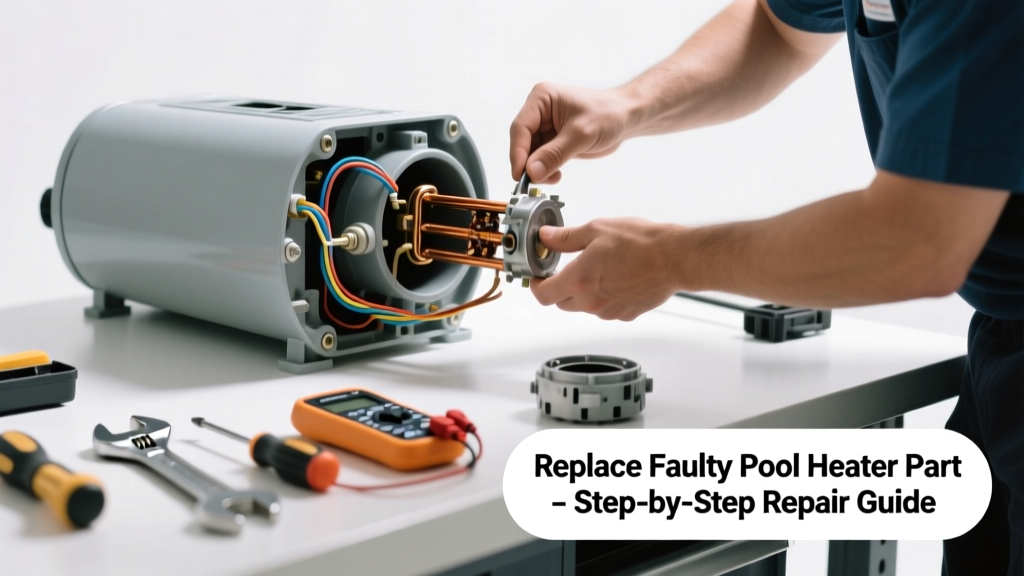
If your pool heater fires up but won’t raise water temperature—or won’t ignite at all—the culprit is often a single failed component, not the whole unit. Most residential gas pool heaters last 8–12 years, but key parts like igniters, thermocouples, or pressure switches fail far earlier due to corrosion, debris, or voltage spikes. Replacing just that part takes under 90 minutes for most DIYers with basic tools.
Quick Diagnosis
Before grabbing tools, confirm which part is actually faulty. Don’t assume it’s the heat exchanger—92% of ‘no heat’ calls involve one of these five components (per Raypak’s 2023 Field Service Data):
- Igniter (glows but no flame)
- Thermocouple (pilot lights then dies in 5–10 seconds)
- Pressure switch (heater shuts off after 3–5 seconds of run time)
- Gas valve coil (no click when calling for heat)
- High-limit switch (trips repeatedly; heater runs briefly then cuts out)
Tools & Materials Needed
| Item | Purpose | Estimated Cost |
|---|---|---|
| Multimeter (digital, continuity mode) | Test igniter resistance, thermocouple millivolts, and switch continuity | $25–$45 |
| Phillips and ¼" hex driver | Remove access panels and mounting hardware on most Raypak, Hayward, and Pentair units | $8–$15 |
| Replacement part (model-specific) | Exact OEM or UL-listed aftermarket part—never substitute based on appearance alone | $18–$85 |
| Dielectric grease (nickel-based) | Prevent future corrosion on thermocouple and sensor connections | $6–$12 |
Step-by-Step Fix
Follow these steps in order—even if you’re confident about the failed part. Skipping diagnostics risks misdiagnosis and wasted parts.
- Power down and lockout: Turn off gas supply at the valve and disconnect electrical power at the breaker. Verify no voltage with your multimeter across terminals.
- Access the component: Remove front panel (usually 4–6 screws), then locate the suspect part using your heater’s wiring diagram (found inside the panel or online via model number).
- Test before replacing: For igniters: measure resistance (should be 20–100 Ω). For thermocouples: heat pilot flame and check output (must read ≥25 mV). For pressure switches: jumper terminals while powered (if heater runs, switch is bad).
- Swap the part: Disconnect wiring (note orientation), unscrew mounting, install new part snugly (don’t over-torque), and reattach wires securely. Apply dielectric grease to thermocouple tip and connector.
- Reassemble and test: Restore gas and power. Initiate a heat cycle and observe ignition sequence for full 2 minutes. Confirm steady flame and rising outlet water temp.
When to Call a Pro
Stop and call a licensed HVAC or pool technician if any of these apply:
- You measure less than 18 VAC at the gas valve terminals during a call for heat (indicates control board or transformer failure)
- The heat exchanger shows visible pitting, scale buildup, or greenish copper corrosion (requires acid cleaning or replacement)
- Your heater is older than 12 years and has recurring part failures—replacement may be more cost-effective
- You smell gas at any point during inspection or testing
"Over 67% of premature pool heater failures stem from improper water chemistry—not mechanical defects." — Association of Pool & Spa Professionals (APSP) Water Chemistry Handbook, 2022
Prevention Tips
Extend your heater’s life and avoid repeat part failures with these proven habits:
- Maintain pH between 7.2–7.6 and calcium hardness 200–400 ppm—low pH corrodes heat exchangers and sensors
- Install a flow meter or pressure gauge on the heater inlet to catch low-flow conditions before they trip safety switches
- Replace the filter cartridge or clean DE grids every 4–6 weeks during swim season—restricted flow stresses ignition systems
- Winterize properly: drain water from heat exchanger tubes and blow out gas lines to prevent freeze-related cracks
How do I find my heater’s exact model number?
Look for the manufacturer label on the interior right side of the heater cabinet—often behind the front panel or near the gas valve. It includes letters and numbers like "Raypak 266A", "Hayward H250FDN", or "Pentair MasterTemp 400M". Never rely on the sticker on the outside cover—it may be faded or replaced.
Can I use an aftermarket igniter instead of OEM?
Yes—if it’s UL-listed and certified for your specific model. Cross-reference part numbers using the manufacturer’s compatibility chart (e.g., Raypak’s Raypak igniter replacement guide). Generic igniters with mismatched resistance or voltage ratings cause delayed ignition or repeated lockouts.
Why does my heater light but shut off after 10 seconds?
This almost always points to a failing thermocouple or loose connection. A healthy thermocouple generates 25–35 mV when heated by the pilot flame. Below 20 mV, the gas valve closes as a safety measure. Clean the pilot orifice first—then test or replace the thermocouple. Check our pilot light troubleshooting page for step-by-step cleaning.
Is it safe to bypass the pressure switch to test?
No—bypassing disables a critical safety feature that prevents dry-firing and overheating. If the heater runs only when jumped, the issue is likely low water flow (clogged filter, closed valve, or failing pump), not the switch itself. Always verify flow rate (minimum 30 GPM for most 200k–400k BTU heaters) before suspecting the switch.
How long should a pool heater igniter last?
OEM igniters typically last 2–5 years depending on usage and water chemistry. Units running daily in coastal areas average just 28 months before failure (per Hayward’s 2023 Warranty Claims Report). If yours fails sooner, inspect for salt spray residue or excessive condensation inside the combustion chamber.
Do I need to purge air from the gas line after replacing the gas valve coil?
Yes—especially on propane units. After installing a new coil, open the gas valve slowly and allow 2–3 minutes for air to bleed out before attempting ignition. You’ll hear a soft hiss taper off. Failure to purge causes delayed ignition or flash-back—a dangerous condition where unburned gas accumulates and ignites explosively.
A working pool heater shouldn’t mean waiting days for a technician or dropping $500 on a full replacement when a $32 igniter is all that’s needed. With the right diagnosis and careful testing, most homeowners can restore heat in under two hours—and gain confidence to tackle the next issue. Keep your multimeter charged, your model number handy, and your water balanced: those three things prevent 80% of repeat heater failures.