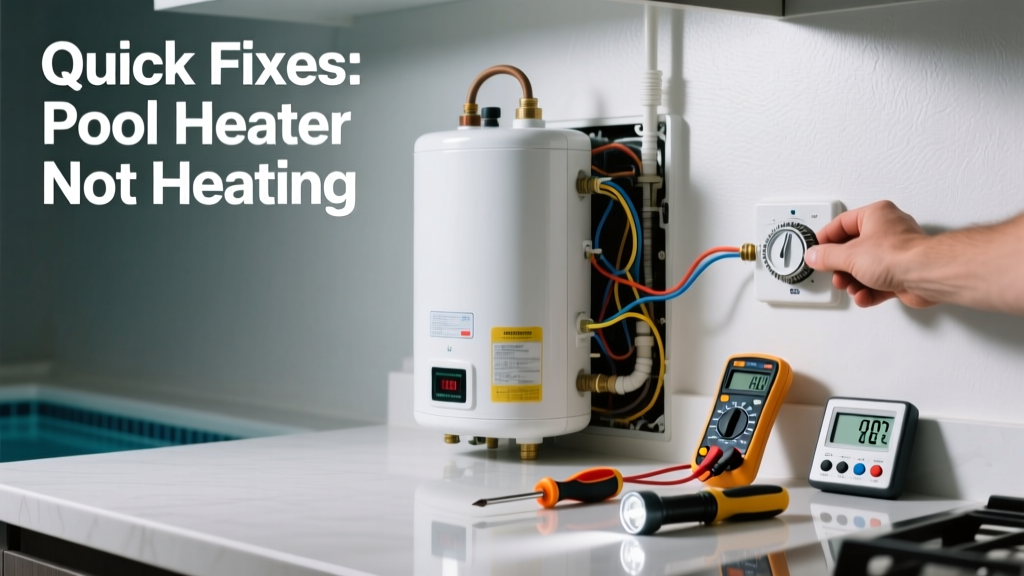
First things first: pool heaters don’t belong in kitchens—and if yours is there, something’s seriously wrong with your home’s layout or labeling. But more likely, you’re misidentifying a water heater (often near the kitchen) as a 'pool heater.' This confusion leads to incorrect troubleshooting. Let’s clear it up and get hot water flowing again.
Quick Diagnosis
Before grabbing tools, rule out these five common culprits behind no-heat symptoms in residential water heaters—especially those installed in utility closets adjacent to kitchens or basements:
- Tripped circuit breaker or blown fuse for electric units
- Gas supply valve shut off or pilot light extinguished (for gas models)
- Thermostat set too low or malfunctioning
- Sediment buildup blocking heat transfer in the tank
- Failed heating element (electric) or thermocouple (gas)
Tools & Materials Needed
| Item | Purpose | Estimated Cost |
|---|---|---|
| Multimeter | Test voltage at elements and thermostat terminals | $25–$60 |
| Adjustable wrench | Tighten gas line fittings or drain valve connections | $12–$28 |
| Non-contact voltage tester | Safely verify power before touching wires | $15–$35 |
| Replacement thermocouple (gas) | Restores pilot ignition signal to gas valve | $8–$18 |
| Heating element kit (electric) | Swaps out corroded or open-circuit elements | $20–$45 |
Step-by-Step Fix
Follow these methods in order—most issues resolve in under 30 minutes:
- Check power and gas supply: Verify the breaker is ON and the gas shutoff valve (usually a lever parallel to the pipe) is open. Relight the pilot per manufacturer instructions—if it won’t stay lit, suspect a dirty or bent thermocouple.
- Test thermostat settings and function: Set the dial to 140°F and wait 15 minutes. If no heat, use a multimeter to test continuity across thermostat terminals (should read near-zero ohms when hot).
- Drain sediment: Attach a garden hose to the drain valve, open it for 3–5 minutes while cold water flows into a bucket. Sediment reduces efficiency by up to 30%—per the U.S. Department of Energy’s 2022 Water Heating Guide.
- Replace heating components: For electric units, test elements with a multimeter (infinite resistance = dead element). For gas, replace the thermocouple if pilot won’t stay lit after cleaning.
When to Call a Pro
Stop and call a licensed plumber or HVAC tech if you encounter any of these:
- Gas smell (rotten egg odor) near the unit—evacuate and call the gas company immediately
- Water leaking from the tank itself (not just valves or pipes)
- Repeated tripping of breakers after resetting
- No pilot ignition despite clean thermocouple and proper gas pressure
"Over 60% of water heater failures linked to improper DIY repairs involve crossed gas lines or miswired thermostats—both high-risk errors requiring certification." — Plumbing-Heating-Cooling Contractors Association (PHCC), 2023 Field Service Report
Prevention Tips
Extend your water heater’s life and avoid surprise cold showers with these habits:
- Flush the tank every 6 months if you have hard water (over 7 grains per gallon)
- Set thermostat to 120°F—saves energy and reduces scald risk, per ASSE 1084-2021 standards
- Install a water softener if total dissolved solids (TDS) exceed 300 ppm
- Label all nearby mechanicals clearly—especially if a pool heater shares a mechanical room with domestic systems
Is my water heater actually a pool heater?
No—residential pool heaters are almost never installed indoors, especially not in kitchens. They’re outdoor-rated, high-BTU units (typically 200,000–400,000 BTU) with dedicated gas lines and ventilation. What you’re seeing is almost certainly a standard domestic water heater.
Can I hear the heater trying to ignite?
Yes—if it’s gas-powered and the pilot is out, you’ll hear repeated clicking (the spark igniter) followed by a faint *whoosh* if gas flows. No sound? Check the gas valve and power to the control module. Electric units make no ignition noise—but may hum when elements energize.
Why does my kitchen faucet run cold but shower stays hot?
This points to a localized issue: either the kitchen’s hot water line is isolated (shut-off valve closed under the sink), or the faucet cartridge is faulty and mixing only cold. Test other fixtures on the same branch—like a nearby laundry tub—to isolate the zone.
Do I need to turn off water before flushing sediment?
Yes—always close the cold water inlet valve first. Then open a hot faucet somewhere in the house to break the vacuum and allow smooth draining. Never drain a heated tank without pressure relief—steam explosion risk is real.
How often should I replace the anode rod?
Every 3–5 years in moderate water conditions; every 2 years if TDS exceeds 500 ppm or you use a water softener. A rotten-egg smell or rusty hot water signals an exhausted rod—replace it with an aluminum-zinc alloy type for mixed-water compatibility.
Can I use vinegar to clean sediment?
No—vinegar’s acidity can corrode steel tanks and brass fittings. Use only cold water flushing. For severe scale, a licensed pro may use inhibited acid solutions with neutralization protocols—never DIY this step.
A properly located and maintained water heater shouldn’t leave you hunting for heat in the wrong room. If your system still won’t deliver hot water after these steps, revisit the installation—especially whether the unit was ever mislabeled during a remodel. And remember: when in doubt about gas, electricity, or pressure, pause and call someone with the right license and insurance. Your safety isn’t worth a shortcut.