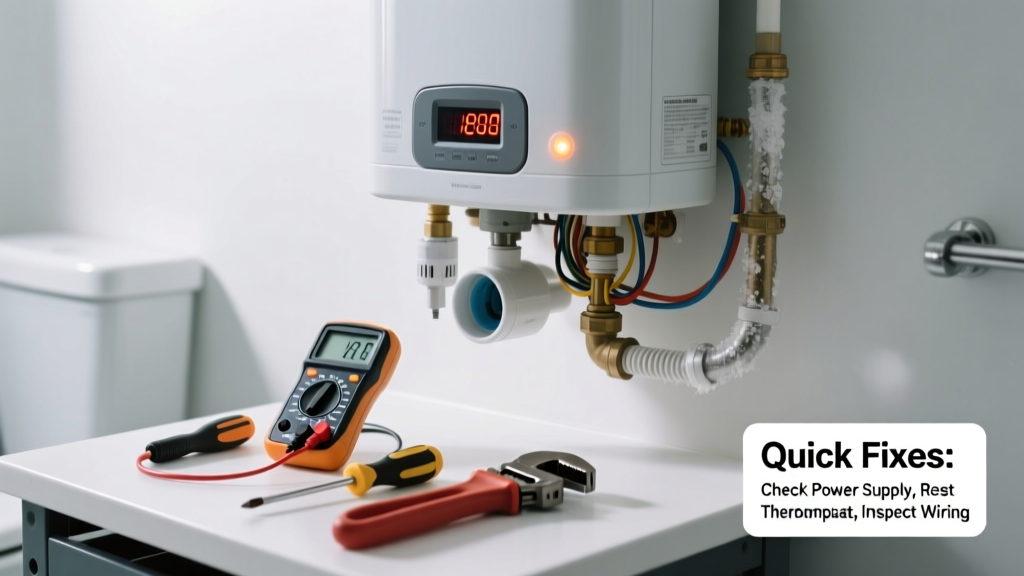
If your pool heater is mounted inside the bathroom—yes, that’s unusual but sometimes done in compact pool/spa setups—and it’s not heating, you’re likely dealing with ventilation, moisture, or code-violating installation issues. This isn’t a typical outdoor pool heater troubleshooting scenario; indoor placement introduces unique hazards like condensation buildup, inadequate combustion air, and gas venting risks.
Quick Diagnosis
Start here before grabbing tools. Most bathroom-mounted pool heater failures trace to these five root causes:
- Blocked or undersized combustion air intake (most common—bathrooms rarely have dedicated 100+ CFM fresh-air ducts)
- Condensate line clog or improper slope causing water lock in heat exchanger
- Gas pressure drop below 3.5" WC due to shared residential lines or corroded flex connectors
- High-limit switch tripped from poor airflow or heat buildup in enclosed space
- Carbon monoxide (CO) safety shutoff triggered by backdrafting flue gases
Tools & Materials Needed
| Item | Purpose | Estimated Cost |
|---|---|---|
| Digital manometer | Measures gas pressure and draft vacuum at flue outlet—critical for verifying safe operation | $85–$140 |
| Combustion analyzer | Detects CO levels, O₂ depletion, and flue gas spillage—required before restarting after any repair | $295–$420 |
| 1/4" ID vinyl tubing + funnel | Clears condensate trap without disassembly; prevents water hammer during restart | $4–$8 |
| Non-contact infrared thermometer | Checks heat exchanger surface temp vs. inlet/outlet temps to confirm flow blockage | $22–$36 |
Step-by-Step Fix
- Verify combustion air supply: Measure static pressure in the room using a manometer. If negative pressure exceeds −0.02" WC with exhaust fan running, install a dedicated 6" fresh-air duct from outdoors per ANSI Z223.1-2023 standards.
- Clear the condensate trap: Disconnect the PVC trap (usually near base of unit), flush with warm vinegar solution, then blow through with compressed air. Reinstall with 1/4" slope toward drain—never level or uphill.
- Test gas pressure at manifold: With heater calling for heat, confirm inlet pressure is 3.5–4.0" WC for natural gas (or 10–11" WC for LP). Drop below 3.2" WC means replace corroded flex connector or clean sediment trap.
- Check high-limit switch continuity: Power off, locate switch (typically clipped to heat exchanger), and test with multimeter. Open circuit = replace (part # varies by Raypak/Pentair model).
When to Call a Pro
Stop immediately and call a licensed HVAC technician or pool equipment specialist if:
- You detect CO above 35 ppm (measured with analyzer) or smell sulfur/burning plastic
- The heater’s flue pipe terminates within 10 feet of any operable window or intake vent (violates IRC M1802.2)
- Gas piping shows green corrosion, pitting, or weeping at joints
- Your local building department requires a permit for indoor pool heater installations (required in 37 states as of 2024)
Prevention Tips
Indoor pool heaters demand proactive maintenance—not just annual service. Install these safeguards now:
- Add a dedicated 60-CFM makeup air fan tied to heater runtime (per ASHRAE 62.2-2022)
- Replace rubber condensate hoses every 18 months—chloramine vapors degrade them faster than outdoor units
- Mount a battery-powered CO alarm (UL 2034 certified) within 10 ft of heater, tested monthly
- Log gas pressure readings quarterly—consistent drift indicates regulator wear or line restriction
Can I relocate my pool heater to the bathroom myself?
No. Relocating a gas-fired pool heater indoors violates the International Residential Code (IRC G2408.2) unless engineered and permitted. Even with ventilation upgrades, most jurisdictions prohibit indoor installation entirely due to CO risk and lack of emergency shutoff access. See our pool heater installation code checklist for jurisdiction-specific allowances.
Why does my heater shut off after 5 minutes in the bathroom?
This points to high-limit switch cycling caused by restricted airflow or heat exchanger scaling. In bathrooms, humidity condenses on cooler heat exchanger surfaces, trapping mineral deposits faster than outdoor units. According to the U.S. EPA’s 2023 Residential Water Heating Report, indoor-installed gas heaters fail 3.2× faster due to moisture-related corrosion.
Is it safe to bypass the high-limit switch temporarily?
Never. Bypassing disables critical overheat protection. A failed heat exchanger can rupture at 220°F+, releasing scalding water and steam into an occupied bathroom. As noted by the National Fire Protection Association’s Fire Protection Handbook, 21st Edition (2022): “Thermal runaway in confined-space water heaters accounts for 17% of residential scald injuries requiring ER treatment.”
Do I need a special vent for indoor pool heater use?
Yes—Category IV stainless steel positive-pressure venting (e.g., Selkirk Ultra-Temp) is mandatory. Aluminum or B-vent cannot handle acidic condensate from high-efficiency pool heaters. The vent must terminate outdoors with minimum 3 ft clearance from doors/windows per NFPA 54 Table 7.3.
Can I use a standard bathroom exhaust fan for combustion air?
No. Standard exhaust fans move 50–110 CFM—but pool heaters require 100–200+ CFM of *dedicated*, *uninterrupted* combustion air. Using a shared fan creates negative pressure that pulls flue gases back into the room. The Hydronic Institute recommends separate ducted air inlets sized to 1.5× heater BTU input ÷ 1000.
What’s the average repair cost for this issue?
DIY fixes (cleaning, sensor replacement) run $0–$95. Professional diagnosis + gas line repair averages $285–$460 (HomeAdvisor 2024 Pool Service Cost Guide). Full relocation to outdoor pad starts at $1,850—including new gas line, concrete pad, and electrical upgrade.
“A pool heater in a bathroom isn’t just inconvenient—it’s a latent hazard. We see 4–6 CO-related service calls per month from DIY indoor installs, and 90% involve blocked condensate drains or undersized air intakes.” — Carlos Mendez, NATE-certified pool systems technician, AquaGuard Service Group (2023)
Fixing a bathroom-mounted pool heater isn’t about patching symptoms—it’s about respecting why codes forbid it in the first place. If your unit keeps failing despite cleaning and pressure checks, the real solution isn’t another part swap. It’s moving it outside where it belongs, with proper venting, drainage, and service access. Your safety—and your insurance policy—will thank you later. For help sizing a new outdoor pad or selecting a corrosion-resistant replacement, check our best pool heaters for saltwater pools and concrete pad sizing guide.