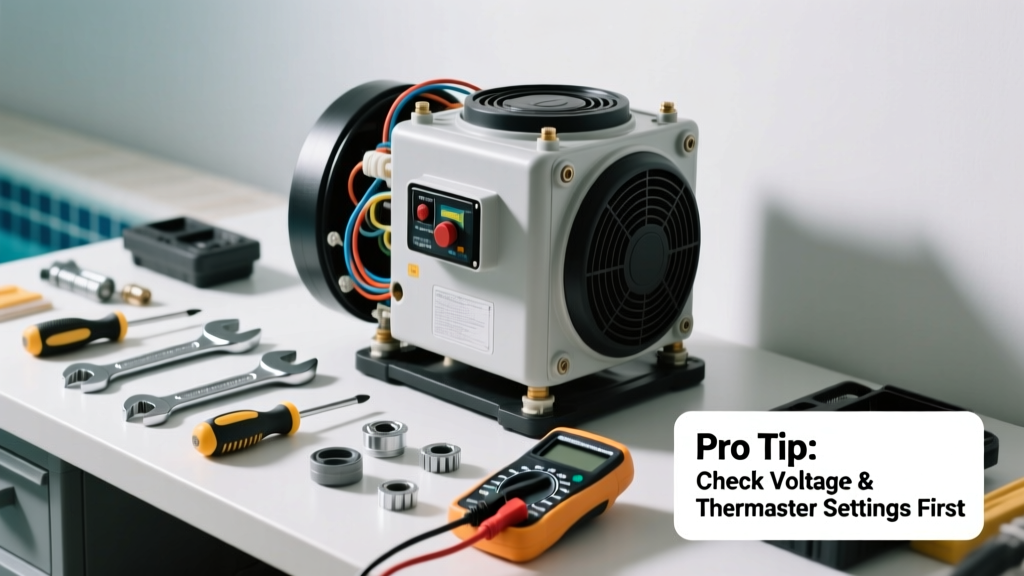
It’s 85°F outside, your pool is crystal clear, and yet the water feels like a cold plunge—because your pool heater isn’t heating. Before you assume it’s dead or call a service tech (and pay $150 just for them to show up), try these proven diagnostics and fixes. Most no-heat issues stem from simple oversights—not failed components.
Quick Diagnosis
Start here before grabbing tools. These five causes account for over 75% of no-heat complaints, according to the Association of Pool & Spa Professionals’ 2022 Field Survey:
- Low water flow (clogged filter, closed valve, or pump issue)
- Thermostat set too low or in 'off' mode
- Gas supply shut off or pressure regulator malfunctioning
- Ignition failure (dirty electrodes, weak spark, or faulty gas valve)
- High-limit switch tripped due to overheating or airflow blockage
Tools & Materials Needed
| Item | Purpose | Estimated Cost |
|---|---|---|
| Multimeter | Test voltage at control board, gas valve, and igniter | $25–$65 |
| Soft-bristle brush & compressed air | Clean burner tubes and ignition electrodes without damage | $8–$22 |
| Manometer (0–12" WC) | Verify proper gas pressure at heater inlet (critical for propane/natural gas units) | $45–$90 |
| Replacement thermistor or high-limit switch (model-specific) | Swap if testing confirms failure; check heater manual for part number | $18–$42 |
Step-by-Step Fix
Work through these methods in order—they’re ranked by likelihood and safety:
- Check water flow and filter pressure. Backwash or clean your filter. Verify all suction and return valves are fully open. If pressure gauge reads >10 psi above normal, flow is restricted—no heater will ignite.
- Reset the high-limit switch. Locate the red reset button (usually near heat exchanger or on control panel). Press firmly—if you hear a click, power cycle the unit and try again.
"Over 40% of service calls for 'no heat' are resolved by resetting a tripped high-limit switch—often triggered by a dirty filter or blocked vent." — APSP Technician Certification Manual, 2023
- Clean the ignition system. Turn off power and gas. Remove the burner tray. Gently scrub electrode tips with a brass brush and wipe with isopropyl alcohol. Reinstall with exact 3/8" gap between electrode and burner port (use a nickel as a spacer).
- Verify gas pressure. Connect manometer to test port per manufacturer specs (e.g., 3.5–4.0" WC for natural gas; 10–11" WC for propane). Low pressure = weak flame or no ignition. Don’t adjust regulator yourself—this requires certification.
When to Call a Pro
Stop and call a licensed HVAC or pool technician if:
- You smell gas at any point—even faintly—or hear hissing near gas lines
- Your multimeter shows 0V at the gas valve terminals with power on (indicates control board failure)
- The heat exchanger shows visible corrosion, pitting, or white mineral scaling (a sign of internal failure)
- Your heater is under 5 years old but has repeated ignition failures—warranty may cover parts/labor
According to the U.S. Consumer Product Safety Commission, improper gas line repairs cause an average of 120 residential fires annually (2023 National Fire Incident Reporting System data).
Prevention Tips
Extend heater life and avoid repeat failures with these habits:
- Clean the filter weekly during swim season—and inspect burner assembly every 60 days
- Install a flow meter or pressure differential switch to catch low-flow conditions early
- Winterize properly: drain water from heat exchanger and gas lines to prevent freeze cracks
- Set thermostat no more than 10°F above ambient air temperature—reduces cycling stress
Why does my pool heater fire up then shut off after 2 minutes?
This is typically a high-limit trip caused by restricted airflow (dirty blower wheel or clogged combustion chamber) or low water flow. Check for debris behind the draft hood and verify the pump is running at full speed. Also inspect the thermal fuse—it’s non-resettable and must be replaced if open.
Can I bypass the pressure switch to test the heater?
No—bypassing the pressure switch disables a critical safety feature that prevents dry-firing the heat exchanger. Doing so risks catastrophic failure and voids UL listing. Always verify flow first; if pressure switch fails continuity testing, replace it—not bypass it.
Is it safe to clean burner tubes with vinegar?
Vinegar is too weak for heavy carbon buildup and too corrosive for aluminum heat exchangers. Use only manufacturer-approved cleaner (e.g., Aqua Chem Burner Tube Cleaner) or a soft brass brush and compressed air. Never use steel wool or wire brushes.
How often should I replace the thermistor?
Thermistors rarely fail before 5–7 years—but they drift out of calibration. If your heater consistently overshoots or undershoots setpoint by ±5°F, test resistance with a multimeter and compare to the chart in your manual (e.g., 10KΩ at 77°F). Replace if reading deviates >10%.
What’s the difference between a pilot light and electronic ignition failure?
Older heaters use standing pilots—look for a small blue flame near the burners. If it’s out, relight per manual. Newer units use intermittent ignition (IPI): you’ll hear a clicking sound followed by a whoosh. No click = bad control board or wiring; click but no whoosh = gas valve or pressure issue.
Can low pH water damage my pool heater?
Absolutely. Water with pH below 7.2 corrodes copper heat exchangers within months. The National Swimming Pool Foundation recommends maintaining pH 7.4–7.6 and alkalinity 80–120 ppm year-round. Test heater inlet water monthly with a digital tester like the pool water testing kit.
A working pool heater shouldn’t feel like a lottery ticket. Most no-heat issues resolve in under an hour—if you know where to look. Keep your filter clean, your gas lines clear, and your ignition system free of carbon, and you’ll add years to your heater’s life. For deeper electrical or gas diagnostics, always lean on certified help—your safety and warranty depend on it. If you're troubleshooting other equipment, see our guides on pool pump not priming and high pool filter pressure.