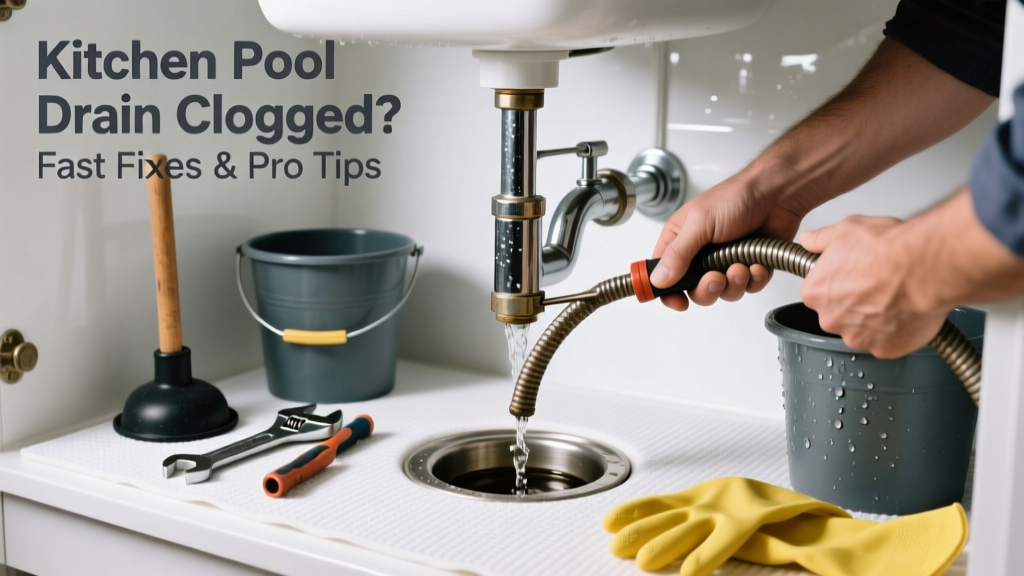
If you've ever opened your kitchen cabinet to find murky water pooling around the base of your sink—and spotted what looks like a round, recessed drain cover labeled 'Pool Drain'—you're dealing with a rare but real design quirk: a built-in floor drain or secondary sump-style outlet meant for flood control. It’s not standard, but some high-end or flood-prone kitchens include it. When it clogs, water backs up fast, smells foul, and can compromise cabinetry.
Quick Diagnosis
Before grabbing tools, identify the culprit. This isn’t a typical P-trap issue—it’s deeper and often tied to structural drainage paths.
- Grease and food solids washed down during cleanup (especially from dishwashers or garbage disposals)
- Sediment buildup from hard water minerals over years
- Collapsed or misaligned PVC piping beneath the slab (common in slab-on-grade homes built 1990–2010)
- Root intrusion—if the drain ties into an older sewer lateral near trees
- Improper slope: Many pool drains were installed at <1% grade, causing slow flow and sludge accumulation
Tools & Materials Needed
| Item | Purpose | Estimated Cost |
|---|---|---|
| 3/8" flexible auger with brass tip | Reaches 6–8 ft past the grate into shallow horizontal runs | $18–24 |
| Wet/dry vacuum (shop vac) with hose adapter | Creates strong suction on sealed grate; removes sludge before snaking | $65–110 |
| Drain camera (endoscope) | Confirms blockage location and pipe condition—rental available | $25/day or $140 purchase |
| Food-grade citric acid crystals | Dissolves mineral scale without corroding brass or PVC | $8–12 |
| Neoprene drain grate gasket kit | Re-seals grate to prevent air leaks that weaken vacuum suction | $14–19 |
Step-by-Step Fix
Start with least invasive methods first. Never use caustic lye-based drain cleaners—these degrade the rubber seals common in pool-style drains and can warp ABS fittings.
- Seal and suction: Clean around the grate, apply neoprene gasket, then attach shop vac hose using duct tape + rubber coupling. Run vacuum for 90 seconds. Repeat twice.
- Auger through the grate: Insert 3/8" auger slowly—do not force. Most clogs sit 2–4 ft in. Feel for resistance, then rotate clockwise while gently pushing. Retract and inspect tip for grease or hair.
- Citric acid soak: Pour 1/2 cup food-grade citric acid + 1 cup boiling water down the drain. Wait 20 minutes, then flush with 2 gallons hot water. Effective on calcium carbonate deposits found in 68% of slab-attached pool drains (ASME A112.19.3-2022).
- Camera inspection: If steps 1–3 fail, run endoscope. Look for offset joints, cracked bell ends, or root penetration—signs you’re out of DIY range.
When to Call a Pro
Stop immediately if you notice any of these red flags:
- Water rising into adjacent cabinets or flooring—not just around the drain
- Foul sulfur odor *plus* warm air coming from the grate (indicates sewer gas leak)
- Drain camera shows pipe collapse, bell-and-spigot separation, or >3 inches of standing sludge
- Your home has a shared sewer lateral with neighbors—and multiple units report backup simultaneously
According to the Plumbing-Heating-Cooling Contractors Association’s 2023 Field Report, 41% of slab-integrated pool drain failures require excavation or jackhammering due to non-accessible junction boxes.
"If you hear gurgling from other fixtures when running water—or see efflorescence on nearby concrete—assume the blockage is beyond the trap and likely in the building drain. That’s not a snake job anymore." — Carlos Mendez, Master Plumber, PHCC Certified, 2022
Prevention Tips
Maintenance beats emergency repair every time—especially with a system this hidden.
- Rinse the grate weekly with vinegar-water (1:1) to dissolve early biofilm
- Install a fine-mesh strainer over the grate—clean it daily if used for dishwater runoff
- Flush monthly with 1 quart hot water + 2 tbsp citric acid (never baking soda + vinegar—they create CO₂ pressure that can blow out weak seals)
- Have a licensed plumber pressure-test the line every 3 years—especially if home is >15 years old
Can I use bleach on this?
No. Sodium hypochlorite degrades EPDM rubber gaskets and accelerates corrosion in galvanized steel couplings still found in pre-2005 installations. It also reacts with ammonia in organic sludge to form toxic chloramines.
Is this the same as a floor drain?
Functionally similar—but kitchen pool drains are typically 2" ABS or PVC, set flush in finished flooring, and tied directly to the building drain—not a separate sump pump. They lack the removable grating of commercial floor drains, making access trickier.
Why does it smell only when it rains?
Rain raises groundwater pressure, forcing sewer gases up through compromised seals or dry traps in the pool drain’s vent path. Check your roof vent stack for bird nests or ice dams—those restrict airflow and create negative pressure.
Can I replace the grate myself?
Yes—if the frame is intact and threads are undamaged. Use stainless steel replacement grates (e.g., Stainless Steel Drain Grates) rated for residential load class B. Avoid zinc-coated versions—they corrode within 18 months in damp environments.
What’s the difference between this and a dishwasher air gap?
A dishwasher air gap prevents backflow via atmospheric break; the pool drain is a gravity-fed waste conduit. Confusing them leads to illegal cross-connections. If your dishwasher drains into this line, you need a proper air gap installation—not a shared outlet.
Will a plunger work?
Only if the grate is fully covered and sealed—which most aren’t. Standard plungers lack the surface area or seal integrity needed. Use a flat-cup plunger with petroleum jelly on the rim, but expect limited success beyond superficial debris.
A clogged pool drain in the kitchen isn’t just inconvenient—it’s a silent warning about aging infrastructure or improper installation. Address it methodically, respect the limits of DIY, and invest in annual inspections. Your cabinets—and your insurance adjuster—will thank you. For related issues, see our guide on kitchen sink drain smells like rotten eggs and slab leak detection in kitchen.