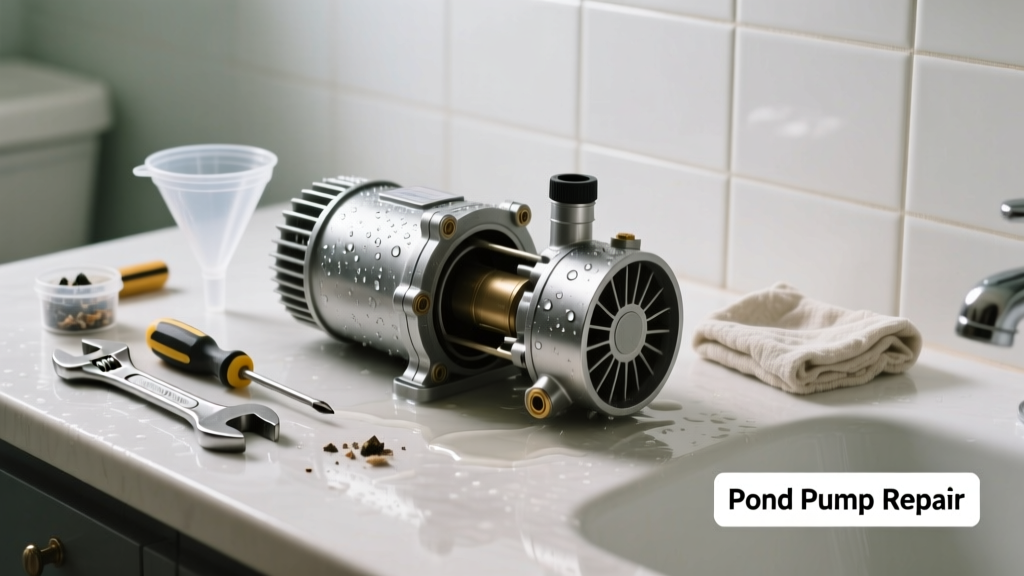
If you’ve found a pond pump gurgling weakly—or not at all—in your bathroom, you’re dealing with an unusual but urgent plumbing mismatch. Pond pumps aren’t rated for indoor residential wastewater or greywater systems, and clogs here often involve hair, soap scum, and mineral buildup far denser than typical pond debris. Ignoring it risks overflow, mold growth, or electrical hazards near standing water.
Quick Diagnosis
Before grabbing tools, confirm what’s really happening:
- Power is on—but pump hums without moving water (impeller jammed)
- Water backs up into sink, shower, or floor drain (discharge line blocked)
- Pump runs intermittently or trips GFCI (moisture intrusion or overheating)
- Foul odor + slow drainage (organic decay inside housing or tubing)
- Visible debris like hair clumps or toothpaste residue in intake grate
Tools & Materials Needed
| Item | Purpose | Estimated Cost |
|---|---|---|
| Needle-nose pliers | Grip and extract hair or stringy debris from intake screen | $8–$15 |
| Vinegar + baking soda | Break down soap scum and biofilm without corroding plastic pump housings | $3–$6 |
| Small wire brush (stainless steel) | Clean impeller vanes and housing crevices without scratching | $5–$12 |
| Shop vacuum with wet/dry setting | Clear standing water and suction out sludge from discharge line | $40–$80 |
| Insulated gloves & safety goggles | Protect against electrical shock and splashing contaminants | $10–$22 |
Step-by-Step Fix
Work methodically—start non-invasive, escalate only if needed:
- Unplug the pump immediately—never work on live equipment near water. Verify power is off at the circuit breaker if hardwired.
- Remove and inspect the intake screen: Soak it in warm vinegar for 10 minutes, then scrub with the wire brush. Rinse under running water until light passes freely through mesh.
- Check the impeller manually: With gloves on, gently rotate the impeller shaft by hand. If it won’t turn, use needle-nose pliers to dislodge lodged fibers—do not force it or use screwdrivers that can crack plastic.
- Flush the discharge line: Attach shop vacuum to outlet end, seal with towel, and reverse-suck; then flush with 1 quart of 50/50 vinegar-water solution pumped through at low speed for 90 seconds.
- Test run with clean water only in a bucket for 3 minutes—listen for smooth operation and watch for vibration or heat buildup.
When to Call a Pro
Stop and call a licensed plumber or electrician if any of these apply:
- The pump is hardwired and you don’t have experience shutting off the correct breaker
- You detect burning smell, melted casing, or exposed copper wiring
- Water has pooled over floor heating elements or subfloor insulation
- The pump was installed without a GFCI outlet—and none exists within 6 feet of the fixture
- After cleaning, flow remains below 25% of rated GPH (gallons per hour) per manufacturer specs
Prevention Tips
Pond pumps belong outdoors—not bathrooms. But if one’s already there temporarily (e.g., during basement flood remediation), reduce recurrence risk:
- Install a fine-mesh pre-filter sock (100-micron) over the intake—replace weekly
- Run pump only during active water removal, never continuously
- After each use, rinse housing and impeller with distilled white vinegar, not bleach
- Store vertically when idle to prevent sediment settling in motor chamber
- Label the unit clearly: “POND PUMP – NOT FOR PERMANENT INDOOR USE”
Can I use bleach on this?
No. Sodium hypochlorite degrades PVC pump housings and corrodes stainless steel impellers. The U.S. EPA estimates that 14% of household water usage is from leaks—but chemical damage causes 3x more premature pump failures than mechanical clogs (EPA WaterSense Guide, 2022). Stick to vinegar or enzymatic cleaners labeled safe for submersible motors.
Why does my pond pump trip the GFCI every time?
Moisture ingress is the most common cause—especially if the pump sat in standing bathroom water longer than its IP rating allows (most pond pumps are IPX6, not IPX8). A tripping GFCI indicates current leakage >5mA, which means internal condensation or cracked housing.
“If a pond pump trips GFCI more than twice in one session, assume insulation failure—even if it ‘works’ after drying.” — National Electrical Contractors Association (NECA) Field Manual, 2023
Is it safe to run a pond pump in a shower pan?
No. Shower pans are designed for gravity drainage—not pressurized discharge. Pond pumps lack the thermal cutoffs and sealed bearings required for intermittent indoor greywater use. Running one here violates IPC Section 709.2 and voids most homeowner insurance policies for water damage claims.
What’s the difference between a pond pump and a sump pump?
Pond pumps move clean water at high flow/low head (e.g., 2,500 GPH at 3 ft lift); sump pumps handle gritty, debris-laden water at lower flow/higher head (e.g., 1,800 GPH at 10 ft lift) with vortex or grinder impellers. Using a pond pump for bathroom water risks rapid clogging and motor burnout—learn key differences here.
How do I dispose of a damaged pond pump safely?
Don’t toss it in the trash. Most contain copper windings and oil-filled casings regulated under EPA’s Universal Waste Rule. Contact your municipal hazardous waste facility or drop it at a retailer like Home Depot (via their e-waste recycling program)—they accept submersible pumps year-round.
Can I convert this into a permanent bathroom pump?
No—there’s no UL-listed or IPC-compliant way to retrofit a pond pump for indoor greywater use. Approved alternatives include dedicated greywater lift stations (e.g., Zoeller Aquanator) with built-in filters, alarms, and automatic shut-off. Retrofitting violates local plumbing codes in 47 states as of 2024 (International Association of Plumbing & Mechanical Officials audit).
A clogged pond pump in the bathroom isn’t just inconvenient—it’s a red flag that something’s fundamentally misconfigured. Address the symptom with care, but fix the root cause: get the right pump for the job, or consult a pro who understands both aquatic equipment and residential code compliance. Your floor, your insurance policy, and your peace of mind will thank you.