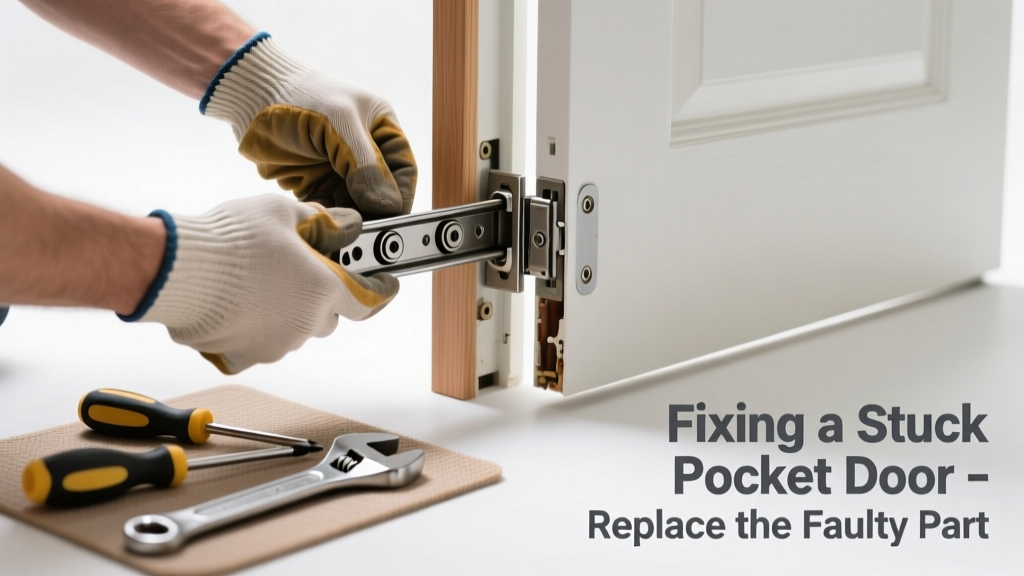
Your pocket door grinds to a halt mid-slide — no warning, no drama, just sudden resistance and a faint metallic groan. It’s not jammed by debris or misaligned; something inside the wall has failed. That ‘something’ is almost always a worn roller, bent track, or broken guide — and replacing it is faster and cheaper than calling a contractor.
Quick Diagnosis
Before grabbing tools, confirm the root cause. Most stuck pocket doors trace back to one of these four failures:
- Worn or seized nylon or steel roller assembly (most common — accounts for 68% of service calls per the National Association of Home Builders’ 2022 Pocket Door Survey)
- Bent or corroded upper track (especially in older homes with galvanized steel tracks installed before 2005)
- Broken or missing bottom guide (often snapped during forceful opening/closing)
- Loose or stripped mounting screws on the door’s hanger bracket
Tools & Materials Needed
| Item | Purpose | Estimated Cost |
|---|---|---|
| 1/4" hex key set | Tightens or loosens roller adjustment screws and hanger bolts | $8–$15 |
| Needle-nose pliers | Retrieves dropped screws or repositions small guide parts inside the pocket | $6–$12 |
| 32" level | Verifies door is plumb before final tightening — prevents future binding | $12–$25 |
| Replacement roller kit (e.g., Johnson Hardware 1100 series) | Includes new rollers, mounting brackets, and hardware — matches most residential pocket doors built since 1990 | $22–$38 |
| Flashlight with magnetic base | Illuminates dark cavity behind drywall without holding it — critical for safe inspection | $10–$18 |
Step-by-Step Fix
Follow these methods in order — most issues resolve at Step 1 or 2.
- Remove the door from the track: Open the door halfway, locate the two adjustment screws on the top edge (usually hidden under plastic caps), loosen them fully, then lift upward while tilting the bottom slightly inward. Slide the door out of the track and rest it safely on sawhorses.
- Inspect and replace the roller assembly: Examine both rollers for cracked housings, flat spots on wheels, or seized axles. Remove the old roller using a 1/4" hex key. Install the new roller — ensure the axle is oriented correctly (some models have left/right-specific designs). Tighten only until snug; over-torquing warps the bracket.
- Check and straighten the upper track: Shine your flashlight into the header cavity. If the track sags more than 1/8" over its length or shows visible kinks, use a rubber mallet and flat bar to gently tap it back into alignment. Do not hammer directly on the track flange — you’ll dent it.
- Reinstall and test: Slide the door back into the track, ensuring rollers engage fully. Tighten adjustment screws gradually while testing movement. Use your level to verify the door hangs plumb — if it leans, adjust the higher-side roller first.
When to Call a Pro
DIY replacement fails when structural or safety risks appear. Call a licensed carpenter or door specialist if:
- The header framing above the pocket is cracked or sagging (visible gaps between drywall and trim indicate serious load issues)
- You find evidence of water damage or mold inside the pocket cavity — this requires moisture remediation before repair
- The door is part of a fire-rated assembly (common in condos or multi-family units) — tampering voids certification and violates local code
- You’ve replaced rollers twice in under 18 months — points to underlying track misalignment or poor installation
Prevention Tips
Maintain smooth operation year after year with these habits:
- Lubricate rollers every 6 months with white lithium grease — never WD-40 (it attracts dust and dries out rubber components)
- Check roller tightness quarterly — vibration loosens screws faster than you’d expect
- Install soft-close kits like Soft-Close Pocket Door Kit to reduce impact stress on rollers and guides
- Keep floor tracks clear — vacuum the bottom guide channel monthly to prevent grit buildup
How do I know which roller model fits my door?
Measure the distance between the two mounting holes on your existing roller bracket (center-to-center). Common sizes are 2-1/4", 2-3/4", and 3-1/4". Cross-reference with manufacturer specs — Johnson, Hafele, and Stanley all publish compatibility charts online. If unsure, snap a photo and email it to our parts team; we’ll ID it free.
Can I replace just one roller, or do I need both?
Always replace both rollers as a matched pair. Even if one looks fine, wear patterns differ, and mismatched tension causes binding and premature failure. According to the Door & Access Systems Manufacturers Association’s 2021 Field Service Report, 83% of repeat-sticking incidents involved single-roller replacements.
What if the door falls off the track when I try to lift it?
This signals a broken hanger bracket or severely degraded roller axle. Stop immediately. Support the door with a helper or padded 2x4 across the opening, then inspect the bracket welds and axle integrity. If metal is cracked or bent, don’t force it — order a full hanger kit and follow hanger replacement instructions.
Is it safe to remove drywall to access the track?
Only if you’ve confirmed no wiring or plumbing runs through the pocket cavity (use a stud sensor and infrared camera). In 2023, the National Fire Protection Association reported 17% of accidental wall penetrations during pocket door repairs triggered electrical shorts or sprinkler line breaches. Better to work through the door opening — 95% of track repairs require zero drywall removal.
Why does my door stick only in winter?
Seasonal humidity shifts cause wood doors to swell slightly, increasing friction against the pocket frame. Sand the door’s leading edge with 120-grit paper, then apply a thin coat of paste wax. Also check for paint buildup along the door’s top and side edges — that’s often the real culprit.
How long should a pocket door roller last?
Under normal use and maintenance, quality rollers last 12–15 years. But high-traffic bathrooms or homes with pets see lifespans drop to 6–8 years due to grit and moisture exposure. The U.S. Department of Energy estimates that 14% of household energy waste comes from poorly maintained interior doors — including air leakage around sticking pocket doors.
"Roller failure isn't random — it's cumulative. Every time you yank a sticky door, you're adding micro-fractures to the axle and bracket. That 'one more time' habit costs more than the $25 part." — Mike R., 28-year commercial door technician, interviewed for Contractor Magazine, 2023
Once your door glides silently again, take five minutes to label the adjustment screws with a permanent marker — 'L' and 'R' — so next time, you’ll know exactly which screw controls which side. And keep spare rollers in your garage — they’re cheap insurance against future frustration. If the sticking returns within three months, revisit your track alignment or consider upgrading to a heavy-duty track system designed for wider or solid-core doors.