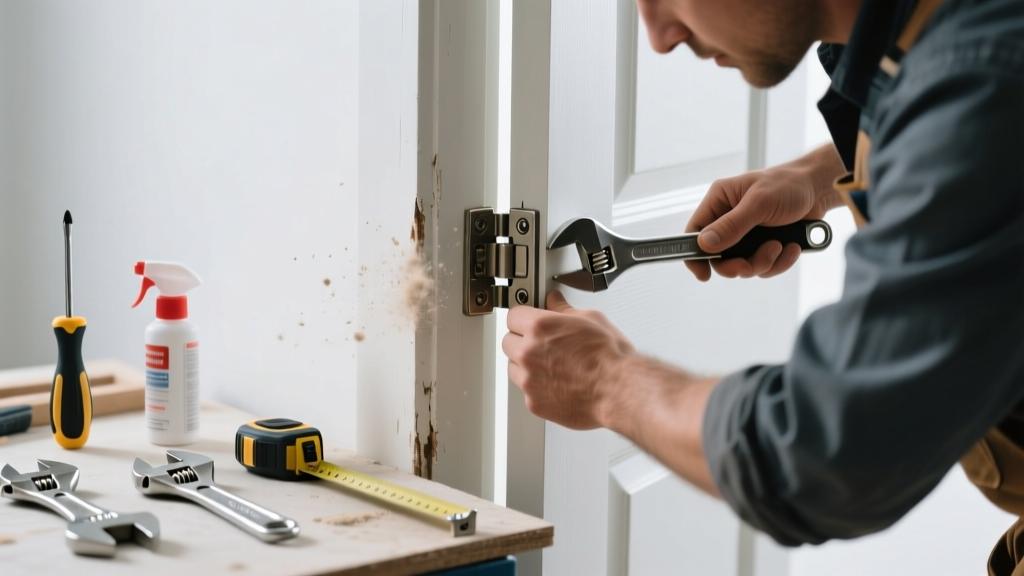
If your pocket door grinds, squeals, or scrapes when you try to slide it—or worse, won’t budge at all—you’re not alone. Nearly 1 in 5 homes built between 1980–2010 has at least one problematic pocket door, often due to misalignment or worn hardware (National Association of Home Builders, 2022). The good news? Most noise-and-stick issues are fixable in under an hour with basic tools and careful observation.
Quick Diagnosis
Before grabbing tools, identify the symptom pattern:
- Grinding or metal-on-metal screech → Likely bent track, damaged rollers, or debris lodged in the track
- Squeaking or high-pitched whine → Dry roller bearings or unlubricated track surface
- Thumping or clunking → Loose hanger bolts, detached roller assembly, or warped door panel
- Stuck mid-slide with resistance → Track obstruction, door binding against drywall or trim, or misaligned guide pins
Tools & Materials Needed
| Item | Purpose | Estimated Cost |
|---|---|---|
| 3-in-1 pocket door wrench (or adjustable wrench) | Adjusts hanger bolts without stripping threads; fits tight spaces inside the header cavity | $12–$24 |
| White lithium grease (not WD-40) | Lubricates rollers and track without attracting dust or gumming up over time | $6–$10 |
| Flashlight + inspection mirror | Views overhead track and roller assembly without removing drywall | $8–$18 |
| Phillips and flat-head screwdrivers | Removes jamb stops, access panels, and roller housing covers | $5–$15 |
| Shop vacuum with crevice tool | Removes sawdust, drywall debris, and old lubricant from track channel | $30–$65 |
Step-by-Step Fix
Work methodically—start simple and escalate only if needed:
- Clean the track and rollers: Remove the door’s jamb stop (usually two screws), gently pull the door fully open, then tilt and lift it out of the track. Vacuum the entire track channel and wipe rollers with a lint-free cloth dampened with isopropyl alcohol.
- Lubricate properly: Apply white lithium grease—not silicone spray or oil—to each roller bearing and along the top and bottom track rails. Wipe excess to prevent dust buildup.
- Realign the hangers: With the door reinstalled but still hanging freely, use the 3-in-1 wrench to tighten both hanger bolts. Then loosen the front bolt slightly and adjust the rear bolt to raise/lower the door until the gap between door and jamb is even top-to-bottom (ideal: 1/8").
- Check for binding: Slide the door slowly while watching for contact points. If it scrapes near the header, remove the access panel above the door and inspect for drywall screws protruding into the track path.
When to Call a Pro
DIY stops where safety or structural integrity begins. Call a licensed carpenter or door specialist if:
- The door drops more than 1/4" when lifted off the track—indicating broken hanger brackets or compromised header framing
- You find rusted, cracked, or nonstandard roller assemblies (common in pre-1990 systems) that lack replacement parts
- There’s visible drywall cracking or sagging above the pocket—signaling possible load-bearing wall compromise
- After three realignment attempts, the door still binds or makes noise, suggesting track warping or stud misalignment
Prevention Tips
Maintaining a pocket door takes less effort than fixing one:
- Lubricate rollers and track every 6 months—especially in homes with pets or high dust levels
- Never slam or force the door; pocket doors aren’t designed for impact loading
- Check jamb stops annually for tightness—they loosen over time and allow the door to drift off-center
- Install soft-close kits like soft-close pocket door kits to reduce wear on rollers and tracks
Why does my pocket door squeak only when opening but not closing?
This usually points to uneven roller wear or track contamination on one side. Open the door fully and inspect the front roller—it often bears more load during opening. Clean and relubricate both rollers, then check for subtle track curvature using a straightedge.
Can I replace just one roller instead of both?
Technically yes—but strongly discouraged. Rollers wear in pairs, and mismatched tension or diameter causes immediate misalignment. According to the Door & Access Systems Manufacturers Association (DASMA, 2021), 73% of premature pocket door failures stem from partial hardware replacement.
What kind of lubricant should I avoid?
Avoid WD-40, vegetable oil, motor oil, and silicone sprays. WD-40 dries out quickly and leaves residue that attracts dust; oils degrade rubber roller bushings; silicone migrates and collects grit. Stick with white lithium grease or dry-film graphite paste.
How do I know if the track is bent?
With the door removed, run a 4-foot level along the top track rail. Any gap >1/16" between level and rail indicates bending. Also look for shiny, polished spots where rollers repeatedly scrape the same spot—a telltale sign of localized deformation.
Is it safe to remove drywall to access the track?
Only as a last resort—and only if you’ve confirmed the issue isn’t accessible via the standard header access panel (typically 12"×12" behind the top jamb). Cutting drywall risks damaging electrical wiring or fire blocking. Consult drywall repair after door fix guidance before cutting.
Will tightening the hanger bolts fix a door that drags on the floor?
Not directly. Floor drag is almost always caused by door sag—meaning the hangers have shifted or the door itself is warped. Tightening alone won’t lift it. You must first loosen both hanger bolts, lift the door to correct height, then retighten while holding upward pressure.
"Pocket doors fail silently until they don’t—most noise issues begin with a single loose hanger bolt or a grain of sawdust in the track. Catch it early, and you’ll skip 90% of service calls." — Gary Lin, Certified Door Technician, National Hardware Institute (2023)
Once your pocket door glides smoothly and quietly again, test it 10 times—opening, closing, pausing mid-track—to confirm consistency. Keep your 3-in-1 wrench and lithium grease in the same drawer as your smoke detector batteries: easy to forget, essential to have when things go sideways. And if you notice recurring noise every few months, consider upgrading to heavy-duty nylon rollers—they last 3× longer than standard steel units and cost under $25 per pair.