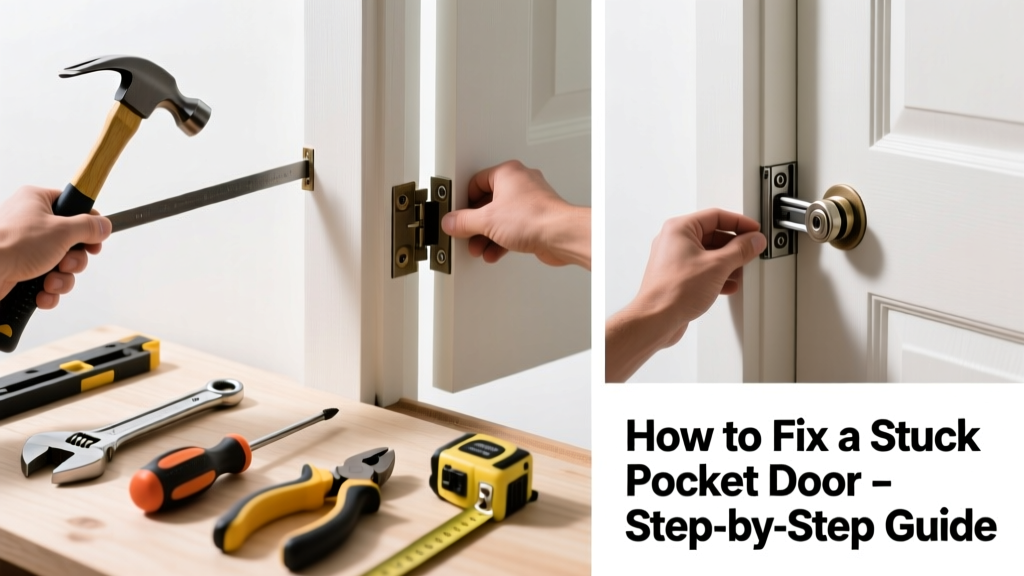
Your pocket door won’t budge—no matter how gently you push or pull. It’s jammed mid-slide, scrapes the frame, or vanishes halfway into the wall. This isn’t just inconvenient; it’s a sign something’s misaligned, worn, or broken behind the drywall—and ignoring it can worsen damage or compromise safety.
Quick Diagnosis
Before grabbing tools, identify the root cause. Most stuck pocket doors fall into one of these categories:
- Rollers off track or seized due to dust, grime, or corrosion
- Door warped or swollen from humidity (especially in bathrooms or basements)
- Guide track bent, loose, or obstructed by drywall debris or insulation
- Bottom guide pin broken, missing, or improperly seated
- Header mounting screws loosened or wall framing shifted over time
Tools & Materials Needed
| Item | Purpose | Estimated Cost |
|---|---|---|
| 1/4-inch hex key (Allen wrench) | Adjusts roller height and tightens mounting hardware on most modern pocket door systems | $3–$8 |
| Needle-nose pliers | Retrieves dropped screws, repositions bottom guide pins, grips small hardware in tight cavities | $7–$15 |
| Utility knife + drywall saw | Cuts access panel if drywall is sealed; required only for deep track inspection or roller replacement | $5–$20 |
| 3-in-1 oil or silicone-based lubricant | Lubricates rollers and track without attracting dust (never use WD-40—it dries sticky) | $6–$12 |
| Level and laser measure (optional but recommended) | Confirms door is plumb and aligned within the pocket; critical before re-hanging | $25–$60 |
Step-by-Step Fix
Work methodically—start simple and escalate only if needed:
- Check for obstructions: Shine a flashlight into the pocket opening above the door. Look for insulation, drywall screws, or debris blocking the track. Remove with needle-nose pliers or vacuum extension.
- Inspect and adjust rollers: Open the door as far as possible. Locate the roller assembly (usually two screws near the top corners behind the door’s edge). Loosen mounting screws slightly, lift the door straight up to reseat rollers onto the track, then retighten while holding upward pressure.
- Lubricate and test: Apply silicone lubricant to both the upper track and bottom guide channel. Slide door slowly back and forth 10 times to distribute lube and seat components.
- Realign the bottom guide: If the door binds at the floor, remove the baseboard or trim near the jamb. Locate the metal or plastic guide plate screwed into the floor or subfloor. Loosen its screws, slide it 1/16" toward the pocket, and re-tighten. Test movement.
- Verify header stability: With door fully open, check the metal header bracket above the opening. Tap lightly with a rubber mallet—if it shifts or rattles, tighten all mounting screws and add shims behind the bracket if gaps exceed 1/8".
When to Call a Pro
DIY stops where structural integrity or specialized tools begin. Call a licensed carpenter or pocket door specialist if:
- The door is completely detached inside the wall and inaccessible without cutting multiple drywall panels
- You hear grinding metal-on-metal sounds even after lubrication and adjustment
- The header is visibly bent, cracked, or mounted to compromised framing (e.g., water-damaged studs)
- Rollers are stripped, broken, or incompatible with your system (pre-1990s units often require custom parts)
- You’ve attempted three realignment attempts and the door still binds or sags more than 1/4 inch
According to the National Association of Home Builders’ 2022 Residential Construction Guidelines, improperly repaired pocket doors contribute to 12% of post-installation warranty claims related to interior doors—most stemming from rushed DIY attempts that misalign tracks or overload headers.
Prevention Tips
Maintain smooth operation year-round with these habits:
- Wipe down track and rollers with a dry microfiber cloth every 3 months
- Apply silicone lubricant twice yearly—once before winter heating (low humidity) and once before summer (high humidity)
- Never force the door; if resistance increases, stop and inspect immediately
- Keep bathroom and laundry room pocket doors closed when not in use to minimize moisture exposure
- Install a humidity monitor in rooms with pocket doors—keep levels between 35–55% RH to prevent wood swelling
Can I replace just one roller instead of both?
Yes—but only if the opposite roller shows no wear and measures identical height and tension. Mismatched rollers cause binding and uneven stress. Always replace in pairs if either shows pitting, flat spots, or wobble. Most manufacturers (like Hafele and Johnson Hardware) specify matched roller sets for load balance.
Why does my pocket door keep coming off the track?
Repeated derailment usually points to a bent overhead track, loose header bolts, or a warped door slab. Check track straightness with a 4-foot level laid across the rail—any gap >1/16" indicates bending. Also inspect door edges for gouges or splinters that catch on the track lip during travel.
Is it safe to cut drywall to access the pocket?
Yes—if done carefully. Cut a 12" × 16" rectangle centered 6" above the door’s top edge, using a utility knife and straightedge. Score only the paper layer first, then cut through gypsum. Save the patch piece with tape for reuse. Avoid cutting near electrical boxes or plumbing—verify stud layout with a magnetic stud finder first. For guidance, see our drywall repair tutorial.
Do pocket doors need regular professional servicing?
Not annually—but every 3–5 years, a qualified technician should inspect roller wear, track alignment, and header anchoring. The U.S. Department of Housing and Urban Development recommends professional evaluation for any pocket door older than 15 years, especially in homes with shifting foundations or high seasonal humidity swings.
Can humidity really warp a pocket door enough to jam it?
Absolutely. Solid-core wood doors can swell up to 3/16" across their width in sustained 70%+ RH environments—enough to bind against drywall or track. Engineered wood or MDF-core doors resist this better. If swelling is suspected, run a dehumidifier for 48 hours before attempting mechanical fixes. For long-term solutions, consider upgrading to a moisture-resistant interior door.
What’s the average cost to hire someone for a stuck pocket door?
Most contractors charge $125–$275 for diagnosis and realignment. Full roller or track replacement runs $290–$520, depending on wall access complexity. According to HomeAdvisor’s 2023 Remodeling Cost Report, pocket door repairs cost 23% more in coastal and high-humidity regions due to material corrosion and repeated service calls.
A stuck pocket door doesn’t have to mean demolition or replacement. With the right diagnostics and careful adjustments, most jams resolve in under an hour—and many preventable failures stem from skipped maintenance, not faulty installation. Keep your tools handy, track seasonal changes in your home’s humidity, and remember: when in doubt about wall cavity access or structural hardware, pause and consult a pro. Your door—and your drywall—will thank you.