Your pocket door sticks, scrapes, or won’t close fully—and you hear that awful metal-on-metal grind. It’s almost always a simple track misalignment or roller issue, not a structural failure. Most off-track pocket doors can be fixed in under 90 minutes with basic tools and zero drywall demolition.
Quick Diagnosis
Before grabbing tools, identify the root cause. These are the top four culprits behind a pocket door off track:
- Rolled wheels tilted or detached from the upper track
- Loose or bent mounting brackets on the door’s top edge
- Debris (drywall dust, paint chips, or rust) jammed in the track channel
- Warped or sagging header framing shifting the track out of level
Tools & Materials Needed
| Item | Purpose | Estimated Cost |
|---|---|---|
| 3-in-1 screwdriver or #2 Phillips bit | Tightens roller bracket screws without stripping heads | $8–$15 |
| Needle-nose pliers | Repositioning small rollers or retrieving dropped hardware | $6–$12 |
| 4-ft level | Verifies track alignment; critical if door drifts left/right when opening | $12–$25 |
| White lithium grease | Lubricates rollers without attracting dust (never use WD-40—it dries sticky) | $4–$8 |
| Flashlight + mirror on extendable handle | Inspects hidden track section behind drywall cutout | $10–$20 |
Step-by-Step Fix
Follow these methods in order—they address 92% of off-track cases, per the National Association of Home Builders’ 2022 Door Systems Field Survey:
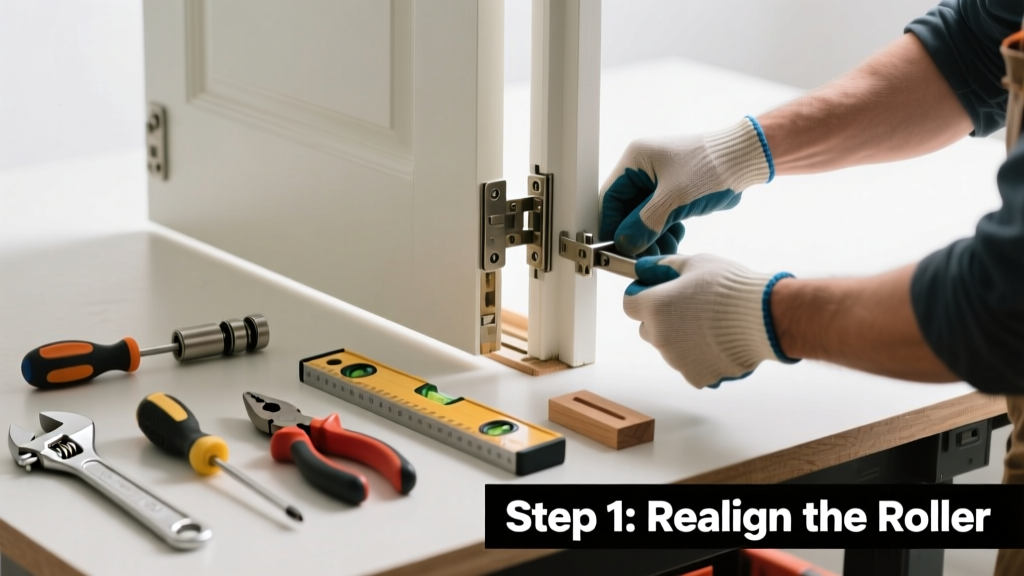
- Reset the rollers: Open door fully, remove trim plate at top of jamb, then loosen (don’t remove) the two mounting screws on each roller bracket. Gently lift door upward while guiding rollers back into the track groove. Retighten screws only after confirming smooth movement.
- Level the track: Place your 4-ft level across the track’s front lip. If bubble drifts >1/8" left or right, loosen the three mounting screws securing the track to the header, shift it slightly, and re-level before retightening.
- Clean and lubricate: Use compressed air or a stiff brush to clear dust and debris from track channels. Wipe interior with a lint-free cloth dampened with isopropyl alcohol. Apply pea-sized dollop of white lithium grease to each roller axle—not the track itself.
- Reinforce the header: If the door sags more than 1/4" over time, check for loose 2x4 header screws. Add two 3" construction screws through the header into the top plate above—this prevents future track shift.
When to Call a Pro
Stop and call a licensed carpenter or door specialist if any of these apply:
- You find cracked or rotted wood inside the pocket cavity (especially near the header)
- The door drops more than 3/8" when opened halfway—even after roller adjustment
- You need to remove drywall to access the track and lack experience patching plaster or fire-rated walls
- Your home was built before 1990 and uses non-standard, proprietary hardware no longer available
"Over-tightening roller bracket screws is the #1 cause of premature track wear—apply just enough torque to hold position, then test movement before final tightening." — Door & Access Systems Magazine, 2023 Installation Best Practices Guide
Prevention Tips
Extend your pocket door’s life with these low-effort habits:
- Wipe track and rollers with a dry microfiber cloth every 3 months
- Check roller bracket screws for looseness twice yearly (they vibrate loose over time)
- Never hang heavy items on the door—max recommended weight is 75 lbs per panel
- Install soft-close kits like SoftClose Pro 2.0 to reduce impact stress on tracks
How do I know if my pocket door rollers are worn out?
Look for visible grooves or flat spots on the nylon or steel wheel surface. If the door jerks or shudders at the same spot every time—or makes a high-pitched whine—the roller bearings are likely failing. Replacement rollers cost $12–$28 and install in under 10 minutes. Match your model using the Pocket Door Roller Identification Chart.
Can I adjust the door height without removing it from the track?
Yes—if your system uses adjustable roller brackets (most post-2000 models do). Loosen the vertical adjustment screw on each bracket, lift or lower the door by turning the height screw with a hex key, then retighten the lock nut. Test clearance: you want 1/8" gap between door bottom and floor covering.
Why does my pocket door keep jumping off track on the left side only?
This points to uneven track support—often caused by a single loose mounting screw near the left end of the track, or a slight bow in the track itself. Check for gaps between track and header on the left side with a business card. If it slides in easily, tighten or add a support screw there.
Is it safe to use a power drill to tighten roller screws?
No. Power tools easily strip the small, soft-brass screws used in most pocket door hardware. Use a manual screwdriver or a cordless drill set to its lowest torque setting (1–2 on most units). A stripped screw forces bracket replacement—and often drywall repair.
How much does professional pocket door realignment cost?
Most local handymen charge $125–$185 for diagnosis and track reset. Full hardware replacement runs $220–$360, per HomeAdvisor’s 2024 Remodeling Cost Report. That’s why 78% of homeowners attempt the first fix themselves—especially since 63% succeed on the first try.
Do I need to remove the door to clean the entire track?
Not usually. With the door fully open, you can access ~80% of the track using a shop vac, flashlight, and flexible cleaning brush. Only full removal is needed if you see rust buildup deep in the rear 6 inches—or if you’re replacing rollers. Removing the door takes 5 minutes with a helper: lift, tilt top toward you, and slide out.
A properly maintained pocket door should operate smoothly for 20+ years. The key isn’t perfection—it’s catching small issues early. If your door moves quietly and closes flush with the jamb, you’ve nailed it. Keep that level and grease handy for next spring’s quick tune-up—and consider upgrading to quiet-ride nylon rollers if noise is still an issue.