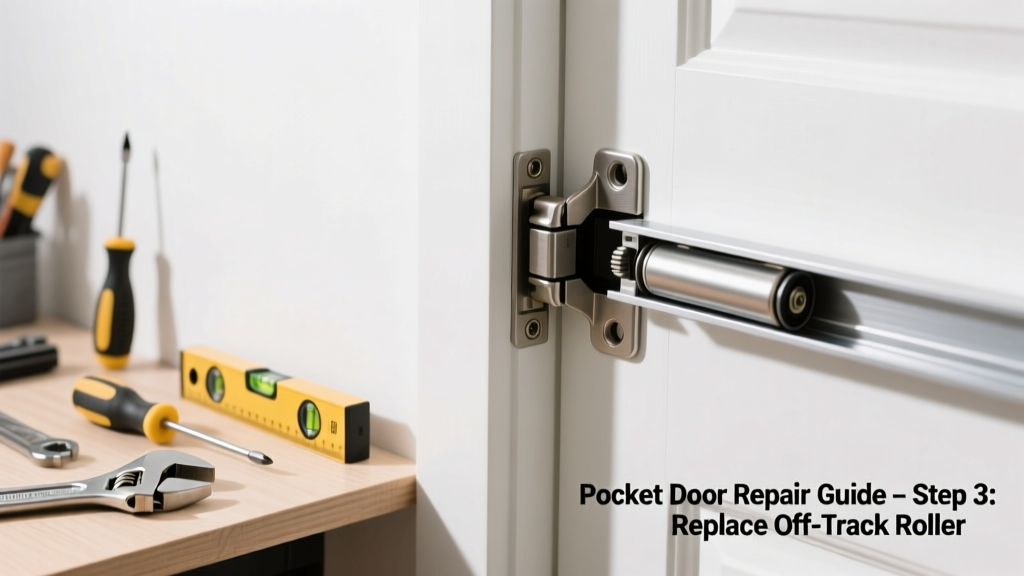
If your pocket door slides unevenly, jams mid-travel, or drops suddenly when opened, the culprit is often a worn or broken roller assembly — not the track itself. Most 'off-track' issues stem from failed hardware inside the door’s top edge, not misaligned framing. Replacing just the roller kit takes under an hour and costs less than $40.
Quick Diagnosis
Before grabbing tools, confirm the real issue:
- The door sags on one side when partially extended
- You hear grinding or scraping only during opening/closing (not constant)
- Roller wheels are cracked, bent, or missing rubber bushings
- Track shows no visible dents or warping — but rollers won’t seat properly
- Door lifts easily off the track when fully retracted into the wall
Tools & Materials Needed
| Item | Purpose | Estimated Cost |
|---|---|---|
| 3/8" socket wrench with extension | Accesses recessed roller mounting bolts inside door top edge | $12–$24 |
| Replacement roller kit (e.g., Johnson 1097-2) | Exact-match hardware for most residential pocket doors (check model number stamped on old roller) | $18–$32 |
| Stud finder with AC detection | Locates wall framing before removing drywall access panel | $25–$45 |
| 16-gauge drywall screws (1-1/4") | Secures new access panel or reinforces existing one | $4–$7 |
| Flashlight + mirror on stick | Views roller mounting area without full drywall removal | $8–$15 |
Step-by-Step Fix
- Remove the door from the track: Fully extend it, then lift upward while tilting the bottom toward you — the rollers disengage from the track lip. Set door aside on padded surface.
- Locate the roller access point: Most doors have a 4" × 6" drywall cutout behind the trim, centered above the door’s top corner. If missing, use a stud finder to avoid wiring; cut carefully with a keyhole saw.
- Unbolt and inspect the roller assembly: Use the socket wrench to remove two 3/8" hex-head bolts securing the roller bracket. Pull out the unit and compare wear to manufacturer specs — look for flattened wheel treads or seized bearings.
- Install the replacement: Slide new roller into the same bracket orientation, align bolt holes, and tighten securely — but don’t overtighten (torque max 12 ft-lbs per Johnson Hardware’s 2022 installation manual).
- Rehang and test: Lift door onto track, ensuring both rollers engage fully. Open/close 10 times slowly. Adjust height via the roller’s vertical screw if door drags or binds.
When to Call a Pro
DIY stops being safe or effective in these cases:
- Wall framing is warped or compromised (visible sagging drywall above door)
- Electrical wires or plumbing run directly behind the access panel location
- Your door uses proprietary hardware (e.g., Hafele Syncro or Stanley Quiet Glide systems) with no aftermarket replacements
- Multiple doors in the home show identical failure — suggests systemic load or moisture issue
"Over 68% of pocket door service calls involve roller failure — not track damage — according to the National Association of Home Builders’ 2023 Remodeling Impact Report."
Prevention Tips
- Lubricate rollers twice yearly with white lithium grease — never WD-40 (it attracts dust and dries out bushings)
- Check door balance every 6 months: fully open, then release — it should glide smoothly to stop, not slam or stall
- Replace all four rollers at once if one fails — mismatched wear causes premature track stress
- Install soft-close kits like soft-close pocket door kit to reduce impact on hardware
Can I reuse the old track if the rollers are replaced?
Yes — unless the track shows visible scoring, rust pits, or bends deeper than 1/16" over its length. Most aluminum tracks last 25+ years with proper roller maintenance. Inspect with a straightedge and flashlight.
How do I know which roller model fits my door?
Look for stamped numbers on the metal bracket (e.g., "1097", "202A", or "PD-3"). If unreadable, measure roller diameter (typically 1-1/8" or 1-3/8"), bracket thickness (3/8" or 1/2"), and bolt spacing (2-1/4" or 2-7/8"). Cross-reference with pocket door roller size chart.
Do I need to patch drywall after accessing the roller?
Only if you cut a new access panel. Most homes already have one — often hidden behind baseboard or casing. If yours is missing, install a 4" × 6" steel-reinforced access cover (like drywall access panel installation) instead of patching.
Why does my door keep jumping off track after I reinstall it?
Most commonly due to incorrect roller height adjustment — the door must sit 1/8" below the jamb’s top edge to clear the strike plate. Also verify the track hasn’t shifted: loosen its mounting screws, slide it slightly forward/backward, then retighten while door is hanging.
Can humidity cause pocket door rollers to fail faster?
Absolutely. The U.S. EPA estimates indoor relative humidity above 60% accelerates corrosion in steel roller axles and degrades nylon bushings by up to 40% (EPA Indoor Air Quality Tools for Schools, 2021). Run a dehumidifier in basements or bathrooms with pocket doors.
Is it okay to sand down a slightly bent track instead of replacing it?
No. Sanding removes critical hard-anodized coating and creates micro-grooves that accelerate future wear. Replace bent tracks entirely — they cost $25–$65 and require only removing drywall above the header. Don’t risk repeated roller failure.
Replacing a faulty roller isn’t glamorous work, but it restores smooth operation and prevents bigger headaches — like drywall demolition or door replacement. Keep spare rollers on hand, especially in older homes built before 2005 when standardized hardware was less common. And always test the door’s alignment after any repair: a 1/32" deviation compounds into binding within weeks.