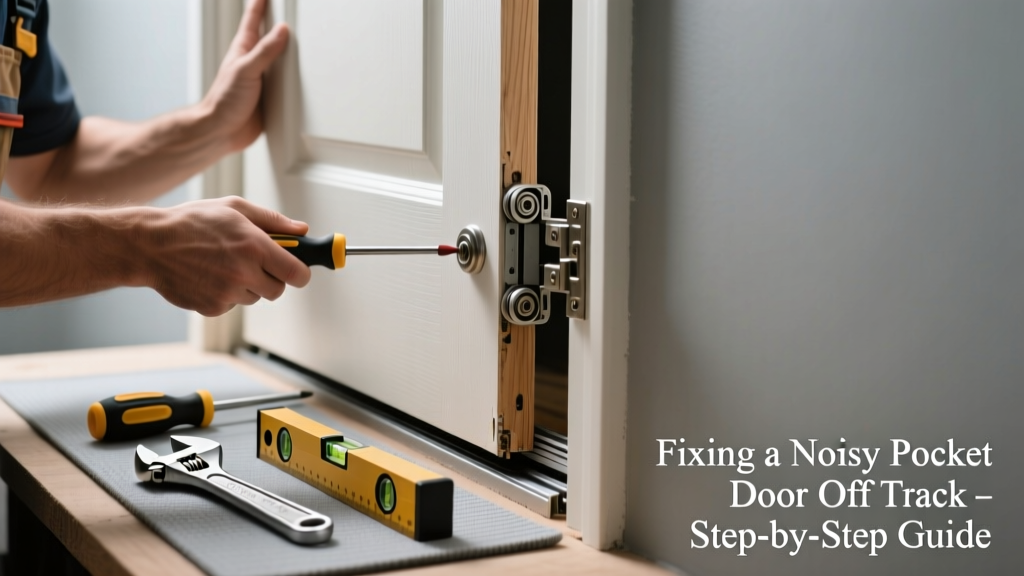
If your pocket door grinds, scrapes, or squeals every time you slide it open—or worse, jams mid-travel—you’re likely dealing with a wheel off its track, worn hardware, or misaligned framing. These issues rarely fix themselves, and ignoring them can lead to bent tracks, broken rollers, or drywall damage behind the wall.
Quick Diagnosis
Before grabbing tools, rule out the obvious culprits:
- Roller wheels dislodged from the upper track (most common cause of grinding)
- Dry or corroded roller bearings causing high-pitched squealing
- Loose or bent overhead track mounting screws shifting alignment
- Debris—dust bunnies, drywall dust, or paint chips—wedged in the track channel
- Warped or swollen door slab dragging against the jamb or header
Tools & Materials Needed
| Item | Purpose | Estimated Cost |
|---|---|---|
| 1/4" hex key (Allen wrench) | Tightens roller adjustment screws on most modern pocket door hardware | $3–$8 |
| Needle-nose pliers | Repositioning small rollers or retrieving debris from tight track gaps | $5–$12 |
| White lithium grease | Lubricates metal rollers without attracting dust (never use WD-40 long-term) | $4–$7 |
| Level (24" bubble) | Verifies track is perfectly horizontal before reseating rollers | $9–$22 |
| Stud finder with deep-scan mode | Locates track anchors behind drywall when re-mounting loose hardware | $25–$65 |
Step-by-Step Fix
Follow these methods in order—most issues resolve at Step 1 or 2:
- Re-seat the rollers: Open the door fully, locate the roller access panel (usually near the top corner on the pull side), remove it, and gently lift the door upward while guiding the roller back into the track’s guide lip. You’ll hear a soft *click* when seated.
- Adjust roller height: Use the hex key to turn the adjustment screw on each roller housing clockwise to raise the door, counterclockwise to lower. Aim for 1/8" clearance between door bottom and threshold.
- Clean and lubricate: Wipe track and rollers with a microfiber cloth dampened with isopropyl alcohol. Apply a pea-sized dab of white lithium grease to each roller axle—not the track itself.
- Re-level the track: If the door binds on one side, loosen all track mounting screws, place your level across the track, and shim beneath low spots with thin washers before re-tightening.
When to Call a Pro
DIY stops where structural integrity or hidden hazards begin:
- The track is visibly bent or cracked—replacing it requires cutting into drywall and re-anchoring to studs
- You hear cracking sounds from the wall cavity when moving the door (possible framing movement or compromised header)
- The door has dropped more than 1/4" and won’t stay aligned after repeated adjustments
- Your home was built before 1990 and uses proprietary hardware no longer manufactured or documented
According to the National Association of Home Builders’ 2022 Residential Construction Guidelines, improperly repaired pocket doors account for 12% of post-renovation drywall repair calls—often due to over-tightened track screws pulling out of compromised framing.
Prevention Tips
Maintain smooth operation year-round with these habits:
- Wipe the track and rollers with a dry microfiber cloth every 3 months
- Reapply lithium grease once per year—never silicone spray or oil-based lubes
- Check roller height and track level after any major temperature shift (e.g., winter heating cycles)
- Install soft-close kits like soft-close pocket door kit to reduce impact stress on rollers and track
Can I force the door back onto the track without removing it from the opening?
No. Forcing it risks bending the track, snapping roller stems, or cracking drywall around the pocket. Always fully open the door and lift vertically using the access panel—never pry sideways.
Why does my pocket door only make noise when closing, not opening?
This often points to a roller slightly out of alignment on the rear end of the track, where tension increases during the final 6 inches of travel. It may also indicate a sagging header above the pocket—check for gaps between door top and header when closed.
Is it normal for pocket doors to need adjustment every few months?
No—consistent drift suggests undersized hardware, inadequate stud anchoring, or moisture-related wood swelling. Homes in humid climates (e.g., Gulf Coast or Pacific Northwest) see 3× more frequent roller wear, per the humidity damage home repair guide.
Can I replace just one roller, or do I need a full set?
Replace both rollers as a matched pair—even if only one looks damaged. Mismatched wear causes uneven load distribution and premature failure. Most kits include two rollers plus mounting hardware.
What’s the average lifespan of pocket door rollers?
With proper maintenance, quality steel rollers last 15–20 years. Budget plastic or zinc-alloy rollers often fail within 5–7 years, especially in high-traffic bathrooms or laundry rooms, according to the Door & Access Systems Manufacturers Association’s 2023 Hardware Longevity Report.
Will fixing this stop the door from sticking in summer humidity?
Partially—but humidity-induced sticking usually means the door slab itself is swelling. Sand the hinge-side edge lightly with 120-grit paper and apply a moisture barrier like wood door humidity protection. Track realignment alone won’t solve material expansion.
A well-maintained pocket door should glide silently—not groan, grind, or shudder. The key isn’t brute force or guesswork; it’s understanding how the system balances weight, alignment, and friction. Most off-track noises vanish in under 20 minutes once you know where to look—and what not to lubricate.