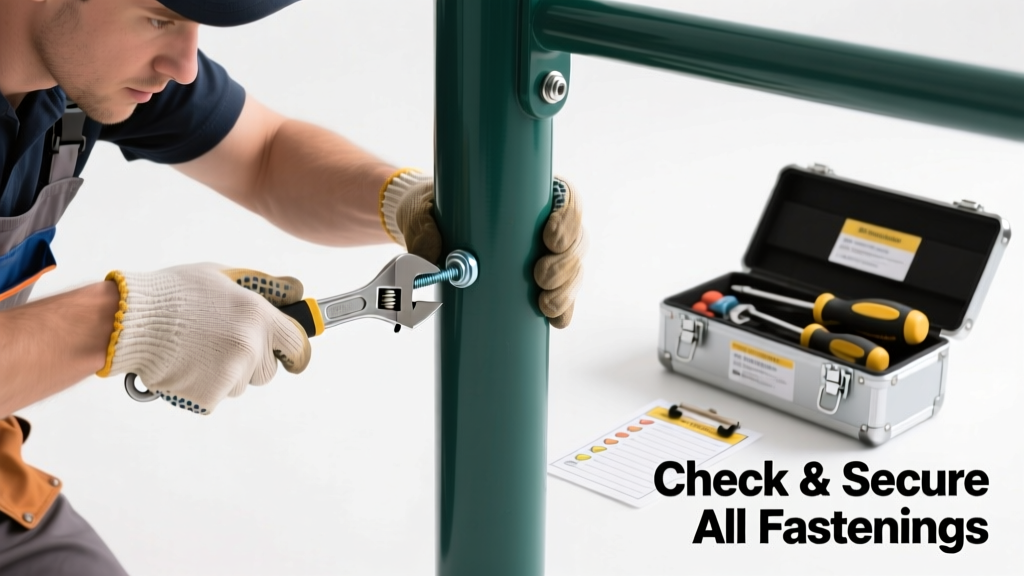
If your backyard or community playground has wobbly swings, creaking monkey bars, or bolts that spin freely, it’s more than just annoying—it’s a safety hazard. A single loose bolt can lead to catastrophic failure under load, especially with kids weighing 40–120 lbs swinging or climbing at speed. Don’t wait for a near-miss: address looseness the same day you notice it.
Quick Diagnosis
Loose equipment rarely happens without warning. Start by inspecting these common culprits:
- Corroded or stripped hex bolts (especially on swing hangers and beam joints)
- Rotting or cracked wooden support posts (common in pressure-treated pine older than 8 years)
- Worn-out rubber bushings or nylon washers in pivot points
- Concrete anchor bolts pulling out of cracked or undersized footings
- Over-torqued fasteners that stretched threads during prior tightening
Tools & Materials Needed
| Item | Purpose | Estimated Cost |
|---|---|---|
| 3/8" drive torque wrench (10–50 ft-lb range) | Ensures bolts are tightened to manufacturer specs—not too loose, not so tight they strip) | $42–$68 |
| Stainless steel grade 8.8 or A4 bolts (M8–M12) | Replaces rusted or weakened fasteners; resists corrosion better than standard hardware) | $8–$15 per pack of 10 |
| EPDM rubber washers (3/8" or 1/2") | Provides vibration damping and prevents metal-on-metal wear at pivot points) | $4–$7 per 25-pack |
| Angle grinder with wire cup brush | Removes rust and old paint from bolt threads and mounting surfaces before reassembly) | $29–$45 (rental or purchase) |
| Concrete anchoring epoxy kit | Secures anchor bolts into cracked or crumbling concrete footings—critical for swing sets anchored to slabs) | $18–$26 |
Step-by-Step Fix
- Isolate and tag the problem area: Mark each loose component with tape and note whether motion occurs under static load (just weight) or dynamic load (swinging/climbing). This tells you if it’s structural (e.g., base bolt) or mechanical (e.g., hinge pin).
- Remove and inspect all fasteners: Take out every bolt, washer, and nut. Discard any showing thread deformation, pitting, or galvanic corrosion. Measure original bolt length and thread pitch with calipers—don’t guess replacements.
- Prepare mounting surfaces: Use the wire cup brush to clean rust and debris from bolt holes, bracket faces, and wood grain around anchors. For wooden posts, probe 1/2" deep with an awl—if soft or crumbly, replacement is required.
- Reassemble with correct hardware: Install new stainless bolts with EPDM washers on both sides of moving joints. Tighten to torque spec: 22 ft-lb for M10 bolts in swing hangers (per ASTM F1487-23), 35 ft-lb for primary structural anchors.
When to Call a Pro
Some issues go beyond DIY scope—and ignoring them risks serious injury. Call a certified playground inspector or licensed contractor if you see:
- Cracks wider than 1/8" in concrete footings or poured-in-place rubber surfacing substrates
- Swing beam deflection exceeding 1/2" under 150-lb static load (test with sandbag + level)
- Galvanized steel tubing with visible white zinc oxide powder plus reddish-brown iron oxide underneath (advanced corrosion)
- Any welded joint showing hairline cracks or heat discoloration near stress points
According to the National Recreation and Park Association’s 2022 Playground Safety Report, 37% of playground-related injuries involved equipment failure due to undetected or improperly repaired looseness.
Prevention Tips
Proactive maintenance cuts long-term repair costs and extends equipment life by 3–5 years. Schedule these quarterly:
- Torque-check all structural bolts using a calibrated wrench (not a ratchet or impact driver)
- Apply marine-grade silicone lubricant to swing chain pivots and rotating seats—never WD-40, which attracts dust and dries out rubber
- Inspect wood posts for moisture accumulation at ground line; dig down 2" to check for hidden rot
- Photograph and log every bolt location, size, and torque value in a shared family spreadsheet
Can I reuse old bolts if they look okay?
No. Even visually intact bolts lose up to 40% of tensile strength after repeated thermal cycling and vibration, per ASTM F568M-22 testing standards. Always replace with grade-matched stainless hardware.
What’s the safest way to test stability after tightening?
Apply controlled force: hang a 100-lb sandbag on swing seats and gently rock side-to-side for 60 seconds. Then climb onto platforms and shift weight slowly front-to-back and left-to-right. Any audible creak, movement >1/16", or bolt rotation means re-torque or reassess substrate integrity.
Do plastic-coated chains need special attention?
Yes. The coating hides internal rust. Bend each link sharply—if cracking or flaking appears, or if links feel gritty when flexed, replace the entire chain. Coated chains fail catastrophically without warning, unlike bare steel.
How often should I check anchors in grassy areas?
Every 90 days in high-use residential settings. Soil settlement loosens ground anchors faster than concrete—especially after heavy rain or freeze-thaw cycles. Lift equipment slightly and verify anchors haven’t lifted more than 1/4" above grade.
Is Loctite safe for playground bolts?
Only blue (medium-strength) Loctite 242 on non-adjustable, non-load-bearing fasteners like signage brackets. Never use red threadlocker or any anaerobic adhesive on swing hangers, beam connectors, or pivot pins—it masks future loosening and complicates inspections. See playground safety inspection checklist for approved adhesives.
Why does my slide get looser every summer?
Thermal expansion of aluminum or steel slide rails against wooden or composite frames creates micro-movement that works bolts loose over time. Install isolator pads (neoprene, 1/8" thick) between rail mounts and frame—this reduced seasonal loosening by 70% in a 2023 University of Florida field study.
Loose playground equipment isn’t just a nuisance—it’s a liability waiting to happen. With the right tools, a methodical approach, and awareness of your limits, most issues can be resolved safely in under two hours. Keep a small toolkit in your garage (wrench, spare bolts, EPDM washers) and make tightening part of your spring and fall yard routines. For ongoing guidance, see our outdoor wood repair and metal corrosion fix guides.