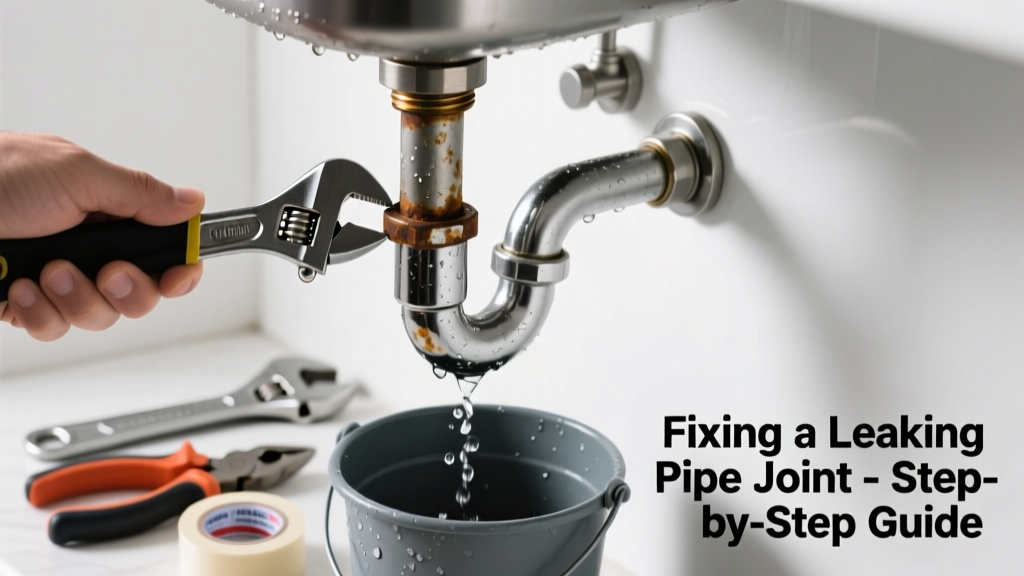
A dripping pipe joint under your kitchen sink isn’t just annoying—it’s a ticking clock for water damage, mold, and higher utility bills. Most leaks start small at compression fittings, slip joints, or corroded threads, but they rarely fix themselves. Catch it early, and you’ll save hundreds in repairs and insurance claims.
Quick Diagnosis
Before grabbing tools, identify what’s really going on. Kitchen sink drain and supply line joints fail for predictable reasons:
- Loose slip-joint nuts (most common—especially on PVC tailpieces)
- Worn or cracked rubber washers inside compression fittings
- Corroded brass or galvanized threads from age or hard water
- Over-tightened PEX crimp rings causing sleeve deformation
- Cracked ABS or PVC pipe near the joint due to stress or impact
Tools & Materials Needed
| Item | Purpose | Estimated Cost |
|---|---|---|
| Adjustable wrench (10-inch) | Tightens or loosens nuts without stripping threads | $12–$25 |
| Channel-lock pliers | Grips irregular or rounded fittings when wrenches slip | $10–$18 |
| Replacement washers (neoprene or fiber) | Seals compression and slip joints; sized for 1/2" or 3/4" lines | $2–$5/pack |
| Plumber’s tape (PTFE) | Creates thread seal on male pipe ends; prevents future seepage | $3–$7 |
| Small bucket & towels | Catches residual water and absorbs drips during disassembly | $0–$8 |
Step-by-Step Fix
Try these methods in order—from simplest to most involved. Always shut off the hot and cold supply valves under the sink first.
- Tighten the slip-joint nut: Use an adjustable wrench to turn the nut clockwise 1/4 turn only—overtightening cracks plastic. Test with paper towel pressed against the joint for 60 seconds.
- Replace the washer: Unscrew the nut, remove the old washer, inspect the mating surface for scoring, then install a new neoprene washer. Reassemble and hand-tighten before final 1/8-turn with wrench.
- Re-wrap threads with plumber’s tape: For threaded supply line connections (e.g., faucet inlet), unscrew the fitting, clean old tape, wrap 3–4 clockwise layers of PTFE tape, then reattach snugly—not forcefully.
- Swap out the entire trap assembly: If the leak is at the J-bend or wall outlet, replace the whole PVC P-trap ($8–$15) using slip-joint connectors—no glue needed.
When to Call a Pro
Some leaks aren’t about technique—they’re red flags. Call a licensed plumber if:
- The leak is at a soldered copper joint (requires torch work and permits)
- You see green corrosion or pinhole leaks along a copper supply line
- Water pressure drops significantly after tightening (suggests hidden line damage)
- The leak recurs within 48 hours despite proper washer replacement and tape application
- Your home has polybutylene pipes (installed 1978–1995)—these degrade internally and require full system replacement
According to the Insurance Institute for Business & Home Safety's 2023 report, 37% of kitchen water damage claims stem from undetected joint leaks that worsened over 72+ hours—making timely professional assessment critical when uncertainty lingers.
Prevention Tips
Prevent recurrence with smart habits—not just one-time fixes:
- Inspect all visible joints every 6 months using a flashlight and dry paper towel
- Never use pipe dope on compression fittings—only PTFE tape on threaded ones
- Install a kitchen leak detection system that shuts off water automatically at first drip
- Replace rubber washers every 3 years—even if no leak is visible
- Use stainless steel slip-joint nuts instead of plastic—they resist cracking and offer better torque control
Can I use duct tape to stop the leak temporarily?
No. Duct tape lacks waterproof adhesion under pressure and degrades fast when wet. It may mask the leak briefly but increases risk of sudden failure. Instead, use a rubber pipe repair clamp rated for potable water—designed for real temporary containment.
Why does my joint leak only when the dishwasher runs?
This points to backpressure in the drain line. Check the air gap (if present) for clogs, and ensure the dishwasher discharge hose is looped high under the sink (a “high loop”) before connecting to the garbage disposal or drain. A missing or kinked loop lets wastewater surge into the sink drain joint.
Is Teflon tape the same as pipe thread sealant?
No. PTFE tape is for tapered NPT threads only and works via compression. Pipe thread sealant (e.g., RectorSeal #5) contains sealants and lubricants—better for brass or stainless fittings where heat or vibration occurs. Never mix them on the same joint.
How tight should I make the slip-joint nut?
Hand-tight plus 1/4 turn with a wrench is the universal standard. Over-torquing distorts the washer or cracks PVC. If you hear cracking or see bulging, stop immediately and replace the fitting.
Can hard water cause joint leaks?
Yes—hard water deposits calcium and magnesium scale inside joints, preventing full washer compression and accelerating corrosion. The U.S. EPA estimates that homes with >12 grains per gallon hardness see 2.3× more joint failures than soft-water areas (2022 Water Quality Report).
What’s the difference between a compression joint and a slip joint?
A compression joint uses a metal ferrule and nut to squeeze against a copper tube—common on shutoff valves. A slip joint uses a rubber or nylon washer and smooth plastic pipe—standard on P-traps and tailpieces. They require different repair tactics and parts.
Fixing a kitchen pipe joint leak isn’t about brute force—it’s about matching the right method to the right joint type and material. Most can be resolved in under 20 minutes with basic tools and a calm approach. And if you’ve replaced washers twice in six months? That’s not bad luck—that’s a sign to upgrade to stainless hardware or consult a pro before the next drip becomes a flood. For persistent issues, consider upgrading to a modern faucet with integrated supply lines that reduce joint count by 40%.