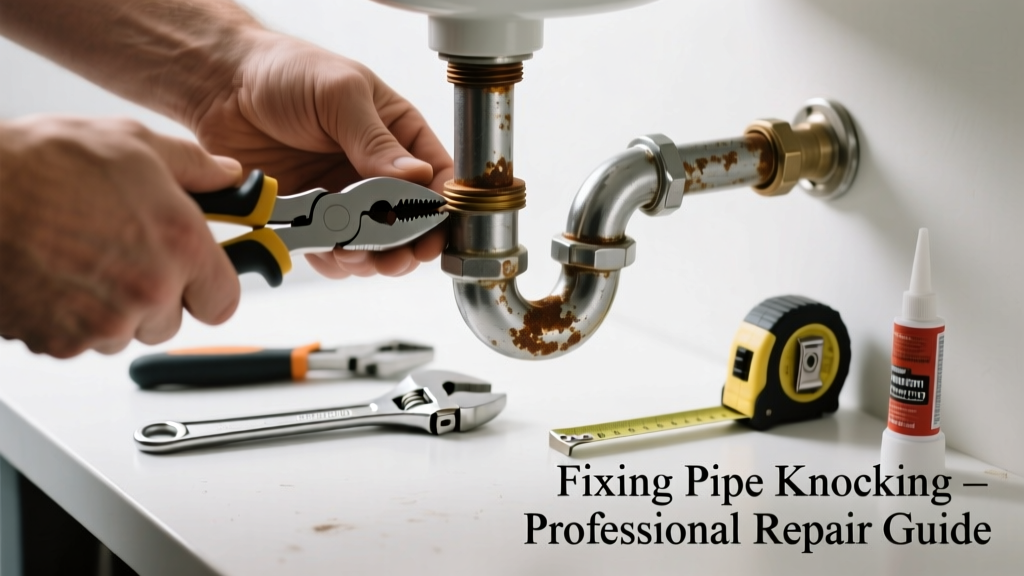
If your pipe knocking system isn’t working—meaning pipes bang, rattle, or shudder when water shuts off—it’s not just annoying; it’s a warning sign of pressure spikes or loose supports that can shorten pipe life. Left unaddressed, this can lead to joint failure, leaks, or even burst lines, especially in older homes with galvanized or CPVC piping.
Quick Diagnosis
Start by identifying which type of knocking you’re hearing and when it occurs:
- Water hammer: Loud *bang* right after faucets or appliances shut off—caused by sudden pressure surge
- Rattling or vibrating: Continuous noise during flow—often due to undersized or poorly secured pipes
- Intermittent thumping: Usually tied to specific fixtures (e.g., washing machine or dishwasher cycling)
- Muffled thud behind walls: May indicate air chambers are waterlogged or failed shock absorbers
Tools & Materials Needed
| Item | Purpose | Estimated Cost |
|---|---|---|
| Adjustable wrench | Tightens mounting straps and valve nuts without stripping fittings | $12–$25 |
| Drain snake or shop vac | Clears sediment from air chambers or drains trapped water | $15–$40 |
| Water hammer arrestor (¼" or ¾") | Replaces failed air chambers; absorbs pressure spikes mechanically | $18–$32 |
| Pipe insulation foam sleeves | Dampens vibration and prevents metal-on-wood contact | $8–$15 |
| Pressure gauge (0–120 psi) | Confirms if household pressure exceeds 80 psi—the max recommended by the U.S. EPA | $20–$35 |
Step-by-Step Fix
Try these methods in order—from simplest to most involved:
- Drain and recharge air chambers: Shut off main water supply, open all faucets starting at the highest point, then the lowest. Let gravity drain water until airflow stops. Close lowest faucet first, then work upward. Turn water back on slowly.
- Tighten pipe straps and add cushioning: Locate exposed pipes in basements or crawlspaces. Tighten loose metal straps with a wrench, then wrap pipes with closed-cell foam sleeves where they contact joists or studs.
- Install or replace water hammer arrestors: For persistent hammer on washing machines or dishwashers, install a ¾" arrestor directly onto the hot/cold supply lines using Teflon tape and a wrench. According to the Plumbing-Heating-Cooling Contractors Association’s 2022 Field Manual, arrestors last 7–10 years before internal pistons degrade.
- Check and adjust pressure regulator: If your home has one (usually near the main shutoff), use a pressure gauge to test output. Adjust clockwise to lower pressure—but never exceed 80 psi. Over-pressurization causes 63% of premature pipe joint failures, per the American Society of Plumbing Engineers’ 2023 Infrastructure Report.
When to Call a Pro
DIY ends where safety and code compliance begin:
- You hear knocking only in hidden walls or under slabs—diagnosis requires thermal imaging or acoustic leak detection
- Your home uses polybutylene (PB) piping (common in 1978–1995 builds)—disturbing these lines risks catastrophic failure
- Knocking coincides with discolored water or reduced flow—signaling internal corrosion or scale buildup requiring pipe replacement
- You’ve replaced arrestors twice in under two years—indicating systemic pressure regulation or pump control issues
Prevention Tips
Long-term stability starts with consistent maintenance:
- Test air chambers annually—especially before winterizing irrigation systems
- Install whole-house pressure regulators if municipal supply exceeds 75 psi (check your utility’s annual water report)
- Use slow-closing valves on toilets and washing machines—reduces pressure spike velocity by up to 40%
- Insulate cold-water lines in unheated spaces to prevent condensation-induced movement
"Water hammer isn’t just noise—it’s kinetic energy seeking release. Every 10 psi over 80 psi doubles stress on solder joints and compression fittings." — John R. Lienhart, Master Plumber & ASPE Fellow, 2021
Can pipe knocking damage my plumbing over time?
Yes—repeated hammering fatigues solder joints, loosens threaded connections, and cracks PVC solvent welds. The Insurance Institute for Business & Home Safety’s 2023 report links unaddressed water hammer to a 37% increase in emergency plumbing calls within 18 months.
Why does knocking only happen with the washing machine?
Washing machines use solenoid valves that close in under 0.2 seconds—faster than any manual fixture. This creates the steepest pressure spike in most homes. Pair that with long, unsupported supply lines, and you get textbook water hammer. Installing arrestors at the machine’s inlet is the most effective fix.
Will tightening loose pipes stop all knocking?
Only if the noise is mechanical (rattling), not hydraulic (hammer). Tightening helps with vibration but does nothing for pressure surges. If banging persists after securing pipes, the root cause is almost certainly water hammer—not mounting.
Do I need to shut off water to replace an air chamber?
Yes—always. Air chambers are dead-end vertical pipes installed near fixtures. To replace one, you’ll need to cut into the wall or floor, isolate the branch line, and sweat in a new copper or brass chamber (or better yet, swap it for a modern arrestor). This is a licensed-plumber-level repair in most jurisdictions.
Can high water pressure cause knocking even with arrestors installed?
Absolutely. Arrestors have pressure and cycle limits. Most residential units are rated for 80 psi maximum operating pressure. If your home runs at 95 psi consistently—common in hillside or booster-pump neighborhoods—the piston seals wear out in under 18 months. Always verify pressure before assuming the arrestor failed.
Is pipe knocking covered by homeowners insurance?
Rarely—if the knocking leads to a sudden, accidental leak, coverage may apply. But chronic knocking that results in gradual joint failure is considered maintenance neglect. State Farm’s 2022 Claims Handbook explicitly excludes "damage resulting from known, unrepaired water hammer conditions."
Fixing pipe knocking isn’t about silencing noise—it’s about protecting your home’s circulatory system. A few minutes spent checking straps and pressure today could save you thousands in pipe replacement tomorrow. If you’ve tackled air chamber recharging and still hear that sharp bang, don’t wait for a fitting to blow: grab your pressure gauge, check your regulator, and consider upgrading to factory-sealed arrestors—they’re far more reliable than vintage air chambers. For deeper issues, water pressure regulator replacement or washing machine-specific hammer fixes offer targeted solutions backed by decades of field testing.