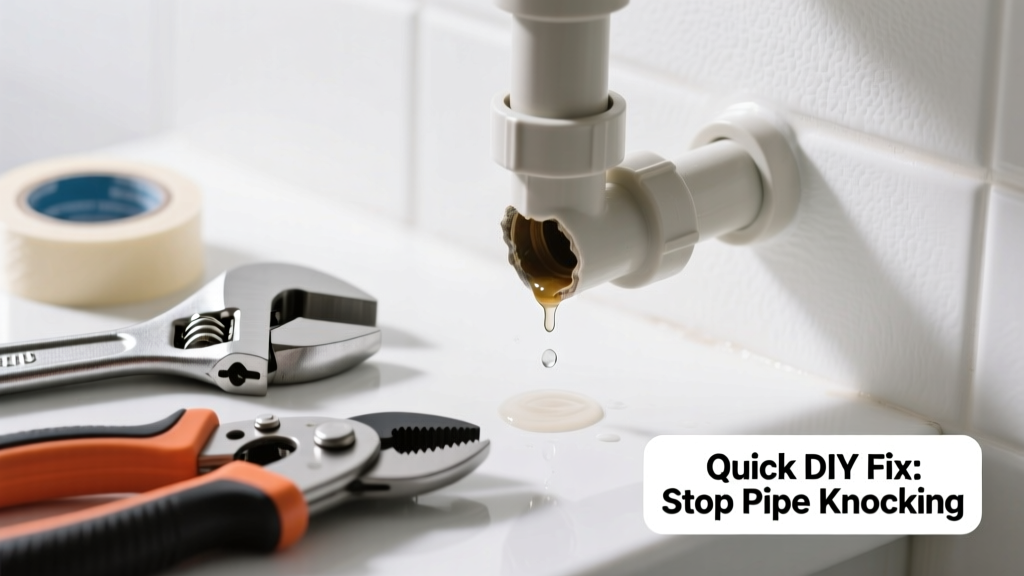
That sharp 'bang' or rhythmic 'knock' when you turn off the bathroom faucet or flush the toilet isn’t just annoying—it’s a warning sign. Pipes shouldn’t sound like a drumline every time water flow stops. Left unaddressed, knocking can loosen joints, damage fixtures, or even lead to leaks over time.
Quick Diagnosis
Start by identifying the pattern and timing of the noise:
- Knocking immediately after shutting off a valve? Likely water hammer.
- Knocking during water flow (e.g., while showering)? Points to loose mounting straps or pipe expansion against framing.
- Intermittent knocking only with hot water? Suggests thermal expansion in copper or PEX lines rubbing against joists.
- Knocking that worsens after replacing a faucet or installing new hardware? Often due to oversized or high-velocity flow cartridges.
Tools & Materials Needed
| Item | Purpose | Estimated Cost |
|---|---|---|
| Adjustable wrench | Tightens mounting straps and compression fittings without stripping | $12–$25 |
| Insulation foam sleeves (3/4" ID) | Buffer pipes from wood framing and absorb vibration | $8–$15 per 6-ft roll |
| Water hammer arrestor (1/2" FIP) | Installed at fixture supply lines to absorb pressure spikes | $22–$38 |
| Strap-tightening kit (with lag screws & washers) | Secures pipes to wall studs or floor joists where original fasteners failed | $14–$20 |
Step-by-Step Fix
Try these methods in order—most issues resolve with the first two:
- Check and tighten pipe straps: Locate accessible supply lines under the sink or behind the toilet. Tighten loose metal or plastic straps using an adjustable wrench—but don’t overtighten; compressing PEX or copper can cause stress fractures.
- Install water hammer arrestors: Shut off main water, drain lines, then screw a 1/2" arrestor onto the hot and cold supply lines directly beneath each fixture (sink, toilet, shower valve). These contain air chambers that cushion hydraulic shock—critical if your home has older galvanized or rigid copper piping.
- Add insulation and isolation: Slide foam sleeves over exposed copper or PEX where pipes contact wood framing. For pipes running through drilled holes in studs, insert rubber grommets before reinserting the pipe to eliminate metal-on-wood contact.
- Reduce water velocity: If knocking persists, install a pressure-reducing valve (PRV) at the main line if household pressure exceeds 75 psi—measured with a gauge like the water pressure test tool. The U.S. EPA estimates that 14% of household water usage is from leaks caused by excessive pressure-related wear.
When to Call a Pro
Don’t risk it if you encounter any of these:
- Knocking occurs only after recent whole-house repiping—could indicate improper hanger spacing or missing expansion loops.
- You hear knocking deep inside walls or ceilings with no visible access points—may require infrared scanning or exploratory drywall cuts.
- Water pressure reads above 80 psi on multiple fixtures, and your PRV is nonfunctional or missing—licensed plumbers must install or replace PRVs in most municipalities per IPC 2021 Section 608.2.
- The noise coincides with discolored water or reduced flow—possible corrosion or sediment buildup requiring pipe descaling or replacement.
Prevention Tips
Long-term quiet starts with smart habits and upgrades:
- Install slow-closing faucet cartridges (look for "ceramic disc" or "quarter-turn" models rated for 1.0 GPM or less).
- Use flexible braided stainless steel supply lines instead of rigid copper—absorb minor movement and reduce transmission of shock.
- Insulate all hot-water lines within 3 ft of the water heater to minimize thermal expansion stress.
- Have your home’s water pressure tested annually—especially if you live in a municipal high-pressure zone like Denver or Chicago, where static pressure often hits 90+ psi.
"Water hammer energy can exceed 1,000 psi in under 0.02 seconds—enough to fracture solder joints or crack ceramic valves." — Plumbing Systems & Design Magazine, 2022
Can pipe knocking damage my bathroom fixtures?
Yes—repeated hydraulic shock accelerates wear on cartridge seals, solenoid valves in smart toilets, and thermostatic mixing valves in showers. A study by the American Society of Plumbing Engineers found that fixtures subjected to frequent water hammer fail 3.2× faster than those protected by arrestors.
Will tightening the shut-off valves stop the knocking?
No—overtightening shut-offs may damage the valve seat or stem packing but won’t address the root cause. In fact, partially closed valves increase water velocity and worsen hammer. Always use full-open or full-closed positions unless servicing.
Is pipe knocking more common in older homes?
Yes—homes built before 1985 often lack water hammer arrestors and use rigid galvanized or copper piping with minimal support spacing. According to the Insurance Institute for Business & Home Safety's 2023 report, 68% of pre-1975 homes show signs of undersupported plumbing.
Can I add arrestors to existing PEX lines?
Absolutely—use PEX-compatible arrestors with brass crimp or push-fit connections (e.g., SharkBite® or Viega PureFlow™). Install within 24 inches of the fixture’s shutoff valve for best results. Avoid threaded adapters on PEX—vibration can loosen them over time.
Why does knocking happen only with hot water?
Hot water causes pipes to expand—especially copper and CPVC—and rub against framing or brackets. Cold lines stay dimensionally stable. Thermal expansion accounts for ~40% of non-hammer knocking cases in bathrooms with tank-style heaters, per the 2021 ASPE Technical Handbook.
Do I need to shut off power before fixing this?
Only if working near electric water heaters, heated towel racks, or GFCI outlets. Standard supply-line work requires only water shutoff. But always verify no nearby circuits are live using a non-contact voltage tester—especially in older bathrooms with shared wall cavities.
Once you’ve addressed the source—whether it’s a loose strap, missing arrestor, or pressure issue—the silence will feel as satisfying as a perfectly sealed shower valve. Keep a log of water pressure readings and strap inspections every six months, and consider upgrading to pressure-balanced shower valves during your next bathroom renovation checklist. Small interventions now prevent costly repairs—and noisy mornings—down the line.