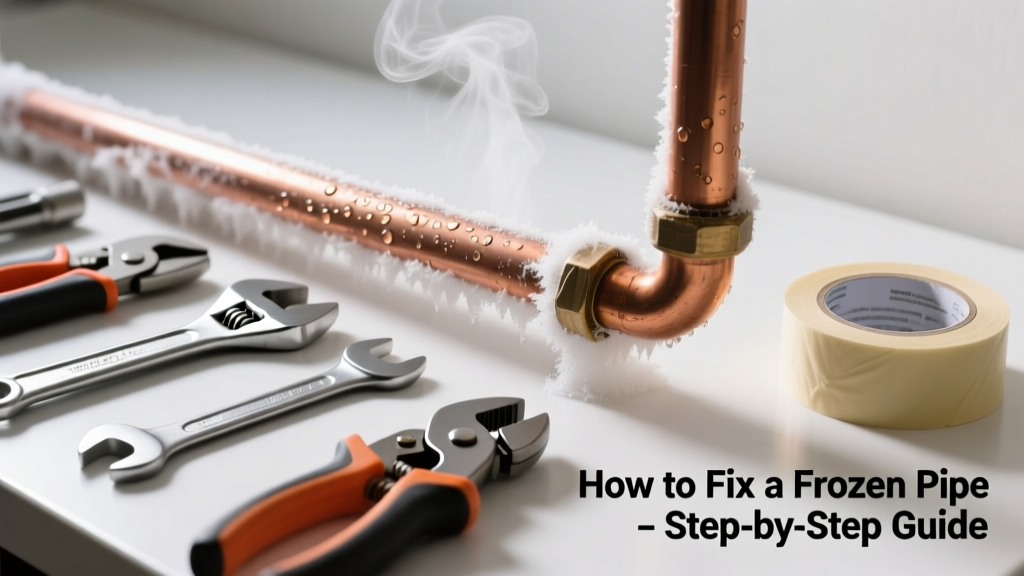
It’s 20°F outside, your faucet sputters, and no water comes out — classic frozen pipe behavior. But not all frozen pipes behave the same: some are fully blocked, others leak when thawing, and a few hide behind walls or under slabs. Acting fast prevents costly bursts and water damage.
Quick Diagnosis
Before grabbing tools, confirm it’s actually frozen — not a valve issue or main shutoff problem. Check these common causes first:
- Only one fixture is affected (e.g., just the kitchen sink), suggesting a localized freeze
- Frost or condensation visible on exposed pipe sections (basement, garage, crawl space)
- Unusual knocking or gurgling sounds when turning on taps
- No water flow but pressure remains in other parts of the house
- Recent outdoor temps below 20°F for >48 hours, especially with poor insulation
Tools & Materials Needed
| Item | Purpose | Estimated Cost |
|---|---|---|
| Heat lamp or infrared thermometer | Locate coldest pipe section without touching; confirms freeze location | $25–$65 |
| Electric heating tape (UL-listed) | Safely wraps pipe to thaw gradually; prevents overheating | $18–$32 |
| Hot towels + buckets | Manual conduction method for accessible copper or PEX lines | $5–$12 |
| Insulation sleeves (foam or fiberglass) | Re-insulate after thawing to delay future freezes | $3–$10 per 6-ft sleeve |
| Shop vacuum (wet/dry) | Remove standing water if pipe cracked during freeze | $60–$120 (rental: $25/day) |
Step-by-Step Fix
Start at the faucet and work toward the coldest point — never heat a closed-off section. Use only one method at a time:
- Open the faucet: Turn on the affected tap fully to relieve pressure and allow steam/air to escape as ice melts.
- Apply gentle heat: Wrap heating tape (set to low) or use a hair dryer on medium heat, moving constantly along 12-inch sections. Never use open flame or propane torches — copper can melt at 1,981°F, but PVC ignites at 752°F.
- Monitor progress: Check every 5 minutes. If water begins trickling, keep heat applied until flow normalizes (usually 20–45 min).
- If no flow after 60 minutes: Shut off main water supply, inspect for bulges or frost cracks, and proceed to when to call a pro.
When to Call a Pro
DIY thawing fails or becomes unsafe in these scenarios:
- Pipe is embedded in concrete slab or interior wall cavity (no access without demolition)
- You detect foul odor or discolored water post-thaw — indicates corrosion or contamination
- Multiple fixtures are dead and main shutoff is already open — possible main line freeze
- Water appears around baseboards or ceiling drywall — sign of hidden leak or rupture
- You own a home with polybutylene piping (installed 1978–1995); these degrade rapidly when heated
"Roughly 14% of household water damage claims stem from frozen pipe failures — and 68% occur in homes where insulation was missing or damaged near exterior walls." — Insurance Institute for Business & Home Safety, 2023 Residential Freeze Damage Report
Prevention Tips
Thawing fixes today; prevention avoids next winter’s crisis:
- Seal gaps around pipes entering foundation with expanding foam (not caulk — it shrinks over time)
- Install pipe insulation on all exterior-facing supply lines, including those in garages and attics
- Set thermostat no lower than 55°F when away in winter — even brief cold snaps cause trouble
- Drip faucets overnight when temps drop below 20°F (0.25 gallons/hour saves ~$0.03 in water cost)
- For seasonal cabins, shut off main, drain lines, and blow out system with compressed air (≥50 PSI)
Can I use a hair dryer on PVC pipe?
Yes — but keep it 6+ inches away and move constantly. PVC softens above 140°F; most hair dryers max out at 130–150°F at the nozzle. Test surface temp with your hand first — if too hot to hold, it’s too hot for the pipe.
What if water starts leaking while thawing?
Turn off the main water supply immediately. A leak means the pipe cracked during freezing. Don’t try to patch it with tape or epoxy — that’s a temporary fix at best. Call a licensed plumber within 24 hours to assess replacement needs. Delaying increases mold risk behind walls.
How long does it take for a pipe to freeze solid?
At 20°F with no insulation, a ½-inch copper pipe with stagnant water freezes in about 4–6 hours. At 0°F, it drops to 2–3 hours. Flowing water resists freezing longer — even 1 gallon per minute delays solidification by 3x (ASHRAE Handbook, 2022).
Will pouring hot water down the drain unfreeze a trap?
Only if the blockage is in the P-trap itself — and only for accessible sinks. Boiling water can crack older cast iron traps or soften PVC glue joints. Better: fill kettle, pour slowly in 1-cup increments, wait 30 seconds between pours, and run cold water afterward to flush debris.
Is it safe to leave space heaters near pipes?
No. Space heaters pose fire and ignition risks near insulation, dust, or flammable vapors (e.g., garage fumes). They also create uneven heating — warming the air but not the pipe core. UL-certified heating tape is safer and more effective.
Do smart thermostats help prevent frozen pipes?
Yes — but only if paired with remote alerts and geofencing. Models like Nest or Ecobee notify you if indoor temps dip below your preset threshold (e.g., 45°F). According to ENERGY STAR’s 2023 Home Monitoring Survey, 72% of users avoided freeze incidents using such alerts.
A frozen pipe isn’t just an inconvenience — it’s a pressure bomb waiting to go off. The right diagnosis, slow heat, and smart prep turn a panic moment into a manageable repair. And once you’ve insulated that basement run and sealed that rim joist gap, you’ll sleep easier through January thaws. For more on related issues, see our guides on leaky faucet repair and water heater leak fixes.