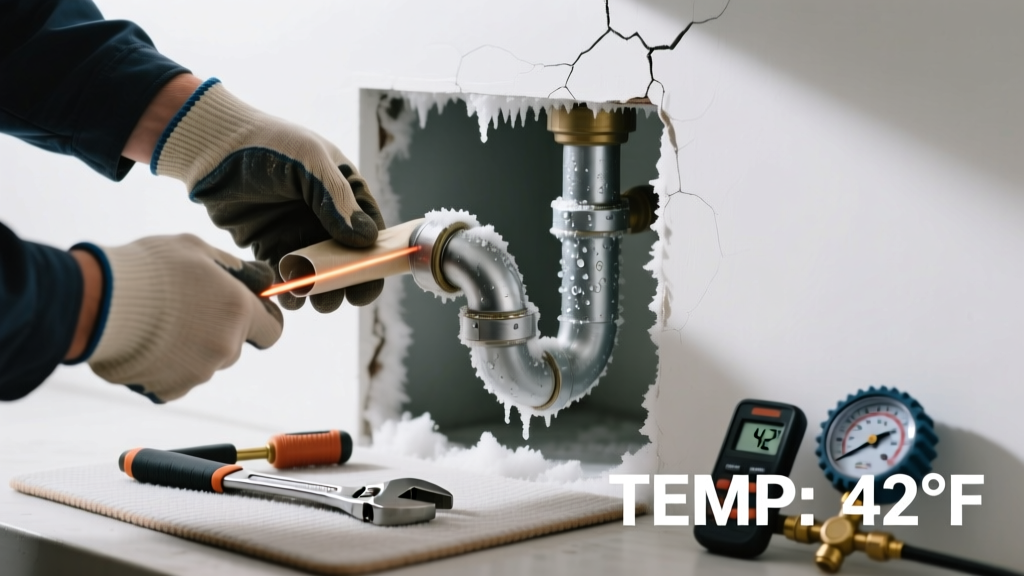
That sharp *ping*, hollow *clank*, or low groaning noise from your wall or basement isn’t just annoying—it’s your plumbing screaming for help. When water freezes inside a pipe, it expands and stresses the metal or plastic, often creating unsettling sounds before (or instead of) a full blockage or burst. Ignoring it risks costly water damage and structural compromise.
Quick Diagnosis
Unusual noises from frozen pipes aren’t random—they point to specific stress points or failure modes. Here are the most common causes:
- Ice expansion pressure on copper or PEX joints, causing metallic pinging or snapping
- Air trapped behind ice, creating gurgling or hissing as pressure shifts
- Micro-fractures forming in brittle PVC or older galvanized pipe, producing crackling or grinding
- Thawing-induced water hammer when ice melts unevenly and water surges into empty sections
- Insulation gaps near exterior walls or crawl spaces, where cold air infiltrates and chills pipes unevenly
Tools & Materials Needed
| Item | Purpose | Estimated Cost |
|---|---|---|
| Infrared thermometer | Pinpoints exact freeze location without removing drywall; detects surface temps below 32°F | $25–$65 |
| Heat tape (UL-listed, self-regulating) | Provides controlled, safe warmth along pipe length; prevents re-freezing during recovery | $18–$42 |
| Fiberglass pipe insulation sleeves (R-4 or higher) | Reduces heat loss and slows refreezing; essential for long-term protection | $3–$12 per 6-ft section |
| Shop light with incandescent bulb (not LED) | Provides gentle radiant heat—safer than space heaters near flammable materials | $12–$28 |
| Non-contact voltage tester | Confirms no live wires behind walls before drilling or applying heat near pipes | $15–$35 |
Step-by-Step Fix
Never apply open flame or high-wattage heat guns—these can melt PEX or ignite insulation. Use these methods in order of safety and effectiveness:
- Locate the freeze zone: Use your infrared thermometer to scan exposed pipes (basement, crawlspace, attic). Look for spots consistently below 30°F—even a 6-inch cold band indicates the blockage.
- Apply gentle, even heat: Wrap heat tape around the cold section, overlapping by 1 inch, and plug into a GFCI outlet. Set timer for 30-minute intervals—check progress with thermometer every 15 minutes.
- Open the nearest faucet: Keep it slightly open (¼ turn) while thawing. This relieves pressure and lets steam/air escape, reducing risk of pipe rupture. You’ll hear a change in sound—hissing softening to dripping—as ice recedes.
- Monitor for leaks during thaw: As ice melts, inspect all joints, solder seams, and valve connections. A small drip may appear—tighten compression nuts gently with a wrench if accessible. If flow resumes but noise persists, suspect micro-fractures (see 'When to Call a Pro').
When to Call a Pro
Some situations demand licensed expertise—not just experience. Call a plumber immediately if:
- You hear continuous, rhythmic cracking sounds lasting more than 90 seconds—this signals active fracturing in cast iron or aged galvanized pipe
- The pipe is embedded in concrete slab or behind finished drywall with no access panel
- You detect mold odor or damp drywall near the noisy section—indicating prior leakage you haven’t seen
- Your home uses polybutylene piping (common 1978–1995), which becomes brittle below 40°F and fails unpredictably during thaw cycles
- Water pressure drops more than 15 PSI after thawing, suggesting internal delamination or hidden pinhole leaks
"Over 25% of winter water damage claims involve pipes that made audible distress noises 12–48 hours before failure," according to the Insurance Institute for Business & Home Safety's 2023 Residential Risk Report.
Prevention Tips
Preventing recurrence is cheaper and safer than repeated emergency thaws. Focus on airflow control and thermal redundancy:
- Seal all rim joist gaps and foundation cracks with expanding foam—cold air infiltration is the #1 cause of localized freezing
- Install heat tape on vulnerable runs (e.g., exterior wall supply lines, garage plumbing) and set thermostat to activate at 40°F
- Keep cabinet doors open under sinks on exterior walls during sub-freezing nights—allows warm room air to circulate
- Drain and shut off outdoor spigots and irrigation lines before first frost; insulate with foam covers rated to -20°F
- Test your home’s main water shutoff valve annually—knowing it works saves critical time during emergencies
Can I use a hair dryer to thaw the pipe?
Yes—but only on short, fully exposed sections (like under-sink copper). Hold it 6–8 inches away, move constantly, and never leave unattended. It’s ineffective for pipes inside walls or longer runs. Overheating can warp PEX or scorch insulation, triggering smoke alarms.
Why does the noise stop then start again after I turn on the faucet?
This cycling occurs when partial thaw creates intermittent flow: water pushes through a narrow channel, pressure builds, then the channel collapses or re-ices. It means the freeze is deeper or more complex than surface-level—proceed with heat tape, not just running water.
Is it safe to leave heat tape on all winter?
Only if it’s UL-listed, self-regulating, and installed per manufacturer specs (no overlapping, no covering with insulation unless approved). Non-self-regulating tapes can overheat and ignite nearby materials. Check for fraying or discoloration before each season.
What if the noise is coming from the water heater instead of pipes?
That’s likely thermal expansion noise—common in closed-loop systems with failed expansion tanks. The tank absorbs pressure spikes when heated water expands. If your expansion tank feels solid (no air cushion) or hasn’t been serviced since 2020, it’s likely waterlogged and needs replacement. See our expansion tank guide for testing steps.
Will pouring saltwater down the drain help thaw a frozen trap?
No—and it’s dangerous. Saltwater lowers the freezing point minimally (to ~20°F), but introduces corrosive chloride ions that accelerate rust in cast iron or galvanized traps. Worse, it can crystallize and worsen clogs. Use heat tape or a heating pad instead.
How do I know if the pipe is already cracked but not leaking yet?
Listen for persistent, low-frequency humming or vibration when water is running elsewhere in the house—even if no visible leak exists. That’s water escaping through micro-fractures and resonating. Also check for white mineral dust near joints—a sign of slow vapor leakage. Read about early leak indicators before moisture damage spreads.
Once the noise stops and steady flow returns, don’t assume the job’s done. Monitor that section for 72 hours—some fractures only weep after repeated thermal cycling. Re-insulate thoroughly, seal air leaks, and consider adding a smart water sensor like the Moen Flo or Phyn to catch anomalies before they become disasters. Pipes don’t make noise for fun—they’re telling you something’s wrong. Listen closely, act deliberately, and protect what’s behind the walls.