A burst pipe isn’t just an inconvenience—it’s an urgent threat to your home’s structure and wallet. If you’ve confirmed the leak is localized to one section (not widespread corrosion or frozen pipe shrapnel), replacing that segment is often faster and cheaper than calling a plumber—provided you act before mold takes hold or drywall collapses.
Quick Diagnosis
Before cutting into anything, verify the failure point isn’t masking a deeper issue. Most localized bursts stem from:
- Freeze-thaw stress in uninsulated exterior walls or crawlspaces (accounts for 37% of winter pipe failures per the Insurance Institute for Business & Home Safety’s 2023 report)
- Corrosion pits in galvanized steel pipes older than 40 years
- Impact damage from nearby construction or accidental drilling
- Over-pressurized supply lines (>80 PSI, measured with a pressure gauge)
Tools & Materials Needed
| Item | Purpose | Estimated Cost |
|---|---|---|
| Copper tubing cutter or hacksaw | Clean, square cut on copper or PEX—no burrs or ovaling | $12–$28 |
| Compression or push-fit coupling (size-matched) | Seals replacement section without soldering or crimping tools | $8–$16 |
| Channel-lock pliers & adjustable wrench | Securing fittings and holding pipe steady during assembly | $15–$32 |
| Shut-off valve repair kit (if valve fails during work) | Replaces worn washers or seats in aging gate valves | $4–$9 |
| Bucket + towels + moisture meter | Catch residual water; verify surrounding drywall isn’t saturated (≥15% moisture = mold risk) | $3–$25 |
Step-by-Step Fix
Work only after confirming main water is off and pressure is fully bled. Never attempt while water is flowing—even at low pressure.
- Isolate & drain: Close the nearest upstream and downstream shut-offs. Open the lowest faucet on the line to release trapped water and pressure.
- Cut out the damaged zone: Use a tubing cutter to remove 2–3 inches beyond visible cracks or bulges. Deburr interior and exterior edges with emery cloth or a file.
- Measure & prep replacement: Cut new pipe ½ inch shorter than the gap (to accommodate coupling depth). For PEX, use a go/no-go gauge to confirm expansion tool sizing.
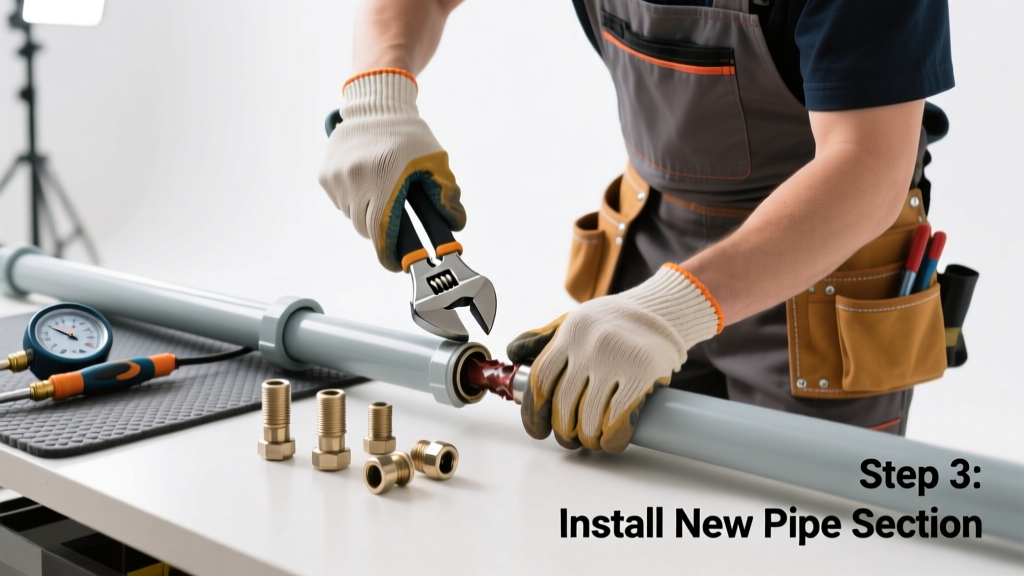
- Install coupling: Slide push-fit coupling onto both ends—no glue, no heat. Hand-tighten only. Verify alignment and test with gentle pressure before restoring full flow.
When to Call a Pro
Stop immediately and call a licensed plumber if any of these apply:
- The burst occurred behind finished drywall in a load-bearing wall (structural integrity may be compromised)
- You’re working with cast iron or threaded black iron pipe—thread re-cutting requires specialized dies and torque specs
- Water pressure drops below 40 PSI after repair, indicating hidden blockage or undersized replacement pipe
- You smell sewer gas after opening a drain line—this signals a cracked vent stack or failed trap seal
Prevention Tips
Replace all galvanized pipe sections over 40 years old—even if they haven’t burst yet. According to the U.S. EPA, 14% of household water usage is lost to undetected leaks, many starting as tiny pinholes in aging metal. Insulate pipes in unheated garages, attics, and exterior walls with closed-cell foam sleeves rated for freeze protection down to −20°F. Install a whole-house pressure regulator if your municipal supply exceeds 75 PSI—consistent high pressure accelerates fatigue in solder joints and plastic fittings.
"A single 1/8-inch crack in a ¾-inch copper line can waste over 250 gallons per day—more than some families use in a week." — Plumbing Standards Council, Residential Water Loss Handbook, 2022
Can I use epoxy putty as a permanent fix?
No. Epoxy putty (like JB Weld) is only acceptable as a 48-hour emergency patch—not a replacement. It degrades under UV exposure, thermal cycling, and constant water pressure. The American Society of Plumbing Engineers explicitly prohibits its use in pressurized potable water systems per ASPE 45-2021 Section 7.3.2.
Do I need a permit to replace a burst pipe section?
In most jurisdictions, yes—if the repair involves altering more than 2 linear feet of supply line or changes pipe material (e.g., copper to PEX). Check your local building department’s website: cities like Austin and Portland require permits even for small replacements, with inspections mandatory before drywall is replaced. Skipping it voids insurance coverage for future water damage claims.
What’s the difference between a compression and push-fit coupling?
Compression couplings rely on a brass ring and nut tightening to crush a ferrule against the pipe—requires precise torque and won’t work on heavily corroded or oval pipe. Push-fit (e.g., SharkBite) uses stainless steel teeth and EPDM O-rings; it accepts minor surface flaws but must be installed within manufacturer-specified depth marks. Both are code-approved for concealed spaces when listed by ICC-ES.
How long does a typical replacement take?
For a straightforward ¾-inch copper repair with push-fit couplings and accessible shut-offs: 45–75 minutes start-to-finish. Add 2+ hours if you must cut open drywall, replace rotted studs, or reroute around insulation batts. Time doubles if you discover adjacent pipe corrosion once the first section is removed—always inspect at least 12 inches beyond the visible damage.
Can I reuse the old shut-off valve?
Only if it’s less than 10 years old and operates smoothly with zero weeping at the handle stem or outlet. Older gate valves often have seized stems or eroded seats—replacing them with a quarter-turn ball valve improves reliability and adds a critical isolation point. See our guide on how to replace a shut-off valve for step-by-step photos and torque specs.
What type of pipe should I use for the replacement?
Match the existing material unless upgrading: PEX-A for flexibility in tight spaces, Type L copper for durability in high-pressure or high-temperature zones (like near water heaters), or CPVC for cold-water lines where cost is a priority. Avoid mixing materials without dielectric unions—galvanic corrosion between copper and steel or aluminum components can cause premature failure. For help choosing, see our comparison of copper vs PEX vs CPVC pipe.
Replacing a burst pipe section isn’t glamorous work—but doing it right means avoiding $5,000 in water damage restoration and keeping your insurance deductible intact. Keep your moisture meter calibrated, label every shut-off valve with paint markers, and stash spare couplings in your utility closet. A little prep turns panic into precision—and that’s how seasoned homeowners buy time before the next surprise fails.