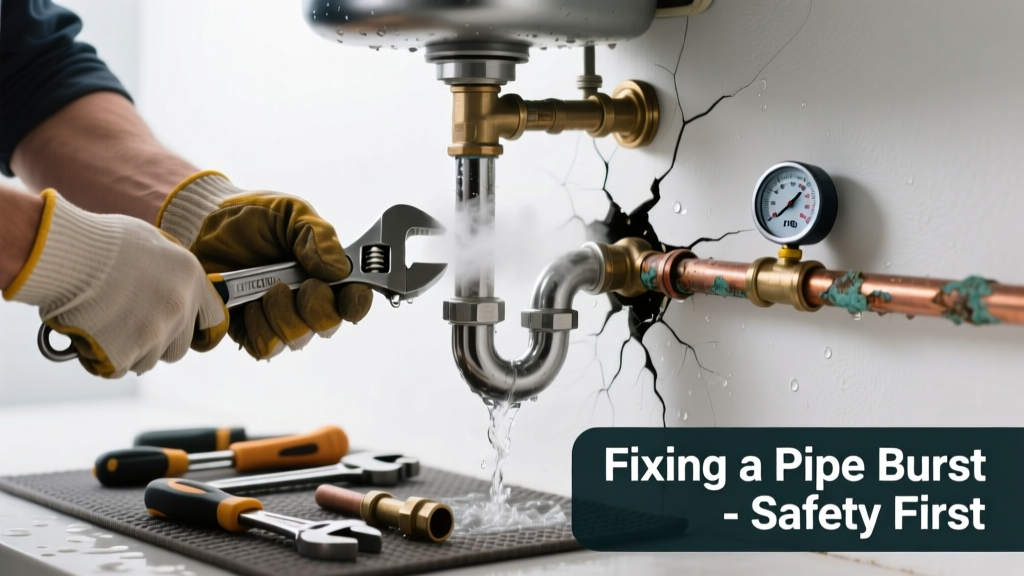
If your pipes are groaning, hissing, or making sharp banging noises—and you spot damp drywall, warped flooring, or a sudden drop in water pressure—you likely have a partial or full pipe burst. Ignoring these sounds invites serious water damage: the Insurance Institute for Business & Home Safety's 2023 report found that 68% of burst-pipe-related claims involved delayed response to early auditory warnings.
Quick Diagnosis
Unusual pipe noise paired with visible signs points to specific failures. Don’t guess—match the symptom:
- Banging or hammering when turning faucets off: water hammer from failed air chambers or high-pressure spikes
- Hissing or sputtering near a joint or fitting: small leak under pressure, often at a corroded solder joint or loose compression nut
- Groaning or vibrating during hot water use: thermal expansion stress on rigid copper lines without proper expansion tanks
- Whistling from a single fixture: mineral buildup constricting flow, not necessarily a burst—but can precede one if pressure builds
Tools & Materials Needed
| Item | Purpose | Estimated Cost |
|---|---|---|
| Adjustable wrench | Tightens or removes corroded fittings without stripping threads | $12–$25 |
| Brass compression sleeve kit (¼"–½") | Temporary seal for pinhole leaks; rated for potable water and up to 200 PSI | $8–$15 |
| Shut-off valve replacement kit (quarter-turn ball type) | Replaces failing valves that cause erratic flow and noise | $14–$22 |
| Non-metallic pipe clamps (stainless steel band) | Stabilizes vibrating supply lines to reduce resonance noise | $6–$11 |
| Pressure test gauge (0–160 PSI) | Verifies system pressure is within safe range (40–80 PSI typical) | $24–$38 |
Step-by-Step Fix
Start with safety: shut off the main water supply and open the lowest faucet to relieve pressure. Then proceed based on severity:
- For hissing at a joint: Dry the area thoroughly, apply Teflon tape clockwise on male threads, then re-tighten with an adjustable wrench—no more than 1.5 turns past hand-tight.
- For water hammer (banging): Install a water hammer arrestor within 24 inches of the noisy valve—mount vertically with mounting bracket, not just taped to the pipe.
- For groaning copper lines: Cut a 6-inch section out where vibration is worst and insert a 6-inch PEX expansion loop secured with two stainless clamps—one on each side of the loop.
- For confirmed pinhole leak: Sand corrosion away, clean with acetone, then slide on a brass compression sleeve and tighten both nuts evenly with dual wrenches—overtightening cracks the sleeve.
When to Call a Pro
DIY stops where risk begins. Call a licensed plumber immediately if:
- You hear gurgling behind walls and see discoloration on ceilings—this suggests hidden rupture inside framing
- The noise occurs only when running the dishwasher or washing machine, and the supply line is braided stainless—internal liner failure requires full line replacement
- Your home has polybutylene (PB) piping (gray, stamped "PB2110"), installed between 1978–1995: these pipes degrade unpredictably and require whole-system replacement
- Water pressure exceeds 80 PSI per your test gauge—even after adjusting the PRV—indicating regulator failure or municipal supply issue
Prevention Tips
Most burst-pipe noise stems from preventable stressors. Install these now:
- A pressure-reducing valve (PRV) if your street pressure exceeds 75 PSI—the U.S. EPA estimates that 14% of household water usage is from leaks caused by excessive pressure
- Insulate all exposed cold-water lines in unheated areas (garages, crawlspaces) using closed-cell foam sleeves rated for freeze-thaw cycles
- Drain outdoor spigots and irrigation lines before first frost—frozen water expands with 9% greater volume, cracking even thick-walled copper
- Test shut-off valves quarterly: turn them fully off and on twice to prevent seizing
Can I use epoxy putty on a leaking copper pipe?
Yes—but only as a temporary field fix for non-pressurized or low-pressure sections (e.g., drain lines). Do not use on supply lines above 40 PSI or near heat sources like water heaters. According to the Copper Development Association’s 2022 Field Repair Guidelines, epoxy bonds fail unpredictably under thermal cycling and sustained pressure.
Why does my pipe only bang when I flush the toilet?
This is classic water hammer localized to the toilet’s fill valve. The rapid shutoff creates a shockwave. Replace the old diaphragm-style fill valve with a Fluidmaster 400A with built-in anti-hammer technology—it closes slower and absorbs surge energy.
Will tightening a loose pipe strap stop the rattling noise?
Sometimes—but only if the strap isn’t already crushing the pipe. Over-tightened straps deform soft copper and create new stress points. Use rubber-lined straps spaced no more than 32 inches apart on horizontal runs, and always pad contact points with neoprene gasket tape.
How long can I wait to fix a hissing pipe?
No longer than 24 hours. A hiss indicates pressurized escape—often at 60+ PSI. That’s enough force to erode copper in under 48 hours, turning a pinhole into a ⅛" jet. The American Society of Plumbing Engineers recommends immediate isolation and repair.
Do pipe insulation wraps reduce noise as well as heat loss?
Yes—especially mass-loaded vinyl (MLV) wraps or split-foam with foil backing. They dampen airborne transmission of mechanical noise. Standard fiberglass wrap offers minimal acoustic benefit but helps prevent condensation-induced drips that mimic leak sounds.
Is it safe to use a pipe clamp on a PVC burst?
Only if the crack is less than ½ inch and located on a straight, non-joint section. PVC becomes brittle below 40°F and loses tensile strength above 140°F—so avoid clamps near water heaters or exterior winter lines. For anything beyond minor surface crazing, cut and replace with Schedule 40 PVC and solvent-welded couplings.
Fixing a noisy burst pipe isn’t about silencing the sound—it’s about reading the warning and acting before wet drywall turns into mold-prone rot or a flooded basement. Most repairs take under two hours if caught early, and every minute spent diagnosing correctly saves hours of drywall tear-out later. Keep your pressure gauge calibrated, your shut-off valves exercised, and remember: pipes don’t whisper—they scream for attention before they fail. If you’re dealing with older galvanized lines, consider reading our guide on galvanized pipe replacement cost before the next emergency. And for persistent vibration issues, check out our troubleshooting on why pipes vibrate when water is running.
"Every audible pipe anomaly represents stored energy seeking release—either through controlled repair or uncontrolled failure." — Master Plumber Elena Ruiz, Plumbing Trade Journal, 2021