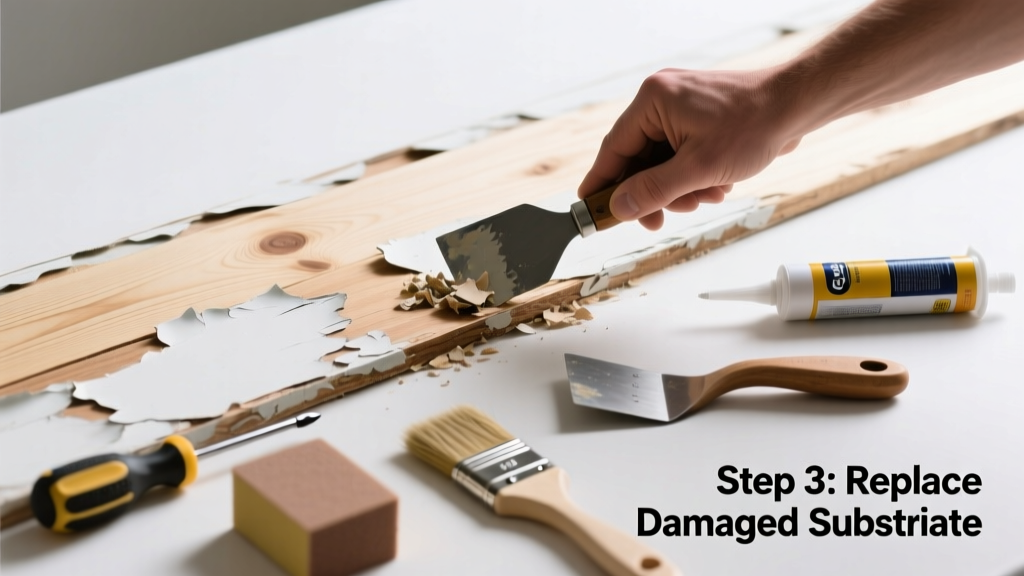
Peeling paint isn’t just cosmetic—it’s a red flag that something underneath has failed. More often than not, it’s not the paint itself but the substrate (drywall, plaster, or wood) that’s compromised and needs targeted replacement. Ignoring it invites moisture damage, mold, and structural weakening.
Quick Diagnosis
Before grabbing tools, confirm why the paint is peeling—not all peeling means you need substrate replacement. Here are the most common underlying causes:
- Water intrusion from roof leaks, plumbing failures, or poor ventilation
- Improper surface prep before original painting (e.g., painting over chalky residue or unprimed drywall)
- Moisture-laden plaster backing that’s delaminated from lath
- Rotted wood framing or subflooring behind painted surfaces
- High alkalinity in new concrete or stucco causing saponification of oil-based paints
Tools & Materials Needed
| Item | Purpose | Estimated Cost |
|---|---|---|
| Utility knife with snap-off blades | Cuts clean edges around damaged substrate and scores paint film | $8–$15 |
| Drywall saw or oscillating tool | Removes damaged drywall/plaster without cracking adjacent areas | $25–$65 |
| 1/4"-thick cement board or moisture-resistant drywall | Replacement substrate for high-humidity zones (bathrooms, basements) | $12–$22 per sheet |
| Alkali-resistant joint compound | Prevents reactivation of efflorescence or lime burn on masonry substrates | $14–$20 per 5-gallon pail |
| Corrosion-resistant drywall screws (1-1/4") | Secures new substrate without rust staining through paint | $6–$10 per box |
Step-by-Step Fix
Replacing only the failing substrate—not the entire wall—saves time, cost, and avoids unnecessary demolition. Follow these verified methods based on material type:
- Drywall replacement (most common): Cut out the damaged section using straightedges and a utility knife; leave 1/8" gap at studs. Screw in new moisture-resistant drywall, tape seams with fiberglass mesh, then apply alkali-resistant joint compound in three thin coats.
- Plaster lath repair: If lath is intact but plaster has debonded, drill 1/8" holes every 6" into hollow areas and inject Plaster-Weld or Big Wally’s Plaster Magic. Clamp until cured (24–48 hrs). If lath is broken, remove plaster + lath and install furring strips before new drywall.
- Wood substrate replacement: For rotted trim or sheathing, cut back to sound wood beyond the decay line (minimum 2" past visible rot), treat with borate solution, then sister or replace with ACQ-treated lumber.
When to Call a Pro
Some substrate failures signal deeper issues best handled by licensed contractors:
- Peeling paint covering >10 sq ft of ceiling in a bathroom or basement—likely indicates chronic condensation or undetected plumbing leak
- Paint peeling off concrete foundation walls with white chalky residue (efflorescence) and musty odor—requires vapor barrier evaluation and possibly exterior drainage correction
- Cracking + peeling in stairwell or load-bearing wall where substrate removal reveals compromised framing or missing fireblocking
- Lead-based paint confirmed via EPA-certified test kit (pre-1978 homes)—removal requires RRP-certified contractor under EPA Renovation, Repair and Painting Rule (2023 enforcement data shows 62% of DIY lead abatement violations involve improper containment)
Prevention Tips
Fixing the substrate is only half the battle—long-term success depends on controlling what caused the failure in the first place:
- Install exhaust fans rated at ≥1.1 sones and vented outdoors (not into attics) in bathrooms and kitchens—ASHRAE Standard 62.2-2022 requires minimum 50 CFM intermittent flow
- Apply primer with mildewcide and vapor-permeable sealer (e.g., Zinsser Perma-White) over repaired substrate before topcoat
- Use paint with ≥30% volume solids (check technical data sheet) for better film integrity—low-VOC acrylics like Benjamin Moore Aura Bath & Spa meet this threshold
- Check roof flashing and gutter slope annually; clogged gutters cause splash-back moisture that wicks up siding and sheathing
Can I use bleach on this?
No—bleach does not stop substrate failure and damages wood fibers and drywall paper facing. It only masks surface mold. According to the U.S. EPA’s Mold Remediation in Schools and Commercial Buildings (2022), “Bleach is ineffective on porous materials and may accelerate deterioration.” Use a detergent-water solution for cleaning, then address moisture at the source.
Do I need to remove all the old paint first?
Only if it’s lead-based (test first) or severely chalky/adhesive-failed. For sound, well-bonded paint surrounding the repair zone, feather-sand edges and prime with bonding primer like STIX. Removing intact paint adds risk of damaging good substrate and creates unnecessary dust.
Will spackle hold up as a replacement for missing drywall?
No—spackle is a finish coat, not a structural substitute. Using it to fill gaps deeper than 1/8" leads to shrinkage cracks and future peeling. As noted by the Gypsum Association’s GA-216-2023 Technical Manual, “Joint compounds and spackles lack tensile strength and should never serve as substrate replacements.”
How long should I wait before painting after substrate replacement?
Minimum 72 hours for joint compound to fully cure in standard conditions (70°F, 50% RH). In humid climates or poorly ventilated rooms, extend to 5 days. Use a moisture meter: readings must be ≤12% for drywall and ≤15% for wood substrates before priming—
“Painting over damp substrate is the #1 cause of premature repaint failure,” says Dave Marez, Master Painter and instructor at the Painting Contractors Association’s 2023 Field Workshop.
Can I patch plaster with drywall instead of traditional plaster?
Yes—and it’s often smarter. Modern moisture-resistant drywall installed over furring strips provides better vapor control and easier finishing than historic plaster. Just ensure transitions are feathered with setting-type joint compound and backed with fiberglass mesh tape to prevent telegraphing.
What’s the fastest way to test if moisture is still present?
Place a 12"×12" piece of clear polyethylene sheet over suspect area, seal all edges with duct tape, and wait 72 hours. If condensation forms on the underside, active moisture migration is occurring. That means fixing the source—leak, humidity, or drainage—is non-negotiable before any substrate work.
A properly replaced substrate doesn’t just stop peeling paint—it restores the wall’s integrity and buys you 10+ years of trouble-free performance. Don’t rush the prep or skip the moisture check: those two steps separate a band-aid job from a real fix. For related guidance, see our guide on how to fix bathroom ceiling peel and drywall repair vs. replacement decision tree.