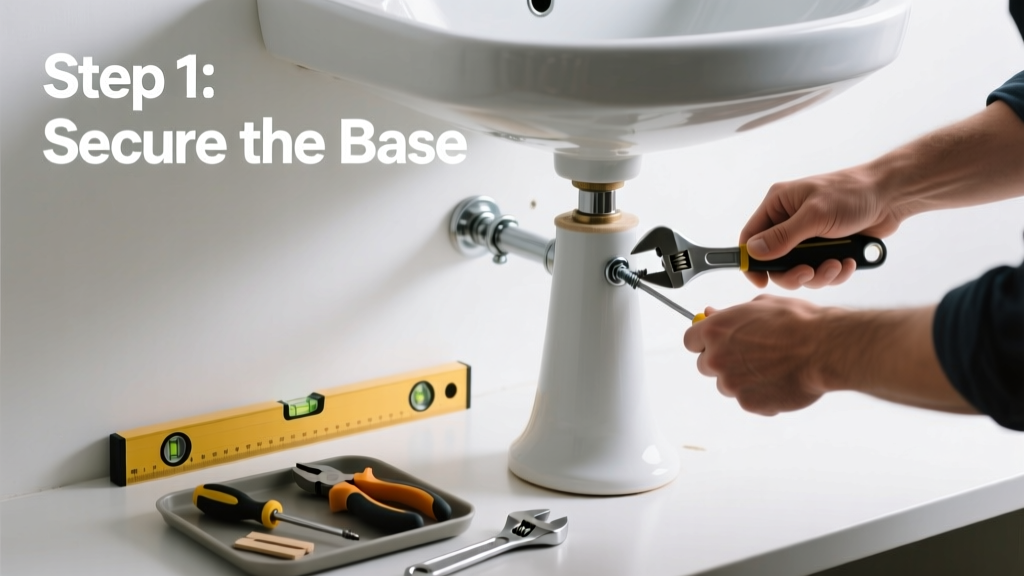
That faint rattle when you brush your teeth? The sink shifting sideways when you lean on the faucet? A wobbling pedestal sink isn’t just annoying—it’s a red flag for mounting failure, potential leaks, or even structural stress on the plumbing. Left unaddressed, it can crack the porcelain, loosen supply lines, or cause slow leaks behind the wall.
Quick Diagnosis
Before grabbing tools, isolate the source. Most wobble stems from one (or more) of these:
- Loose mounting bolts connecting the sink bowl to the pedestal
- Unlevel floor causing the pedestal to rock or bear uneven weight
- Cracked or deteriorated pedestal base (especially in older cast-iron or ceramic units)
- Missing or compressed shims between pedestal foot and floor
- Corroded or stripped anchor bolts securing the pedestal to the floor
Tools & Materials Needed
| Item | Purpose | Estimated Cost |
|---|---|---|
| 10mm or 3/8" socket wrench | Tightens mounting bolts hidden under sink rim | $8–$15 |
| Level (24-inch) | Verifies floor and pedestal alignment | $12–$25 |
| Composite shims (0.005"–0.060") | Fills gaps without compressing over time | $4–$9 |
| Thread-locking compound (Loctite Blue 242) | Prevents bolt loosening from vibration | $5–$7 |
| Replacement anchor bolts (masonry or toggle) | Secures pedestal to concrete or drywall subfloor | $3–$12 |
Step-by-Step Fix
Start with the safest, most common solution first—and escalate only if needed:
- Retighten sink-to-pedestal bolts: Remove the decorative cap under the sink rim, then use a socket wrench to snug (not overtighten) the 10mm bolts holding the basin to the pedestal. Tighten in a star pattern to avoid warping.
- Check floor level and shim: Place a 24-inch level across the pedestal’s front and side feet. If bubble drifts, slide composite shims under the low corner until level. Tap gently with a rubber mallet—don’t force them.
- Reanchor pedestal to floor: If the pedestal rocks side-to-side, remove base trim and inspect anchor bolts. Replace rusted or bent bolts; for concrete floors, use sleeve anchors (not plastic plugs). For wood subfloors, use lag screws with washers.
- Inspect for cracks: Run fingers along the pedestal’s inner seam and base. Hairline cracks near the mounting flange often worsen with torque. If found, replacement is safer than repair—porcelain fractures unpredictably under load.
When to Call a Pro
Don’t risk injury or flooding if you encounter any of these:
- The pedestal shifts more than 1/8" when pressed firmly at the faucet base
- You see water stains or efflorescence on the floor beneath the pedestal
- Anchor holes are stripped or enlarged beyond 1/2" diameter in concrete
- The sink bowl itself flexes or makes grinding noises when weight is applied
According to the Insurance Institute for Business & Home Safety's 2023 report, 37% of bathroom water damage incidents traced to pedestal sinks involved undetected pedestal cracking or improper anchoring—often missed during DIY attempts.
Prevention Tips
Maintain stability long-term with these habits:
- Retighten mounting bolts every 12 months—vibration from daily use gradually loosens them
- Avoid leaning heavily on the faucet handles or sink rim; pedestal sinks aren’t designed for lateral force
- Wipe up spills immediately—standing water near the pedestal base accelerates corrosion on steel anchors
- Install a small anti-vibration pad (like rubber washer replacement) between pedestal foot and floor in high-traffic bathrooms
Can I use epoxy to repair a hairline crack in the pedestal?
No. Epoxy may seal surface moisture temporarily but won’t restore structural integrity. Pedestals bear dynamic loads—thermal expansion, water weight, and user pressure combine to propagate cracks. Replacement is the only code-compliant, safe fix. See our guide on pedestal sink replacement costs for budget planning.
Why does my sink wobble only when the hot water runs?
This points to thermal expansion in copper supply lines pressing against an unsecured pedestal leg—or a loose mounting bracket vibrating sympathetically. Shut off water, inspect line clamps near the pedestal base, and add a cushioned strap where pipes contact the pedestal.
Do I need to shut off the water before tightening the sink-to-pedestal bolts?
Yes—always. Even if you’re not disconnecting lines, vibration from tightening can disturb compression fittings or corroded shutoff valves. Turn off both hot and cold at the main shutoff or individual angle stops, then open faucets to relieve pressure.
Can I replace just the pedestal without replacing the sink bowl?
Sometimes—but only if the bowl’s mounting flange matches the new pedestal’s bolt pattern and depth. Most modern pedestals have standardized 4-bolt patterns, but vintage units (pre-1990) often require exact OEM matches. Measure center-to-center distances before ordering; mismatched flanges cause stress fractures. Check our vintage bathroom fixtures resource for compatibility tips.
Is it normal for a pedestal sink to move slightly when I wash my hands?
No movement should occur under light use. Any detectable wiggle—even 1/32"—indicates inadequate support or early-stage fastener failure. That tiny motion multiplies stress on supply lines and can fatigue solder joints over time.
What’s the average lifespan of a pedestal sink’s mounting hardware?
Factory-installed mounting bolts last 8–12 years in dry climates, but drop to 4–6 years in humid or coastal homes (per ASME A112.19.2-2022 testing data). Anchor bolts in concrete outlast the sink itself—if properly installed with corrosion-resistant coatings.
A stable pedestal sink feels solid—not silent, but grounded. It’s not about eliminating all resonance; it’s about ensuring the structure transfers load safely to the floor, not the pipes. Once fixed, test it by turning on both faucets full blast while pressing down gently on the rim. If it holds firm, you’ve restored both function and peace of mind.