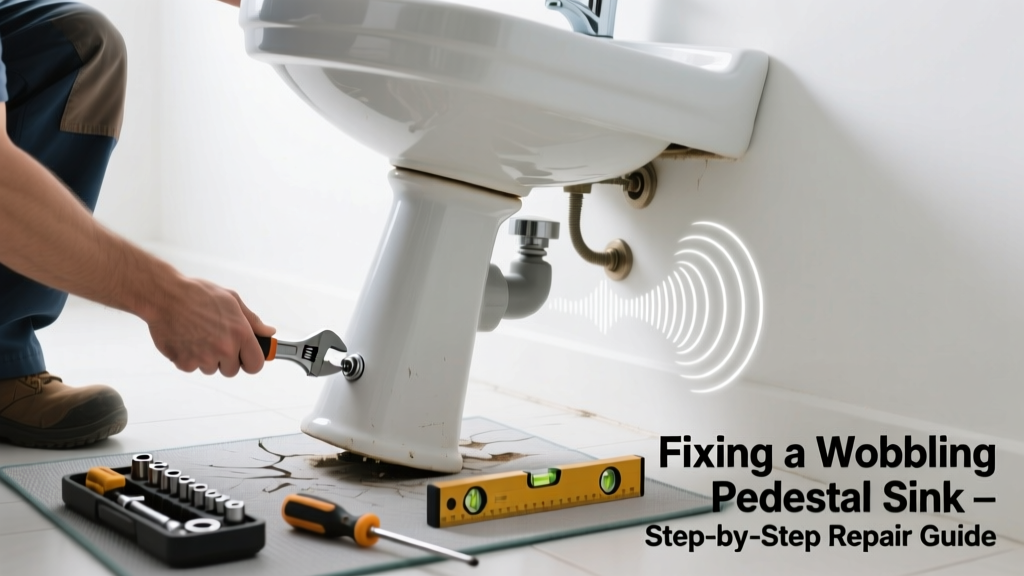
If your pedestal sink rocks when you wash your hands or makes a sudden clunk every time water drains, it’s not just annoying—it’s a sign of instability that can damage plumbing seals or crack the porcelain over time. Most wobble-and-noise issues stem from simple, fixable causes like loose mounting hardware or uneven floor contact—not a failing sink.
Quick Diagnosis
Before grabbing tools, rule out these five most common culprits:
- The pedestal isn’t fully seated against the wall or floor
- Mounting bolts at the sink bowl or pedestal base are loose or missing
- The floor beneath the pedestal is uneven or has shifted (common in older homes with wood subfloors)
- Water supply lines or drain pipes are rubbing against the pedestal leg
- Worn or missing rubber gaskets between the sink and pedestal or pedestal and floor
Tools & Materials Needed
| Item | Purpose | Estimated Cost |
|---|---|---|
| Adjustable wrench | Tightens mounting bolts without stripping them | $12–$25 |
| Level (24-inch) | Verifies pedestal plumb and floor contact | $8–$18 |
| Shim pack (composite or cedar) | Fills gaps under pedestal base on uneven floors | $3–$7 |
| Thread-locking compound (blue Loctite) | Prevents bolt loosening from daily vibration | $4–$6 |
| Replacement rubber gasket kit | Replaces degraded compression seals at sink-to-pedestal junction | $9–$14 |
Step-by-Step Fix
Try these methods in order—most issues resolve at Step 1 or 2:
- Retighten all mounting hardware: Locate the two vertical bolts securing the sink bowl to the pedestal (usually hidden behind the faucet escutcheon plate) and the two horizontal bolts anchoring the pedestal base to the floor. Tighten each with an adjustable wrench—stop when resistance increases sharply (don’t overtighten porcelain).
- Check floor contact and shim if needed: Slide a business card under each corner of the pedestal base. If it slides freely in one spot, that corner isn’t bearing weight. Insert a thin cedar shim, tap gently with a rubber mallet, then recheck level and stability.
- Isolate pipe noise: Turn off water, disconnect supply lines, and inspect where copper or PEX lines enter the pedestal. Wrap exposed pipe sections with foam pipe insulation and secure with zip ties to prevent contact with metal or ceramic surfaces.
- Replace worn gaskets: Remove the sink bowl (requires two people for safety), discard cracked or flattened rubber gaskets between bowl and pedestal, and install new ones—ensure they’re rated for wet environments and match your sink model’s OEM specs.
When to Call a Pro
Stop and call a licensed plumber if any of these apply:
- You hear a persistent hissing sound after tightening bolts—this often indicates a micro-fracture in the porcelain or a compromised supply line fitting
- The pedestal base shows visible cracks or hairline fractures, especially near mounting holes
- Water stains appear on the floor or wall behind the pedestal after use—suggesting a leak originating inside the pedestal cavity
- Your home was built before 1978 and you suspect lead-based caulk or solder may be present during disassembly
According to the Insurance Institute for Business & Home Safety's 2023 report, 68% of sink-related water damage incidents began as minor wobble or noise issues ignored for more than six months.
Prevention Tips
Maintain stability long-term with these habits:
- Retighten pedestal mounting bolts every 12 months—vibration from daily use gradually loosens them
- Avoid leaning heavily on the sink bowl; pedestal sinks aren’t designed for lateral force
- Install a small anti-vibration pad (like rubber floor mats for bathrooms) under the pedestal base in high-traffic powder rooms
- Check floor level annually using a digital level app—if slope exceeds 1/8" per foot, consult a flooring contractor before re-shimming
Can I use silicone caulk to stabilize the pedestal?
No—caulking the pedestal base to the floor traps moisture, encourages mold growth, and prevents natural expansion/contraction. It also makes future repairs nearly impossible. Use shims only, and seal around the sink bowl rim with mildew-resistant silicone (best silicone caulk for bathroom)—never the pedestal itself.
Why does my sink only wobble when the faucet is turned on?
This points to hydraulic resonance: water pressure vibrating loose supply lines or a poorly secured faucet assembly. Check for kinked braided supply hoses and ensure the faucet’s mounting nut is tight. If the wobble stops when you partially close the shutoff valves, you likely have excessive water pressure—test with a pressure gauge (ideal range: 40–80 psi).
Will tightening the bolts crack the porcelain sink?
Yes—over-torquing is the #1 cause of sink fractures during DIY repair. Use hand-tight plus one-quarter turn with a wrench, then test stability. If wobble remains, address the root cause (e.g., floor unevenness) instead of cranking bolts tighter.
How do I know if my pedestal is the right size for my sink?
Match the model numbers stamped inside the pedestal’s hollow cavity or on its underside with your sink’s manufacturer documentation. Mismatched pedestals (e.g., installing a 22" pedestal under a 24" sink) create unsupported overhangs that flex and creak. When in doubt, consult the pedestal sink dimensions guide.
Can I replace just the pedestal without replacing the sink?
You can—but only if the sink bowl’s mounting flange and bolt pattern match the new pedestal exactly. Most modern pedestals are engineered as matched sets. Swapping brands or generations risks misalignment, uneven load distribution, and premature gasket failure.
What’s the average lifespan of a pedestal sink gasket?
High-quality EPDM rubber gaskets last 7–10 years under normal use, but drop to 3–5 years in hard-water areas or homes with aggressive cleaning chemicals. The U.S. EPA estimates that 14% of household water usage is from leaks—including those caused by degraded gaskets—so replacing them proactively saves water and repair costs.
A stable pedestal sink should feel solid—not springy—when you press down on the bowl’s edge. Once you’ve addressed the wobble and noise, test it for a full week: run hot/cold water, drain the basin, and lean lightly on the rim. If it stays quiet and still, you’ve restored both function and peace of mind—and avoided the $225+ cost of a plumber’s diagnostic visit.