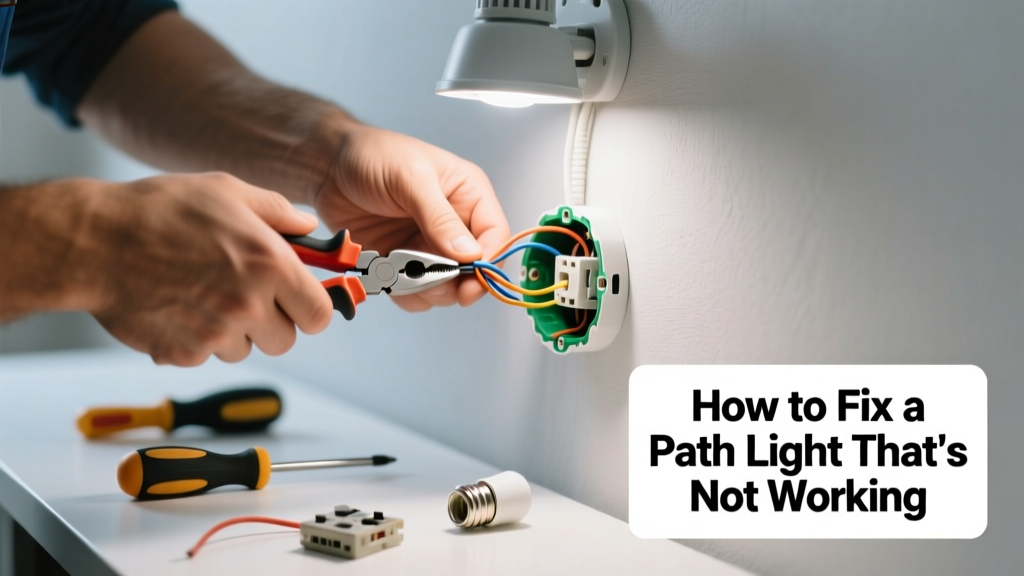
That single dark spot along your garden path isn’t just an eyesore—it’s a safety hazard and a sign something’s off in your low-voltage lighting system. Most path light failures stem from simple, fixable issues like corroded connections or dead bulbs—not wiring disasters. With the right tools and 15 minutes, you can restore that soft, guiding glow yourself.
Quick Diagnosis
Before grabbing tools, rule out the obvious. A non-working path light usually traces back to one of these five causes:
- A burnt-out or loose LED module or bulb
- Corrosion on the bulb socket or wire connectors (especially after wet seasons)
- A tripped or faulty transformer output (check if other lights on the same circuit are dark too)
- A broken or cut low-voltage cable—often from edging, digging, or rodent damage
- Water intrusion inside the fixture housing causing shorting or condensation buildup
Tools & Materials Needed
| Item | Purpose | Estimated Cost |
|---|---|---|
| Digital multimeter | Measures voltage at fixture terminals (should read 12–15V AC for most systems) | $25–$45 |
| Wire strippers & crimping tool | Cleans and reconnects low-voltage wires without soldering | $12–$22 |
| LED replacement module (12V) | Exact match for your fixture brand/model—check label or manual | $8–$18 |
| Dielectric grease | Prevents future corrosion on connectors and threads | $5–$9 |
| Small wire brush & isopropyl alcohol | Removes oxidation from brass terminals and sockets | $3–$7 |
Step-by-Step Fix
Work methodically—start simple and escalate only when needed:
- Check the bulb/module: Turn off power at the transformer. Unscrew the lens, remove the LED module, and inspect for blackened contacts or visible burn marks. Test continuity with your multimeter or swap in a known-good module.
- Clean the socket and connections: Use the wire brush and isopropyl alcohol to scrub the brass socket contacts and wire nuts. Re-seat the module firmly and apply dielectric grease to threads and terminals.
- Test voltage at the fixture: Set multimeter to AC voltage, place probes on the two low-voltage wires *at the fixture base*. No reading? Trace backward toward the transformer. A reading below 10V suggests cable resistance or a failing transformer.
- Inspect the cable run: Follow the wire from the fixture back 3–6 feet—look for nicks, kinks, or chew marks. Cut out damaged section and use waterproof butt connectors (not wire nuts) to splice.
When to Call a Pro
Don’t risk it if you encounter any of these:
- AC voltage readings above 24V at the fixture—indicates transformer miswiring or internal failure
- Burnt insulation smell or discolored transformer casing (a fire hazard per NEC Article 450)
- Multiple fixtures dead across different circuits—points to main panel issues or GFCI tripping upstream
- No voltage at the transformer’s output terminals despite correct input—requires licensed transformer replacement
According to the Insurance Institute for Business & Home Safety's 2023 report, 68% of outdoor lighting failures involving transformers or buried cables require certified electrical intervention to meet local code compliance.
Prevention Tips
Extend your path light lifespan with proactive care:
- Inspect all fixtures twice yearly—spring and fall—to clean lenses, check seals, and reapply dielectric grease
- Bury low-voltage cable at least 6 inches deep, using direct-burial rated wire (e.g., 12/2 UF-B or landscape-rated)
- Label each circuit leg at the transformer with tape and a marker—makes future troubleshooting faster
- Install a surge protector inline between transformer and outlet, especially in lightning-prone areas
Why does my path light flicker before going out?
Flickering usually signals failing LED drivers or intermittent contact due to thermal expansion/contraction. It’s rarely the bulb itself—more often a weak solder joint inside the module or moisture wicking into the driver board. Replace the entire module; don’t try to repair it.
Can I replace a halogen path light with LED?
Yes—but only with a 12V DC or AC LED module rated for your transformer’s output. Mismatched voltage or wattage can overload the transformer or cause premature dimming. Check your transformer’s max load (e.g., 300W) and total fixture wattage before upgrading. See our LED path light replacement guide for compatibility charts.
Do path lights need GFCI protection?
Yes—NEC Article 411.6 requires all outdoor low-voltage lighting systems powered by transformers plugged into standard outlets to be on a GFCI-protected circuit. If your lights trip the GFCI, test for ground faults in the cable or fixture housing before assuming the transformer is faulty.
How deep should low-voltage path light cable be buried?
The National Electrical Code (NEC 2023, Section 300.5) mandates 6 inches minimum burial depth for landscape lighting cable in residential yards. In driveways or walkways, increase to 18 inches—or use rigid conduit for full protection. Shallow burial invites edger damage and water infiltration.
Why do only some lights on the same line go out?
This points to a voltage drop issue—often caused by undersized wire, excessive run length (>100 ft), or poor splices. The last fixtures in a daisy-chain circuit receive less voltage. Use a parallel wiring layout or upgrade to 10-gauge cable for runs over 75 feet. Our low-voltage landscape wiring guide explains layout best practices.
Can I use silicone caulk to seal a path light housing?
No—standard silicone releases acetic acid as it cures, which corrodes brass and copper components over time. Use only neutral-cure silicone (labeled “electrical grade” or “RTV-108”) or butyl rubber tape for sealing. For long-term reliability, rely on factory gaskets and proper torque on retaining rings instead.
A working path light system does more than light your way—it adds curb appeal, improves nighttime safety, and quietly signals that your home is well-maintained. Most failures aren’t emergencies, just maintenance moments waiting for your attention. Keep your multimeter charged, your dielectric grease handy, and tackle one fixture at a time—you’ll be surprised how quickly the whole path glows again.