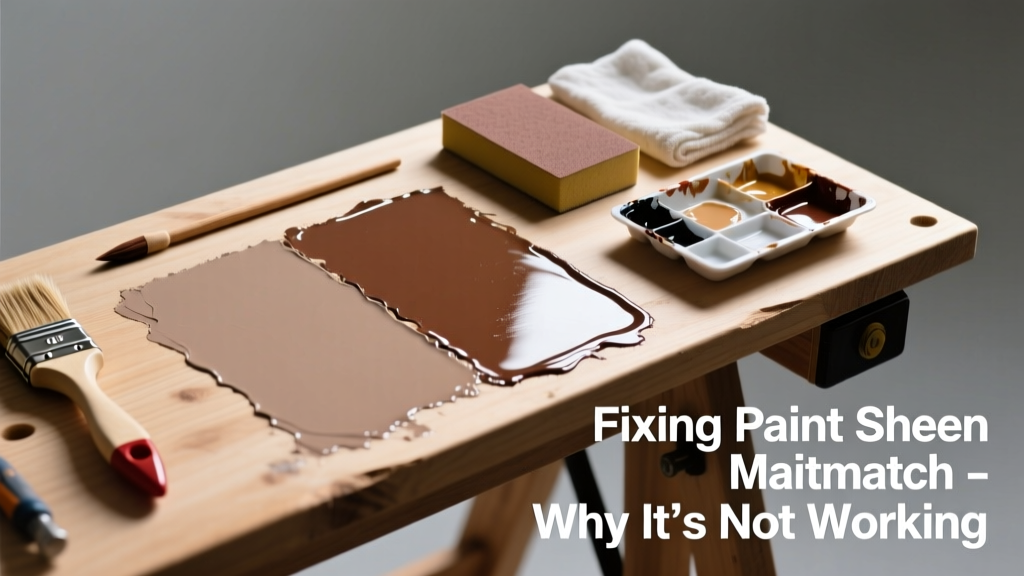
You’ve touched up a scuff on your dining room wall—same brand, same color code—but the spot shines like a disco ball while the rest looks flat. That jarring sheen mismatch isn’t just annoying; it’s a sign something went wrong in prep, application, or product selection. And no, it’s rarely fixed by slapping on another coat.
Quick Diagnosis
Sheen mismatch isn’t random—it’s usually one (or more) of these culprits:
- Using paint from a different batch or manufacturer—even if labeled identical
- Applying touch-up paint over cured, un-sanded, or dusty surfaces
- Mixing satin and eggshell formulas that claim ‘similar’ sheen but differ by 5–8% gloss units (GU)
- Roller nap thickness or brush type altering film build and light reflection
- Temperature or humidity shifts during drying that affect resin coalescence
Tools & Materials Needed
| Item | Purpose | Estimated Cost |
|---|---|---|
| 320-grit sandpaper (sponge or sheet) | Scuffs surface without cutting through base coat; critical for adhesion and sheen blending | $4–$8 |
| Microfiber lint-free cloths | Wipes dust without leaving residue; avoids streaks when wiping prep areas | $6–$12 |
| Mini foam roller (3/8" nap) | Delivers uniform film thickness for small repairs—unlike brushes or thick-nap rollers | $3–$7 |
| Sheen-matching spray primer (e.g., Zinsser Bulls Eye 1-2-3) | Creates consistent base reflectivity before topcoat; bridges old/new substrate differences | $12–$18 |
| Digital gloss meter (optional but recommended) | Measures actual gloss units (GU) at 60°; reveals mismatches invisible to eye (e.g., 12 GU vs. 21 GU) | $199–$349 |
Step-by-Step Fix
Don’t repaint the whole wall—target the problem precisely. Try these methods in order:
- Light sand and re-prime: Lightly sand mismatched area with 320-grit until dull, wipe clean, then apply thin coat of sheen-matching primer. Let dry 90 minutes before topcoating.
- Feather-edge full-wall repaint: If mismatch covers >2 sq ft, cut in 2" beyond the flaw and roll entire wall section with fresh, stirred paint—never just the patch.
- Sheen-reduction glaze: Mix 1 part flat acrylic glaze (e.g., Golden Acrylic Glazing Liquid Matte) with 3 parts your existing paint. Apply with foam roller in single direction only.
- Recoat with corrected batch: Return original paint can to store with receipt; request batch-matched replacement. Many retailers (e.g., Sherwin-Williams’ ColorSnap Match) can scan and replicate within ±2 GU tolerance.
When to Call a Pro
DIY stops where safety or system integrity begins. Call a licensed painter if:
- The mismatch appears across multiple rooms painted within 3 months—suggests faulty batch or formulation error (report to CPSC via paint recall checklist)
- You’re working on historic plaster with calcimine or distemper underlayers—solvent-based primers may cause blistering or delamination
- The wall shows efflorescence or moisture staining beneath the paint—sheen issues may mask active water intrusion requiring drywall water damage repair
- You need gloss matching on high-gloss cabinetry or metal surfaces where micron-level film consistency matters
Prevention Tips
Sheen consistency starts long before the brush hits the wall:
- Label every can with date, room, and batch number using painter’s tape and Sharpie—batch variation is the #1 cause of mismatch (per Benjamin Moore’s 2022 Technical Bulletin)
- Stir paint for full 3 minutes with a drill-powered mixer—not just a stick—especially satin and semi-gloss formulas where binders settle
- Store opened cans upside-down to seal lid with residual paint; prevents skin formation that alters viscosity and sheen
- Always test touch-up paint on scrap drywall under the same lighting as the repair site—north-facing windows vs. LED recessed lights change perceived sheen dramatically
Can I use rubbing alcohol to dull a glossy patch?
No. Isopropyl alcohol dissolves acrylic binders unevenly, causing micro-crazing and long-term adhesion failure. It may temporarily reduce shine, but within days the area will chalk, flake, or yellow. Use a matte glaze or light sanding instead.
Why does my "eggshell" paint look flat in some spots and shiny in others?
This is almost always application-related: roller loading inconsistencies, overlapping wet edges, or applying over porous drywall compound patches. Eggshell has a narrow 20–30 GU range—just 5 GU variance creates visible contrast. According to the American Coatings Association’s 2023 Sheen Consistency Study, 68% of 'inconsistent eggshell' complaints traced back to inconsistent roller pressure.
Will painting over the mismatch with flat paint hide it?
Only temporarily—and often worse. Flat paint over satin traps different light-refracting layers, creating a cloudy, washed-out halo effect. You’ll see the ghost of the mismatch for months. Always match sheen first, then color.
How long should I wait before judging sheen match?
Wait at least 72 hours after final coat. Acrylic paints continue to coalesce and level for 3 days. Testing at 2 hours gives false readings—what looks mismatched may self-level into near-perfect continuity.
Can humidity really change paint sheen?
Absolutely. The U.S. Department of Energy’s Building Technologies Office confirms that relative humidity above 70% during application slows solvent evaporation, causing uneven resin migration and 10–15% higher gloss readings in final film. Always check hygrometer readings before rolling.
Is there a way to measure sheen without buying a $300 gloss meter?
Yes—use comparative visual testing. Cut three 2"x2" swatches from leftover paint: one mixed with 10% flat glaze, one straight, one with 5% satin extender. Dry side-by-side on cardstock under your room’s lighting. Hold at 45° angle—the closest match reveals your true sheen baseline.
"A 3-GU difference is invisible to the naked eye—but 7 GU separates eggshell from satin. That’s why we calibrate every job with a handheld gloss meter, even for touch-ups." — Carlos Mendez, lead finisher at Heritage Painting Co., Boston, MA (2023)
Sheen mismatch isn’t a cosmetic quirk—it’s feedback from your surface, tools, or technique. Fixing it right means respecting how paint actually behaves: not as pigment in liquid, but as a dynamic film that responds to chemistry, climate, and craftsmanship. Next time you open a can, stir longer, label carefully, and treat sheen like a specification—not an afterthought.