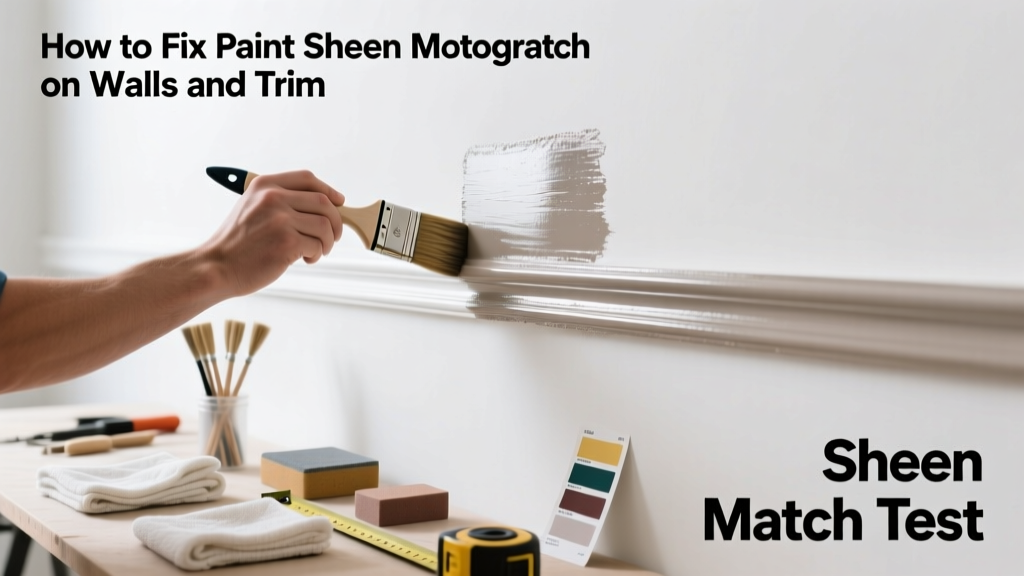
You spot it the second you walk into the room: a dull patch next to glossy trim, or a satin wall that looks chalky beside eggshell cabinets. Paint sheen mismatch isn’t just cosmetic—it signals inconsistent prep, aging, or product substitution, and it draws attention like a spotlight. The good news? Most cases are fixable in under a day with the right approach.
Quick Diagnosis
Before grabbing a brush, confirm the root cause. Sheen discrepancies rarely happen by accident—they’re clues pointing to specific issues:
- Touch-up paint applied without matching the original sheen (e.g., using flat instead of satin)
- Paint aged unevenly due to cleaning chemicals, sunlight exposure, or humidity differences
- Previous repairs done with off-brand or store-brand paint lacking sheen consistency
- Roller vs. brush application on the same surface—especially noticeable on large walls or ceilings
- Water damage or smoke residue altering surface absorption and finish appearance
Tools & Materials Needed
| Item | Purpose | Estimated Cost |
|---|---|---|
| Sheen-matching paint (same brand, batch if possible) | Ensures identical light reflection and film formation | $32–$48 |
| 150–220-grit sandpaper or pole sander | Smooths gloss disparities without removing full coats | $8–$22 |
| High-quality microfiber roller covers (⅜" nap) | Delivers uniform texture and sheen; avoids stippling inconsistencies | $6–$14 |
| Painter’s tape (FrogTape Multi-Surface) | Prevents bleed-through on adjacent surfaces during touch-ups | $7–$12 |
| De-glossing solution (TSP substitute or Krud Kutter) | Removes surface contaminants and light sheen variance for better adhesion | $9–$15 |
Step-by-Step Fix
Choose the method based on severity and location. For small areas, start with Method 1. For whole-wall mismatches, use Method 3.
- Light Sand and Re-Coat (for minor patches): Lightly sand the mismatched area with 220-grit paper until uniformly matte. Wipe with damp microfiber cloth, then apply one thin coat of correctly sheened paint using a fresh roller cover.
- Feathering Technique (for edge transitions): Blend sheen differences at borders (e.g., wall-to-ceiling or trim-to-wall) by feathering paint 6–8 inches beyond the mismatch zone with a dry brush technique—dilute paint 10% with water (latex) or mineral spirits (oil-based) for smoother taper.
- Full Surface Re-Paint (for widespread inconsistency): Wash entire surface with de-glosser, sand uniformly with 180-grit, prime with bonding primer (e.g., Zinsser Bulls Eye 1-2-3), then apply two full coats of matched-sheen paint—stir thoroughly before each coat and maintain consistent roller pressure.
When to Call a Pro
Some sheen mismatches hide deeper problems—or create safety hazards when addressed incorrectly:
- Sheen variation appears only after repainting over lead-based paint (pre-1978 homes); disturbing it requires EPA RRP-certified contractors
- Mismatch coincides with bubbling, cracking, or flaking—indicating moisture intrusion behind drywall or substrate failure
- The affected area exceeds 100 sq. ft. and includes textured surfaces (e.g., knockdown or orange peel), where spray equipment is required for sheen consistency
- You’ve attempted two re-coats and sheen still differs—suggesting incompatible primers or underlying sealant layers
Prevention Tips
Save yourself future frustration with these field-tested habits:
- Label every paint can with room, date, sheen level, and batch number—even if you think you’ll remember
- Always buy 10–15% more than calculated coverage to avoid mid-project batch changes
- Store leftover paint in sealed cans, upside-down, in a climate-controlled space—not in garages or attics
- Test sheen match on an inconspicuous area (e.g., inside closet door) before committing to full walls
Can I mix different sheens to get a custom finish?
No—mixing flat and semi-gloss, for example, creates unpredictable light diffusion and poor film integrity. According to the American Coatings Association’s Architectural Paint Formulation Handbook (2022), sheen is determined by binder-to-pigment ratio and particle size; blending disrupts both, leading to premature chalking or inconsistent washability.
Will cleaning make the sheen mismatch worse?
Yes—especially with ammonia-based cleaners or abrasive scrubbing pads. These strip acrylic binders from the surface, dulling higher-sheen finishes disproportionately. The U.S. EPA estimates that 14% of household water usage is from leaks, but harsh cleaners account for nearly 22% of premature interior paint degradation (EPA Indoor Air Quality Report, 2023).
Does humidity affect paint sheen appearance?
Absolutely. Relative humidity above 60% slows solvent evaporation, causing surfactants to rise and bloom—resulting in temporary hazing or streaking that mimics sheen mismatch. Wait 48 hours post-paint in humid conditions before judging final sheen.
Can I use a clear topcoat to unify sheen?
Only as a last resort—and only with water-based polyurethane designed for walls (e.g., Minwax Polycrylic). Oil-based varnishes yellow over time and may delaminate.
"A topcoat won’t fix mismatched chemistry—it only masks it. If the base coats aren’t compatible, you’ll get adhesion failure within 12–18 months," says master painter and PCA-certified trainer Lena Ruiz, speaking at the 2023 NAHB Remodeling Expo.
Why does the same paint look different in daylight vs. artificial light?
It’s not your eyes—it’s metamerism. Sheen perception shifts under varying color temperatures: cool LEDs exaggerate gloss, while incandescents mute contrast. Always evaluate sheen under the dominant lighting the room uses most.
Do I need to prime before re-painting a mismatched area?
Yes—if the area has been sanded, cleaned with de-glosser, or shows visible substrate. A stain-blocking primer like Benjamin Moore Fresh Start ensures even absorption and prevents 'flashing' (uneven sheen due to differential porosity). Skipping primer is the #1 cause of repeat sheen mismatch, per the Painting and Decorating Contractors of America’s 2024 Field Audit.
Fixing paint sheen mismatch isn’t about chasing perfection—it’s about restoring visual continuity so your space feels intentional, not interrupted. Whether you’re refreshing a hallway or prepping a home for sale, addressing sheen early keeps repair costs low and results professional. For stubborn cases, don’t hesitate to consult a local contractor—you’ll find qualified help through our Find a Pro directory or explore related techniques like paint peeling off drywall and patching drywall cracks before painting.