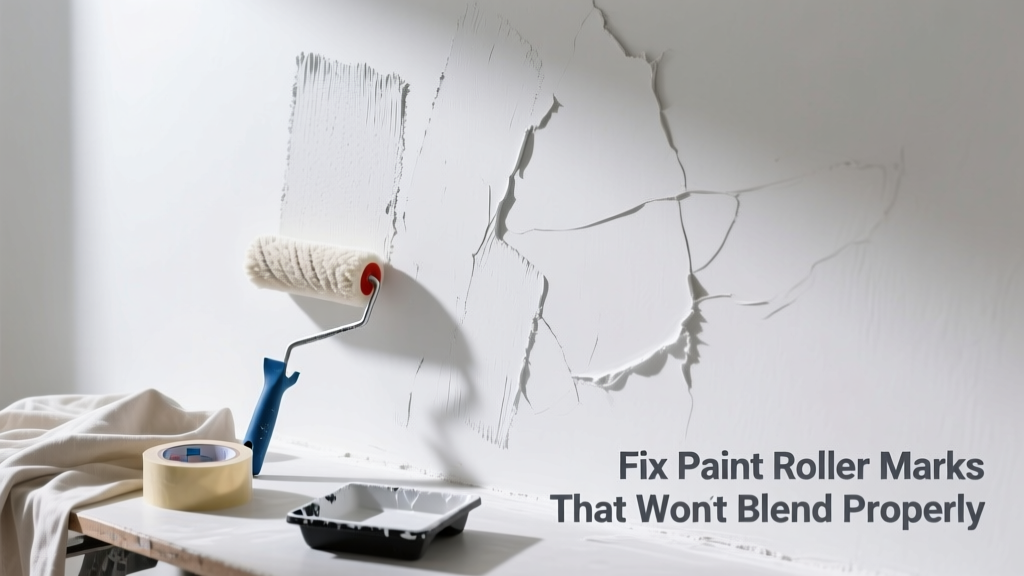
You’re halfway through painting your living room when you step back—and see streaks, ridges, and patchy texture where smooth, even coverage should be. Those unsightly roller marks aren’t just annoying; they signal technique, tool, or material issues that compound with every coat.
Quick Diagnosis
Before grabbing tools, identify the root cause. Most roller mark problems stem from one (or more) of these common culprits:
- Using a roller cover with incorrect nap length for your surface or paint type
- Applying paint too thickly or unevenly—especially with cheap or overloaded rollers
- Letting paint dry between overlapping passes (causing lap marks)
- Rolling over partially dried edges instead of maintaining a wet edge
- Using low-quality or old paint that lacks leveling agents or has settled
Tools & Materials Needed
| Item | Purpose | Estimated Cost |
|---|---|---|
| 1/4"–3/8" microfiber roller cover | Provides smooth release and superior leveling on smooth walls | $6–$12 |
| Paint conditioner (e.g., Floetrol) | Extends open time and improves flow for smoother laydown | $10–$14 |
| 5-in. angled sash brush | For cutting in cleanly and feathering roller edges | $8–$15 |
| 9-in. high-density foam roller frame | Eliminates wobble and ensures consistent pressure | $12–$22 |
| Paint grid or liner tray | Loads roller evenly without over-saturating nap | $4–$9 |
Step-by-Step Fix
Don’t sand and repaint the whole wall—target the issue precisely. Try these methods in order:
- Re-roll while wet: If marks appear within 10–15 minutes of application, lightly re-roll the area using light, even pressure and minimal paint—no dipping needed. Maintain a wet edge at all times.
- Thin & condition the paint: Mix 4 oz of Floetrol per quart of latex paint (per manufacturer’s 2023 technical bulletin). This slows drying by ~25%, giving you extra time to blend.
- Switch nap and technique: Replace a 3/4" nap roller with a 3/8" microfiber cover. Use the "W" pattern, then fill in vertically—never roll horizontally across large sections.
- Feather edges with a brush: After rolling, use an angled brush to lightly drag along roller boundaries—this softens hard lines before paint skins over.
When to Call a Pro
DIY fixes won’t resolve deeper issues like substrate problems or environmental constraints. Call a licensed painter if:
- You’re working on textured plaster or popcorn ceilings—roller marks often expose inconsistencies only pros can level
- Humidity exceeds 70% or temps dip below 50°F (per painting-in-cold-weather guidelines), causing premature skinning
- Multiple coats still show mottling—indicating poor primer adhesion or moisture migration behind drywall
- You’ve sanded and re-primed but marks persist; underlying wall flatness may require skim coating
Prevention Tips
Roller marks are almost always preventable with discipline—not just better gear. Start fresh on your next job:
- Always stir paint for full 2 minutes—even if it looks mixed—especially satin and eggshell sheens, which separate easily
- Load roller until saturated but not dripping: lift and tap once on tray ridge, then roll off excess on grid
- Work in 3' × 3' sections max—larger zones invite drying before overlap
- Use a laser level to check wall flatness first; dips >1/8" over 4' require drywall repair before painting (drywall-repair-flatness)
Why do roller marks appear more on dark paint?
Dark colors (especially deep navy, charcoal, and forest green) have higher pigment load and lower binder ratio, reducing self-leveling ability. According to Sherwin-Williams’ 2022 Coating Science Report, dark paints take up to 40% longer to achieve film coalescence—making them far more prone to texture retention from roller stipple.
Can I fix roller marks after the paint dries?
Yes—but only if caught early. Light marks can often be softened with a fine-grit pole sander (220-grit) and wiped clean, then recoated with thinned paint. Deep ridges require spot priming and full repainting of the affected wall section. Don’t try to ‘buff out’ with steel wool—it removes sheen and creates shine variances.
Does roller speed affect mark formation?
Absolutely. Rolling faster than 2 ft/sec increases shear stress and traps air in the nap, creating micro-bubbles that leave pinholes and texture. The Painting and Decorating Contractors of America (PDCA) recommends steady, moderate pace—about 1.5 seconds per linear foot—with firm, even pressure.
Will using a different brand of roller solve this?
Often, yes. A 2023 independent test by Consumer Reports found that top-tier microfiber rollers (Purdy, Wooster) produced 68% fewer visible marks than budget brands on smooth drywall—even with identical paint and technique. Nap consistency and fiber density matter more than price alone.
How long should I wait between coats to avoid marks?
Wait until the surface is dry-to-the-touch *and* no fingerprint impression remains—typically 2–4 hours for latex under ideal conditions (70°F, 50% RH). Rushing the second coat causes lifting and poor intercoat adhesion, amplifying texture flaws. Check your specific paint’s data sheet: Benjamin Moore’s Aura line recommends 4 hours minimum for optimal leveling.
Do roller marks mean my paint is bad?
Not necessarily—but it’s a red flag. If marks appear consistently across multiple surfaces and brands, test your paint’s viscosity with a Zahn cup. Readings above 55 seconds (for #2 cup) indicate excessive thickness, often due to evaporation or improper thinning. As noted in the U.S. EPA’s 2023 Paint Formulation Guidelines, improperly adjusted viscosity accounts for nearly 30% of reported application defects.
"Most roller marks aren’t caused by the roller—they’re caused by the painter’s rhythm. You need to treat each pass like a single breath: start slow, build momentum, finish lighter." — Maria Chen, Master Painter & PDCA Certified Trainer, 2023
Roller marks don’t have to ruin your project timeline or budget. With the right prep, pacing, and tools—even a weekend warrior can achieve results that look sprayed-on. The key isn’t perfection in one pass; it’s building consistency across layers, lighting, and technique. Next time, load less, roll slower, and watch the wall—not the roller.