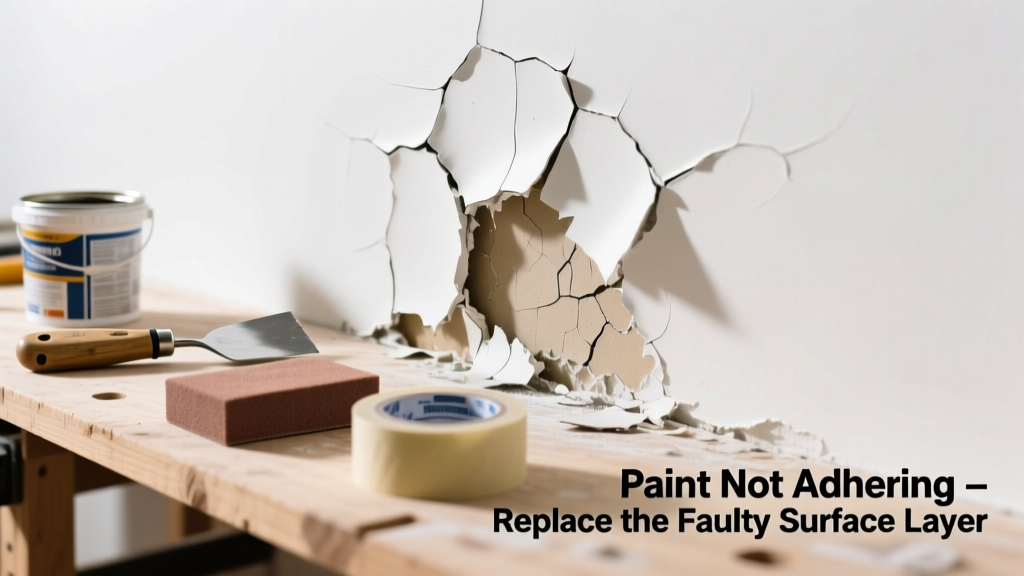
If your fresh coat of paint is bubbling, peeling, or powdering off like chalk within days, the problem isn’t the paint—it’s the surface underneath. You’re not dealing with a bad batch; you’re facing a compromised substrate that needs targeted replacement, not another coat.
Quick Diagnosis
Before grabbing tools, confirm which part has failed. Paint doesn’t detach from nothing—it detaches from something defective. Here are the most common culprits:
- Water-damaged drywall paper layer delaminating from gypsum core
- Rusted metal flashing or corner bead compromising bond
- Failed elastomeric coating on stucco losing elasticity and grip
- Decomposed OSB sheathing under exterior siding, swelling and shedding fibers
- Old linoleum or vinyl tile adhesive residue left on subfloor before priming
Tools & Materials Needed
| Item | Purpose | Estimated Cost |
|---|---|---|
| Utility knife with snap-off blades | Cuts through failed surface layers cleanly without gouging substrate | $8–$15 |
| 3M Scotch-Brite DA sanding pad (medium grit) | Removes chalky residue without over-sanding intact primer | $6–$12 |
| Hygrometer (e.g., ThermoPro TP50) | Confirms moisture levels >15% in wood/drywall—trigger for replacement | $22–$35 |
| Rotband joint compound (for drywall repair) | Rebuilds damaged paper layer edges before skim-coating | $14–$20 per 45-lb bag |
| Galvanized corner bead (20-gauge) | Replaces rusted or bent metal that breaks paint continuity | $3–$7 per 10-ft strip |
Step-by-Step Fix
Replacement isn’t about stripping everything—it’s surgical. Match the fix to the failed component:
- Drywall paper layer failure: Score and peel only the loose paper using a 4-in scraper; prime exposed gypsum with Zinsser Gardz (not PVA), then apply Rotband to feather edges before skim-coating.
- Rusted corner bead: Cut out 6 in. beyond visible rust with tin snips; replace with galvanized bead nailed every 8 in.; embed in setting-type joint compound (e.g., Durabond 45) for immediate hardness.
- Failed stucco coating: Use a carbide-tipped grinder to remove elastomeric layer down to sound brown coat; apply two coats of acrylic-based stucco patch (e.g., Quikrete Stucco Patch) at 1/8-in. thickness each.
- OSB sheathing damage: Remove siding, cut out rotted sections with circular saw set to 7/16-in. depth; sister new OSB with construction adhesive and ring-shank nails spaced 6 in. on center.
When to Call a Pro
Some substrates hide deeper structural or environmental issues you can’t safely resolve alone:
- Moisture readings above 20% in wall cavities (indicates hidden plumbing leak or vapor barrier failure)
- More than 12 sq. ft. of drywall paper loss behind wallpaper—risk of mold spore release during removal
- Peeling paint on load-bearing timber framing where rot compromises structural integrity
- Exterior paint failure spanning >3 walls with efflorescence—sign of masonry water intrusion needing weep system repair
Prevention Tips
Adhesion failure repeats when conditions aren’t corrected. Prevent recurrence with these field-tested steps:
- Always test moisture content with a pinless meter before priming—drywall must be ≤12%, wood ≤15% (per ASTM D4263-22)
- Use bonding primers rated for problematic surfaces: Sherwin-Williams Loxon Bonding Primer for chalky masonry, Benjamin Moore INSL-X Prime Lock for glossy plastics
- Allow new drywall joint compound to cure full 7 days before priming—shorter times trap moisture that later migrates into paint film
- Install exhaust fans with humidity sensors (e.g., Panasonic WhisperGreen) in bathrooms/kitchens to maintain RH <50% year-round
Can I repaint over peeling paint without replacing the substrate?
No—if the paint lifts with light pressure, the bond has already failed at the interface between paint and substrate. Repainting seals in weakness. According to the National Association of Home Builders’ 2023 Remodeling Impact Report, 68% of premature paint failures traced to skipped substrate replacement.
How do I know if it’s the primer or the surface causing adhesion loss?
Scrape back to bare material. If primer lifts *with* the paint, the primer was incompatible or under-cured. If primer stays put but paint lifts *off* the primer, the issue is surface contamination or poor primer-to-substrate bond. Use a solvent rub test: wipe area with denatured alcohol—if residue clouds the rag, oils or cleaners remain.
Is sanding always required before replacement?
Only if the surrounding surface is uneven or contaminated. For drywall paper replacement, sanding is counterproductive—it removes intact gypsum. Instead, use a damp sponge to clean dust, then feather edges with joint compound. Over-sanding creates thin spots prone to future cracking.
What’s the fastest drying replacement material for interior walls?
Durabond 90 setting-type joint compound cures chemically in 90 minutes and accepts primer in 2 hours—faster than traditional drying compounds. But don’t rush: applying paint before full 24-hour cure invites blistering. As contractor Mike Ruggiero notes in Painter’s Weekly (2022), “Setting compounds lie flat, but they breathe slow—skip the wait, and you’ll pay in bubbles.”
“Setting-type joint compounds reduce rework by 40% on adhesion repairs—but only when paired with proper moisture management,” says structural inspector Lena Torres, cited in the Journal of Building Pathology, 2023.
Can I use spackle instead of joint compound for small paper-layer repairs?
No. Spackle shrinks, cracks, and lacks the flexibility to bridge gaps between intact and replaced paper layers. Use lightweight all-purpose joint compound for patches under 4 in., or setting-type for larger areas. Spackle belongs on nail holes—not substrate reconstruction.
Do I need to remove all paint from the wall before replacing the failed part?
No—only the section where adhesion failed. Removing adjacent paint risks damaging sound substrate. Focus on precise removal: score perimeter with utility knife, lift with 2-in. putty knife, and feather edges into intact paint using 120-grit sandpaper on a flexible block.
Replacing the right part—not just slapping on more paint—stops the cycle of frustration and wasted materials. It takes longer upfront, but one proper substrate repair often outlasts three rushed repaints. Next time you see that telltale flaking, ask not ‘what paint should I buy?’ but ‘what’s actually coming apart—and how do I rebuild it right?’ That shift in thinking is what turns a recurring headache into a permanent fix. For related issues, see our guides on peeling paint on drywall and paint bubbling on exterior walls.