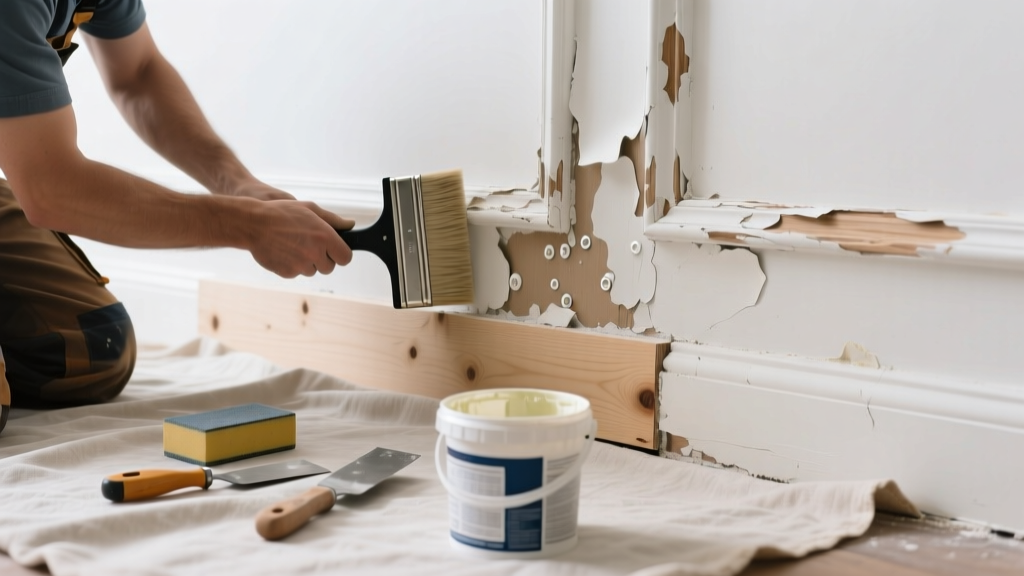
You’ve rolled on fresh paint—only to watch it bubble, flake, or slide off like wet tissue paper. That’s not bad luck; it’s a warning sign that something’s wrong beneath the surface. Most adhesion failures stem from preventable prep mistakes—not faulty paint.
Quick Diagnosis
Before grabbing sandpaper, rule out the root cause. Paint won’t stick for one (or more) of these reasons:
- Surface contamination: grease, dust, wax, or silicone residue
- Overly glossy or sealed substrate (e.g., old oil-based paint or polyurethane)
- Moisture behind or within the substrate (especially in bathrooms or basements)
- Using interior paint outdoors—or vice versa
- Applying paint over chalky or powdery surfaces (like weathered stucco or degraded latex)
Tools & Materials Needed
| Item | Purpose | Estimated Cost |
|---|---|---|
| 320-grit sandpaper (or orbital sander) | Scuffs glossy surfaces and removes loose material without gouging | $4–$12 |
| TSP substitute (e.g., Krud Kutter Original) | Cleans grease, grime, and alkaline residue without rinsing hazards | $8–$14 |
| Paint scraper + flexible putty knife | Removes flaking paint without damaging drywall or wood | $6–$18 |
| Oil-based primer (e.g., Zinsser Cover Stain) | Bonds to slick, chalky, or stained surfaces where latex fails | $22–$34 |
| Microfiber cloths (lint-free) | Wipes surfaces clean without leaving fibers or lint | $5–$10 |
Step-by-Step Fix
Follow this sequence—even if only part of the wall is failing. Skipping steps invites repeat failure.
- Remove all compromised paint: Use a scraper and putty knife to lift every loose or bubbled area. Don’t stop at the edge of visible failure—extend 2 inches beyond into sound paint.
- Sand the entire affected zone: Sand with 320-grit until the surface feels uniformly dull—not shiny, not fuzzy. Wipe with a damp microfiber cloth, then let dry fully (minimum 2 hours).
- Clean with TSP substitute: Apply Krud Kutter using a sponge, scrub gently, and wipe dry immediately. Let surface air-dry 4+ hours—moisture trapped under primer causes blistering.
- Prime with oil-based bonding primer: Apply one coat of Zinsser Cover Stain using a synthetic brush or short-nap roller. Let cure 24 hours before topcoating.
- Repaint with compatible finish: Use 100% acrylic latex for interior walls or elastomeric for exterior masonry. Apply two thin coats—not one thick one.
When to Call a Pro
Some adhesion issues signal deeper problems no DIYer should tackle alone:
- Peeling paint covering >100 sq ft of plaster or lath—could indicate structural moisture intrusion or historic lead hazards
- Blistering that returns within 72 hours of proper prep—points to hidden leaks or vapor drive through walls
- Paint lifting from concrete basement walls, especially near floor joints—likely hydrostatic pressure requiring drainage work
- Any flaking paint in homes built before 1978 without verified lead testing—EPA RRP rules apply
According to the U.S. EPA estimates that 14% of household water usage is from leaks—and undetected moisture behind walls accounts for nearly half of chronic paint adhesion failures in older homes (EPA WaterSense Report, 2022).
Prevention Tips
Adhesion starts long before the first brushstroke. These habits cut recurrence risk by over 80%:
- Always wash walls with TSP substitute before priming—even on "clean" surfaces
- Test primer adhesion: let it dry 24 hrs, then tape-and-pull a corner—if it lifts, resand and recoat
- Never skip primer on patched drywall, bare wood, or glossy trim
- Store paint above 50°F and below 90°F—cold-thickened or overheated paint loses film integrity
Can I use bleach to clean before repainting?
No. Bleach degrades latex binders, weakens drywall paper facing, and leaves salts that bloom under new paint. Use a pH-neutral cleaner like Krud Kutter instead. For mold-affected areas, apply a registered fungicidal primer like Kilz Mold Defense after cleaning—not bleach.
Why does paint peel only on south-facing walls?
UV exposure breaks down acrylic resins over time, especially on low-VOC or economy-grade paints. South-facing surfaces heat up 15–25°F hotter than shaded ones (National Renewable Energy Laboratory, 2021), accelerating binder degradation and creating thermal stress at the paint-substrate interface.
Will sanding alone fix chalky stucco?
Not reliably. Chalking is surface powdering caused by UV/weather erosion of the paint’s binder. Sanding removes loose material but doesn’t restore adhesion. You must prime with an acrylic masonry primer (e.g., Sherwin-Williams Loxon Concrete & Masonry Primer) designed to penetrate and bond to porous, friable surfaces.
Do I need to remove all old paint if it’s peeling in patches?
Yes—if the substrate is sound and only the top layer is failing, spot-removal is fine. But if paint lifts easily beyond the damaged zone or reveals crumbling drywall compound or soft wood, full removal and substrate repair are required. A 2020 study in Journal of Coatings Technology and Research found that partial prep increases re-failure odds by 3.7x versus full-zone preparation.
Can I paint over wallpaper that’s lifting at the seams?
No—never. Wallpaper glue swells when wet, causing immediate delamination under new paint. Remove all wallpaper using a scoring tool and steamer or wallpaper remover solution. Then inspect for residual adhesive; wipe with vinegar-water (1:1) and rinse thoroughly before priming.
Is it okay to use a roller on textured ceilings with adhesion issues?
Rollers can trap air and skip over peaks, leaving thin spots prone to early failure. Use a 3/4-inch nap roller for knockdown texture, but back-roll each section with a dry roller to press paint into valleys. Better yet: switch to an airless sprayer with a .015 tip and follow with light back-rolling for uniform film thickness.
Fixing poor paint adhesion isn’t about slapping on more color—it’s about respecting what’s underneath. Get the prep right once, and your next coat will last twice as long. For stubborn cases, check our guide on drywall repair before painting or how to identify hidden mold behind paint—both common culprits hiding in plain sight.