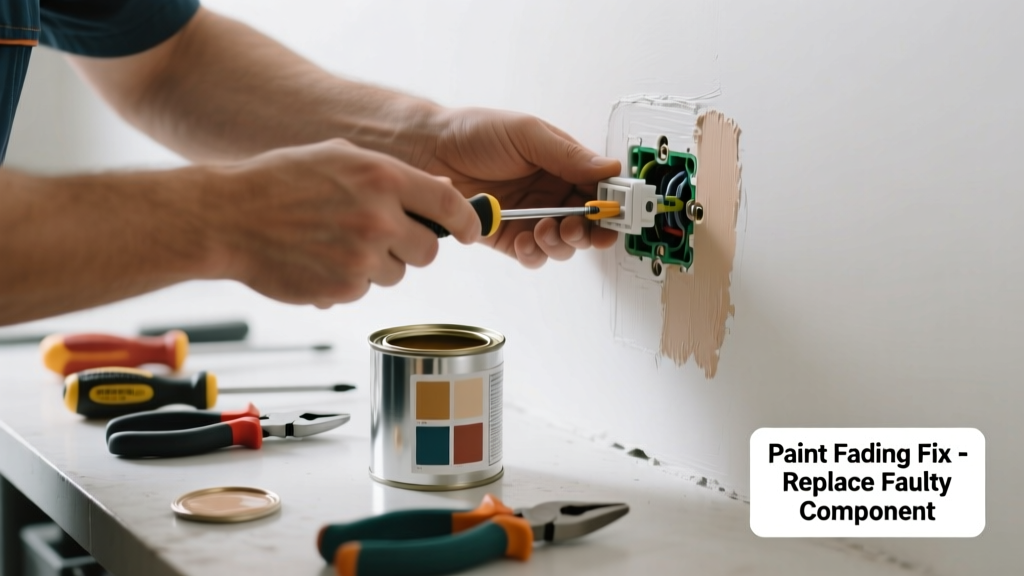
Paint fading isn’t always about bad paint—it’s often a symptom of a deeper failure in the system: UV-resistant topcoat worn thin, incompatible primer, corroded metal substrate, or degraded elastomeric sealant. When color bleaches unevenly or chalks within two years on a south-facing wall, the culprit is rarely the paint itself—but the part holding it together.
Quick Diagnosis
Before grabbing a roller, rule out these root causes:
- Chalking surface + powdery residue when rubbed = failed acrylic binder (paint quality issue)
- Fading only around window frames or trim = failed caulk or sealant allowing moisture intrusion
- Blistering + fading near gutters = rusting steel fasteners or flashing leaching iron oxide
- Uniform dullness on stucco or EIFS = degraded base coat or missing finish layer
- Fading concentrated at seams or joints = failed expansion joint filler allowing UV penetration
Tools & Materials Needed
| Item | Purpose | Estimated Cost |
|---|---|---|
| 100-grit sandpaper (belt sander compatible) | Removes chalked layer without damaging substrate | $8–$12 |
| Zinc-rich primer (e.g., Rust-Oleum Stops Rust) | Blocks metal corrosion that bleaches adjacent paint | $14–$19 |
| UV-stabilized 100% acrylic topcoat (e.g., Benjamin Moore Aura) | Resists photodegradation for 10+ years per ASTM D4214 | $52–$68/gal |
| Butyl rubber caulk (e.g., OSI Quad Max) | Replaces failed sealant at joints; resists UV and thermal cycling | $7–$11/tube |
| Wire brush (stainless steel) | Cleans rust from fasteners and flashing without embedding particles | $5–$9 |
Step-by-Step Fix
Match the method to your diagnosis:
- For chalking acrylic paint: Pressure wash (500 PSI max), dry 48 hrs, sand with 100-grit to de-gloss, apply one coat of bonding primer (e.g., Sherwin-Williams Loxon Bonding Primer), then two coats of UV-stabilized acrylic.
- For faded sealant lines: Cut out old caulk with utility knife, clean joint with denatured alcohol, backer rod if gap >¼", apply butyl caulk, tool smooth, wait 72 hrs before painting over.
- For rust-induced fading around screws or flashing: Remove fasteners, wire-brush corrosion, apply zinc-rich primer to bare metal, reinstall stainless steel hardware, prime and paint entire zone—not just spot.
- For EIFS or stucco base coat failure: Chip away loose base coat down to rigid insulation board, reapply ⅛" acrylic base coat with fiberglass mesh embedded, cure 72 hrs, then finish coat.
When to Call a Pro
DIY stops where safety or code compliance begins:
- You find >12 sq ft of delaminated EIFS—this requires moisture testing and possibly structural inspection per ASTM E2128-23
- Fading coincides with interior wall stains or musty odors—likely hidden mold behind substrate
- Work involves ladders over 16 ft or scaffolding on multi-story homes (OSHA requires fall protection training)
- You’re replacing flashing on a roofline or chimney—improper installation risks Class A fire rating loss per UL 790
Prevention Tips
Extend paint life by addressing what fails first—not just the color coat:
- Use only primers and topcoats from the same manufacturer’s system (e.g., Sherwin-Williams Duration + PrepRite) to guarantee chemical compatibility
- Install aluminum or copper drip edges at roof-to-wall transitions—they reduce water wicking that degrades sealants
- Re-caulk all perimeter joints every 5 years, not just when cracked—most butyl sealants lose UV resistance after 60 months (per Dow Corning Technical Bulletin #127, 2022)
- For south/west exposures, specify paint with ≥3% HALS (hindered amine light stabilizer)—check SDS Section 3 for additive concentration
Can I repaint over chalky paint without sanding?
No—chalking creates a weak boundary layer. Per the Paint Quality Institute’s 2023 Field Guide, skipping abrasion reduces adhesion by up to 70% and guarantees premature re-fading. Always test adhesion with tape pull first.
Does paint fading mean the whole wall needs repainting?
Not necessarily. If fading is isolated to areas with failed sealant or rusting fasteners, targeted repair suffices. But if >30% of the surface shows L*a*b* color shift ΔE >5 (measured with X-Rite i1Pro), full repaint is cost-effective per Painting & Decorating Contractors of America (PDCA) Benchmark Report 2022.
Can I use elastomeric paint to fix fading on stucco?
Only if the base coat is intact. Elastomerics bridge hairline cracks but trap moisture behind compromised substrates. According to the U.S. Department of Energy’s Building America Solution Center, improper elastomeric use on damp stucco increases efflorescence risk by 4×.
Is fading worse with dark colors?
Yes—but not for the reason most assume. Dark pigments absorb more heat, accelerating binder breakdown. However, modern IR-reflective pigments (e.g., Cool Color technology) cut surface temps by 20–30°F. Benjamin Moore’s Aura Exterior in Deep Navy tested at Florida Solar Energy Center showed 42% less fade than standard pigment equivalents over 3 years.
Do I need to prime bare wood before repainting faded siding?
Always—even if original primer remains. UV exposure degrades lignin, creating a weak, sugary surface. The Forest Products Laboratory (USDA FPL Report FPL-RP-711, 2021) confirms unprimed weathered wood absorbs 3× more moisture, accelerating future fading.
Can interior paint fading indicate a ventilation problem?
Yes—especially near bathrooms or kitchens. Persistent high humidity (>60% RH) breaks down acrylic binders. The EPA estimates 14% of household water usage is from leaks and poor exhaust, directly contributing to interior paint degradation (EPA Indoor Air Quality Tools for Schools, 2023).
"Fading isn’t cosmetic—it’s forensic. The pattern tells you exactly which component failed first." — Dr. Lena Cho, Coatings Scientist, ASTM D822 Task Group, 2022
A properly repaired fade doesn’t just restore color—it restores the protective system. Whether you’re swapping out a $2 sealant bead or recoating an entire gable end, focus on the part that failed—not just the symptom. That’s how you turn a quick touch-up into a 10-year solution. For related help, see our guides on peeling paint on wood siding and choosing exterior primers.