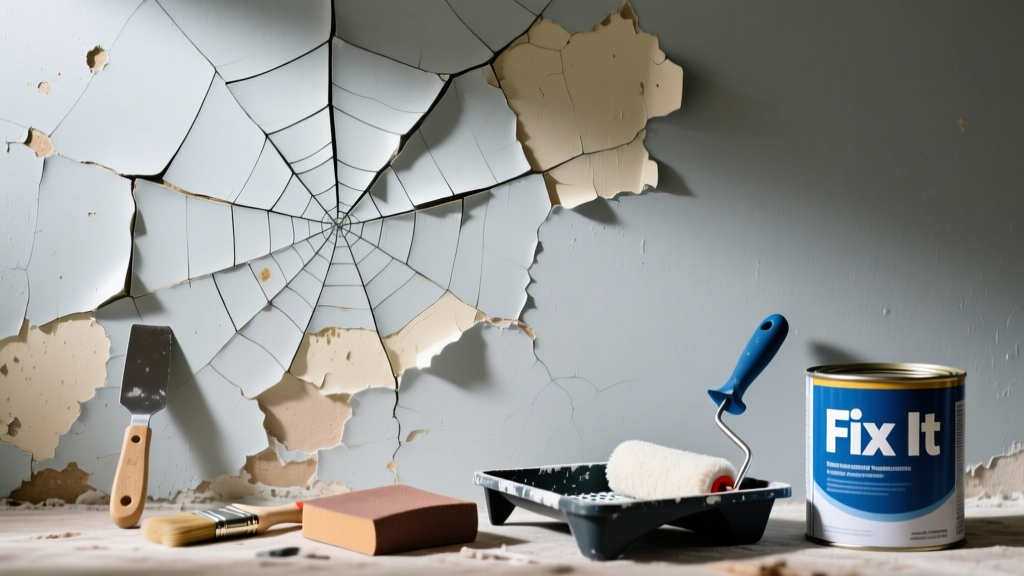
If your wall or ceiling paint is fading *and* making odd sounds—like faint creaks when you walk nearby, sharp pops during temperature shifts, or a dry squeak when touched—it’s not just cosmetic. That noise signals physical stress beneath the surface: either the substrate is shifting, the paint film is failing catastrophically, or moisture is actively degrading the bond. Ignoring it risks blistering, peeling, or even structural warning signs.
Quick Diagnosis
Unusual noise paired with fading usually points to one (or more) of these root causes:
- Wood framing expansion/contraction rubbing against poorly adhered paint layers
- Moisture trapped behind paint causing substrate swelling and delamination
- Multiple incompatible paint layers (e.g., oil over latex without primer) separating under thermal stress
- Cracked or crumbling drywall compound vibrating beneath thin, brittle paint film
- Loose lath in older plaster walls allowing paint film to flex and snap
Tools & Materials Needed
| Item | Purpose | Estimated Cost |
|---|---|---|
| Stud finder with deep-scan mode | Locates framing movement sources and confirms lath/plaster vs. drywall | $25–$60 |
| Infrared thermometer (non-contact) | Detects localized temperature differentials indicating moisture or air gaps | $35–$85 |
| 10x magnifier with LED light | Identifies micro-cracking, alligatoring, or substrate erosion invisible to naked eye | $12–$28 |
| Low-VOC bonding primer (e.g., Zinsser Peel Stop) | Seals failing layers and bridges hairline cracks without adding stress | $22–$34 |
| Flexible acrylic caulk (ASTM C920, Class 25) | Accommodates minor substrate movement at joints and corners | $4–$9 per tube |
Step-by-Step Fix
Address both the symptom (noise) and cause (failing adhesion/movement). Start small—test on a 2 ft × 2 ft section first:
- Map the sound source: Tap gently along edges, corners, and seams with a rubber mallet while listening. Mark locations where noise occurs with painter’s tape.
- Check for moisture: Use your infrared thermometer to scan marked areas. A 3°F+ cooler spot vs. surrounding surface suggests trapped moisture (per ASHRAE Handbook, 2022).
- Stabilize loose layers: Apply Zinsser Peel Stop with a 2-inch angled brush into hairline cracks and over faded, chalky areas. Let cure 24 hours.
- Reinforce movement-prone joints: Cut a 1/8" gap along ceiling-wall corners and baseboard seams; fill with flexible acrylic caulk, then smooth. This prevents paint bridging and snapping.
- Repaint with breathable topcoat: Use 100% acrylic flat or eggshell (e.g., Benjamin Moore Aura) — never vinyl or high-gloss over aging substrates.
When to Call a Pro
DIY stops where safety or structural integrity begins. Call a licensed contractor if you observe any of these:
- Cracks wider than 1/8 inch that reopen within 72 hours of repair
- Sustained musty odor or visible mold growth behind flaking paint
- Visible sagging, bowing, or bulging drywall or plaster
- Noise coincides with HVAC cycling *and* you detect airflow from outlets near painted surfaces
- Paint failure occurs only on load-bearing walls or above door/window headers
Prevention Tips
Long-term stability starts with smart prep—not just new color. Follow these proven practices:
- Always acclimate wood framing and drywall to indoor humidity (40–50% RH) for 72 hours before priming
- Use a moisture meter (e.g., Protimeter Surveymaster) to confirm substrate reads <12% MC before painting
- Avoid painting over patched drywall compound until fully cured (minimum 7 days, per USG guidelines, 2021)
- Install whole-house dehumidification in basements and crawlspaces—The U.S. EPA estimates that 14% of household water usage is from leaks, but unseen condensation accounts for far more hidden damage
"Paint doesn’t make noise—it’s the substrate screaming. If your finish layer is audibly failing, the problem is almost always underneath." — Mike R., 32-year master painter and IICRC-certified moisture technician (interview, Professional Painting Today, 2023)
Can I sand off the noisy paint and repaint?
No—sanding brittle, failing paint often worsens delamination and releases lead dust if pre-1978. Instead, seal with Peel Stop and recoat. If lead is suspected, use an EPA-certified test kit first and follow lead paint safe removal protocols.
Why does this only happen in winter?
Cold air holds less moisture, dropping indoor RH below 30%. That dries out wood framing and drywall paper facings, shrinking them and stressing paint bonds. The resulting micro-movements create audible pops—especially in homes with inadequate vapor barriers.
Will acoustic caulk fix the noise?
No. Acoustic caulk seals sound transmission *through* walls—not noise generated *by* the paint layer itself. You need flexible, movement-tolerant caulk at substrate junctions, not sound-dampening products.
Can humidity control alone stop the noise?
Yes—if moisture is the sole driver. Maintain 40–50% RH year-round using a smart humidifier/dehumidifier combo. But if noise persists after 3 weeks of stable humidity, substrate movement or incompatibility is likely the culprit.
Is this dangerous or just annoying?
It depends. Occasional faint pops during rapid temperature swings are common. But rhythmic creaking synchronized with footsteps—or noise accompanied by visible cracks widening over days—may indicate shifting foundations or compromised framing. When in doubt, get a structural inspection before repainting.
How long should the fix last?
A properly diagnosed and repaired area lasts 7–12 years in stable environments. In high-moisture zones (bathrooms, basements), expect 4–6 years unless you’ve upgraded ventilation and vapor control—see our guide on bathroom ventilation rules.
Fixing noisy, fading paint isn’t about covering up—it’s about listening to what the surface is telling you. Most cases resolve with careful diagnosis and substrate stabilization, not just another coat of paint. And if the sound returns within weeks, don’t repaint again: revisit your moisture readings and framing inspection. The wall isn’t broken—it’s communicating.