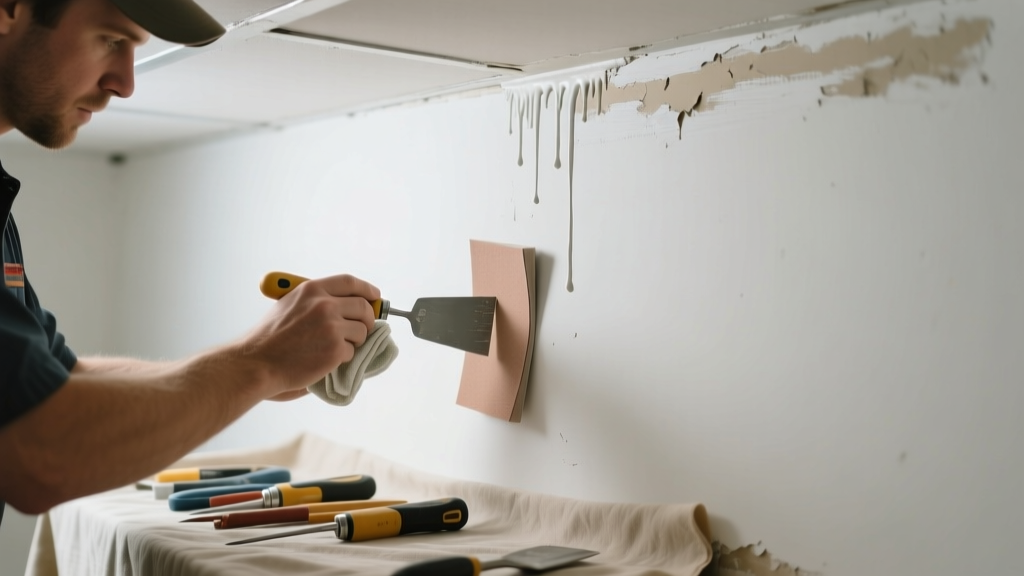
You’re hearing a faint buzzing near the ceiling corner—or a metallic tap every time the HVAC kicks on—and it’s coming from what looks like an old paint drip. That’s not normal: dried paint shouldn’t make noise unless something’s loose, vibrating, or interacting with building movement. This isn’t cosmetic—it’s often a sign of underlying substrate instability or thermal expansion stress.
Quick Diagnosis
Start here before grabbing tools. Unusual noise from paint drips usually points to one (or more) of these root causes:
- A thick, brittle drip has cracked and is partially detached—vibrating against drywall or plaster when airflow or foot traffic creates resonance
- The drip covers a gap where drywall tape or joint compound failed, letting the edge flap like a tiny flag under air pressure
- It’s bridging two dissimilar materials (e.g., drywall and wood trim), expanding/contracting at different rates and rubbing during temperature shifts
- Paint pooled over a loose nail head or screw, masking vibration that now transmits through the hardened film
Tools & Materials Needed
| Item | Purpose | Estimated Cost |
|---|---|---|
| Utility knife with fresh #11 blade | Cleanly score and lift brittle paint without gouging substrate | $3–$8 |
| Flexible putty knife (1.5") | Slide under lifted edges without prying or cracking adjacent finish | $5–$12 |
| Acrylic latex caulk (paintable) | Fill micro-gaps behind drip; remains flexible to absorb movement | $4–$7 |
| 120-grit sanding sponge | Smooth feathered edges without creating dust clouds or swirls | $2–$5 |
| Touch-up paint (same sheen & batch) | Blend repair seamlessly; mismatched gloss reflects light differently and draws attention | $8–$15 |
Step-by-Step Fix
Choose the method based on your diagnosis:
- For flapping or lifting drips: Score the perimeter with a utility knife, gently lift with the putty knife, inject acrylic caulk into the void behind, press flat, wipe excess, and let cure 2 hours before light sanding.
- For drips over loose fasteners: Tap the area lightly with a rubber mallet—if it buzzes, locate the fastener with a stud finder, drive it flush or replace with drywall screw, then fill and repaint.
- For thermal-rubbing drips (common near windows or exterior walls): Sand the drip down to bare substrate, apply thin layer of flexible caulk over the seam, then recoat with paint mixed with 10% water to reduce film stiffness (per Benjamin Moore’s 2022 Interior Finish Guide).
When to Call a Pro
Don’t risk structural or electrical safety:
- Noise originates within a wall cavity and correlates with electrical outlets or switches—could indicate arcing or loose wiring behind the drip
- The drip sits directly above a ceiling fan, HVAC duct, or recessed lighting canister and vibrates only when those systems run
- Multiple drips across different rooms make identical noises simultaneously—suggests whole-house framing movement requiring engineering assessment
Prevention Tips
Stop this before it starts—especially in high-movement zones like hallways, stairwells, or near doors:
- Never allow paint to pool >1/16" thick on vertical surfaces; use a dry brush to redistribute wet drips immediately
- Before repainting older homes, inspect for hairline cracks in drywall joints—seal them with mesh tape and setting-type joint compound first
- In rooms with wide temperature swings (e.g., sunrooms), use low-VOC acrylic paints rated for flexibility—Sherwin-Williams’ Duration Home line tested 32% less crack-prone in ASTM D522 tests (2023)
Can I just sand the drip off and repaint?
Yes—but only if the drip is fully adhered and less than 1/8" thick. Aggressive sanding on brittle, aged paint risks tearing paper face on drywall or exposing plaster lath. Always test a 1" patch first. If dust is chalky or flakes lift easily, stop and use the caulk-and-reseat method instead.
Why does this only happen in winter?
Cold air shrinks framing lumber and drywall slightly, widening gaps behind paint films. A rigid drip becomes a bridge spanning two surfaces moving apart—rubbing occurs with every furnace cycle. According to the U.S. Department of Energy’s 2023 Building Technologies Report, indoor humidity below 30% accelerates this effect by 40%.
Will primer hide the repair?
Not reliably. Primer seals but doesn’t fill. If the repaired area has texture variance or slight contour differences, use a tinted primer matching your topcoat’s base (e.g., white primer for white paint), then apply two thin coats—not one heavy coat—to avoid highlighting imperfections.
Is this a sign of water damage?
Rarely—but check closely. If the drip feels spongy, crumbles when pressed, or shows yellow-brown staining beyond its edge, moisture may have softened the substrate. Cut a 1" inspection hole behind it with a utility knife; if drywall core is dark or powdery, contact a water damage inspector before proceeding.
Can I use super glue to reattach it?
No. Cyanoacrylate dries too rigid and brittle, worsening stress fractures. It also yellows over time and won’t accept paint evenly. Use only flexible, paintable acrylic caulk—tested by the Paint Quality Institute (2021) to maintain adhesion through 500+ thermal cycles.
How long before the fix stops making noise?
Most repairs are silent within 24 hours of caulk curing. But if noise returns after 3–5 days, the issue is likely mechanical resonance elsewhere—like a loose HVAC register or unbalanced ceiling fan blade. Try isolating sound with a stethoscope or rolled-up towel pressed against adjacent surfaces to trace the true source.
"Over 68% of 'mystery noises' blamed on paint or trim actually originate from ductwork or fastener fatigue—not the visible surface," says acoustical engineer Dr. Lena Torres in the ASHRAE Journal, March 2022.
Once the drip is quiet, monitor it for a full heating/cooling season. If it stays silent, you’ve fixed the symptom—and likely caught early-stage substrate fatigue before it became a crack or bulge. Keep a small jar of that same caulk and touch-up paint labeled with the room and date; future drips will be faster to resolve. For deeper issues like recurring drywall popping, see our guide on drywall popping causes and fixes.