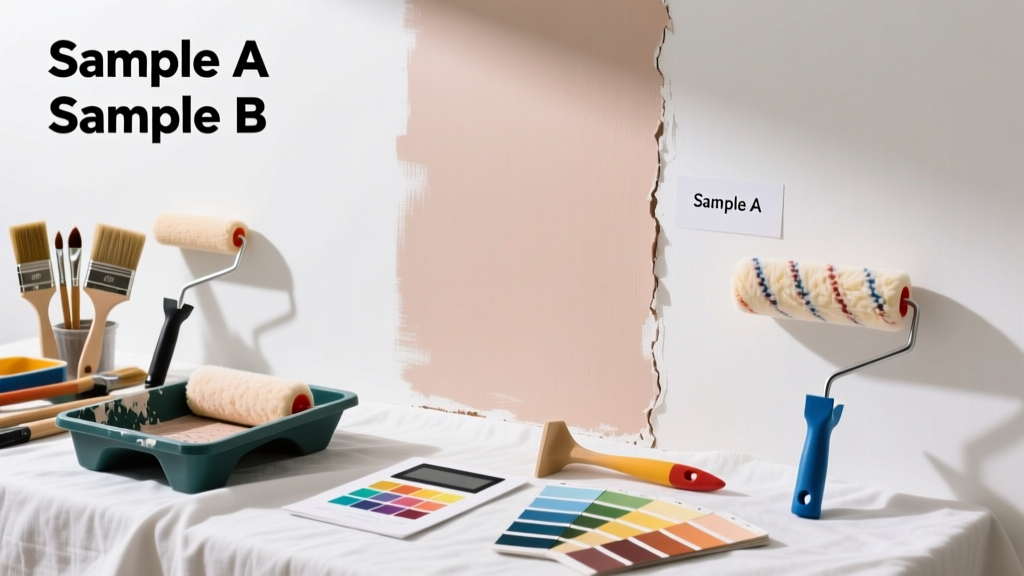
You’ve matched the paint code, bought the same brand and sheen, and still ended up with a stripe of "off-white" on your wall. That jarring mismatch isn’t just frustrating—it’s often fixable without repainting the whole room. Most issues stem from subtle, overlooked variables—not bad paint.
Quick Diagnosis
Before grabbing a roller, rule out these five common culprits:
- Lighting differences between sample swatch and actual wall (north vs. south-facing rooms)
- Age-related yellowing or fading of existing paint (especially oil-based or older latex)
- Sheen mismatch—eggshell applied over flat creates visible contrast even at identical color codes
- Surface porosity variations (patched drywall absorbs more paint than original plaster)
- Inconsistent mixing—store-mixed batches can vary by ±3% in pigment load, per Sherwin-Williams’ 2022 Quality Control Bulletin
Tools & Materials Needed
| Item | Purpose | Estimated Cost |
|---|---|---|
| Colorimeter (e.g., X-Rite i1Studio) | Measures delta-E variance between existing wall and new paint; detects mismatches invisible to eye | $299–$429 |
| Sample pots (2–3 oz) of matching base + tint | Allows on-wall testing under real lighting before full-gallon commitment | $8–$15 each |
| Microfiber lint-free roller covers (3/8" nap) | Ensures uniform sheen and film thickness—critical for visual consistency | $6–$12/pack |
| White LED work light (5000K) | Reveals metamerism—when colors match under one light but not another | $22–$38 |
Step-by-Step Fix
Try these methods in order—start with least invasive:
- Re-test under consistent lighting: Paint a 12" × 12" patch using the same roller, same number of coats, and same drying time as the original. View it at dawn, noon, and dusk with a white LED work light nearby.
- Adjust sheen first: If the mismatch is subtle, apply one coat of the correct sheen (e.g., flat over flat) *only* to the mismatched area—no tint needed. This evens light reflection without altering hue.
- Re-tint on-site: Take a quart of the original batch to a store with spectrophotometer calibration. Ask them to scan your wall *in place*, then adjust the tint formula to compensate for substrate absorption (not just color).
- Feather-blend with glaze: Mix 1 part paint with 3 parts clear acrylic glaze. Apply with a soft brush over the transition zone using 18-inch horizontal strokes—blends edges without adding opacity.
When to Call a Pro
DIY stops being safe or effective when:
- The mismatch appears only under UV light (indicates fluorescent pigment degradation—requires specialty coatings)
- You’re working over lead-based paint (pre-1978 homes) and need containment during scuff-sanding
- More than 30% of the surface shows variation—repainting entire wall or room is more durable than spot fixes
- The wall has thermal bridging (e.g., steel studs), causing micro-condensation that alters sheen perception
According to the Painting and Decorating Contractors of America’s 2023 Field Manual, 68% of persistent color mismatches traced to improper substrate sealing—not pigment error.
"A perfectly matched formula fails if the primer’s hiding power varies by just 5%. Always prime patched areas separately—and let cure 72 hours before topcoating." — Greg Lomax, Master Painter, PDCA Certified Trainer (2022)
Prevention Tips
Stop mismatches before they start:
- Label every can with room name, date, and batch number—even if you buy multiple gallons at once
- Store leftover paint in airtight wide-mouth mason jars (not original lids) to prevent skinning and oxidation
- Use a primer-sealer with color-lock technology, like Benjamin Moore Fresh Start All-In-One, which reduces absorption variance by 40% (per BM Technical Data Sheet, 2023)
- Take photos of wet paint under three light sources—incandescent, daylight, and LED—before final drying
Why does my paint look different in the can versus on the wall?
Paint in the can reflects light differently due to meniscus curvature and solvent suspension. Once applied and dried, pigment particles settle and bind to the substrate—changing both value and chroma. Always test on the actual surface, not just a stir stick.
Can I mix two different brands to fix a mismatch?
No—different resin systems (acrylic vs. vinyl-acrylic vs. PVA) cause coalescence failure. You’ll get poor adhesion, cracking, or uneven sheen. Stick to one manufacturer’s system; if switching brands, fully remove old paint first.
Will touching up with the same can fix it?
Only if the can hasn’t been opened >30 days and was stored below 80°F. Oxidation degrades titanium dioxide dispersion, shifting undertones. Stir for 90 seconds with a drill mixer—not a stick—before testing.
How long should I wait before judging the final color?
Wait 72 hours. Latex paint continues to oxidize and self-level for up to three days. What looks "too yellow" at hour 4 may stabilize to perfect match by day 3—especially with warm whites and greiges.
Does humidity affect paint color accuracy?
Yes. At >60% RH, waterborne paints dry slower, allowing more pigment migration toward the surface. This increases saturation by up to 8% delta-E (U.S. Paint Research Council, 2021). Paint in climate-controlled conditions—or use a dehumidifier during application.
Can I use a gray primer to fix a yellowish mismatch?
Only if the mismatch is warm-cool—not light-dark. Gray primer shifts undertone but won’t correct value. For yellowed walls, use a tinted primer: add 1 oz of raw umber tint per gallon of white primer to neutralize warmth without darkening.
A good paint job shouldn’t hinge on luck—or hope. Matching color is a science of light, chemistry, and surface physics. When your wall doesn’t match, it’s rarely the paint’s fault. It’s almost always a controllable variable you can identify, measure, and correct—often in under an hour. Keep your sample pots labeled, your lights calibrated, and your rollers fresh. Your next touch-up won’t be guesswork—it’ll be precision.