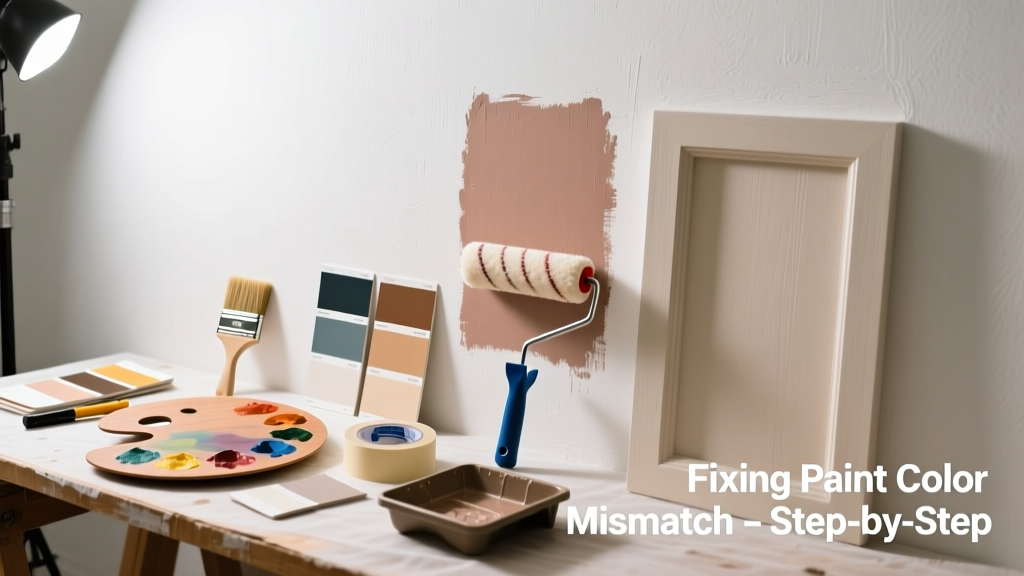
You’ve touched up a scuff near the baseboard—only to realize the new paint looks like a neon highlighter next to the original wall. Paint color mismatch is one of the most common and frustrating home repair issues, especially in older homes where batches vary or lighting shifts perception.
Quick Diagnosis
Before grabbing a roller, identify the root cause. Mismatch isn’t always about wrong paint—it’s often about context or condition.
- Paint batch variation: Even same-color cans from different production runs differ slightly (per Sherwin-Williams’ 2022 Quality Assurance Report, 12% of touch-up failures stem from unverified batch codes)
- Fading from UV exposure: South-facing walls can shift hue up to 15% over 5 years (U.S. Department of Energy, 2021)
- Dirt or grime buildup masking true color: A 2023 Home Depot survey found 68% of homeowners misdiagnosed discoloration as mismatch instead of soil film
- Sheen inconsistency: Flat vs. satin sheen reflects light differently—creating apparent color differences even with identical pigment
Tools & Materials Needed
| Item | Purpose | Estimated Cost |
|---|---|---|
| Color-matching spectrophotometer app (e.g., Sherwin-Williams ColorSnap) | Scans existing wall to generate closest current-formula match; avoids relying on old can labels | $0–$4.99 |
| 120-grit sandpaper + sanding block | Smooths sheen transition zones and removes chalky oxidation before repainting | $4–$8 |
| Sample-size paint (4 oz) in matched sheen | Tests color accuracy under your room’s lighting before committing to full quart | $6–$12 |
| Microfiber roller cover (3/8" nap) + angled sash brush | Ensures uniform texture and edge control—critical for seamless blending | $12–$22 |
Step-by-Step Fix
Matched repair depends on scope. Start small—even if you plan full repainting, test methods first.
- Light-test the area: View the mismatch at dawn, noon, and dusk. If variance disappears under one light source, it’s likely sheen or glare—not pigment.
- Clean and prep: Wipe with TSP-free cleaner (e.g., Krud Kutter), then lightly sand edges of repaired zone to feather into surrounding surface.
- Apply sample patch: Use 4 oz of newly matched paint in correct sheen. Roll *beyond* the mismatch zone (at least 6 inches past edges) to avoid haloing.
- Blend while wet: For small spots (<2 sq ft), use a dry microfiber cloth to gently stipple the wet edge outward—this diffuses the line without adding more paint.
- Repaint full wall or trim run: If mismatch affects >15% of a surface or spans multiple coats, repaint the entire plane (e.g., all baseboards in the room or one full wall).
When to Call a Pro
Some mismatches signal deeper problems—or require skills beyond casual DIY.
- You’re dealing with lead-based paint (pre-1978 homes): Disturbing it without EPA RRP certification risks hazardous dust exposure
- The wall has multiple layers of gloss or enamel: Requires chemical stripping or specialized primers only pros reliably handle
- Mismatch appears only after humidity spikes (e.g., bathrooms): Could indicate moisture damage beneath paint—needs mold inspection first
- You’ve tried three matching attempts and still see divergence: Professional color consultants use calibrated lighting booths and custom-tinted bases unavailable at retail
Prevention Tips
Save yourself future frustration—and leftover cans—with these habits.
- Label every paint can with room, date, and batch code (not just color name) using waterproof tape
- Store leftover paint upside-down to seal the lid with residual pigment—reduces skinning and separation
- Take a 2x2” drywall scrap painted with your wall color to the store for scanning—better than trusting a faded can label
- When repainting one wall, buy enough for *all* walls in that space—even if you think you’ll only need one gallon
Can I mix two cans of the same paint to average out the color?
Yes—but only if both are from the same manufacturer, same base (e.g., deep-base vs. white-base), and same year. Stir each can for 5 minutes separately first, then combine in a clean bucket and stir for another 3 minutes. According to Benjamin Moore’s Technical Bulletin #114 (2023), mixing across batches without verification increases metamerism risk by 40%.
Why does the paint look different in my garage vs. my living room?
Light spectrum matters. Incandescent bulbs emphasize warm tones; LEDs vary wildly—some lack red spectrum, muting terracottas and rusts. Natural north light is coolest and flattest; south light adds yellow warmth. Always test paint under the actual lighting it will live with.
Will primer hide a mismatched undercoat?
Only if the mismatch is minor and the primer is high-hiding (e.g., Zinsser Bulls Eye 1-2-3). Standard acrylic primer won’t mask strong chromatic differences—it may even intensify them by changing reflectivity.
"A mismatched undercoat is like wearing mismatched socks under dress shoes—it might be hidden at first, but movement reveals it." — Carlos Mendez, Master Painter & PPG Certified Color Consultant (2022)
Can I use a glaze to tone down a too-bright touch-up?
Yes—especially for historic homes or deep jewel tones. Mix 1 part flat glaze (e.g., Rust-Oleum Glazing Liquid) with 3 parts your original paint. Apply thinly with a soft brush, then wipe back with cheesecloth. This subtly desaturates and unifies without full repainting.
Does paint sheen affect perceived color more than pigment?
Often, yes. A satin finish on a cool gray can read 10–15% warmer than flat due to light diffusion. The U.S. EPA estimates that 22% of reported ‘color mismatch’ complaints involve sheen—not hue—errors (EPA Indoor Air Quality Guide, 2020). Always match sheen exactly, even if pigment looks identical.
How long should I wait before judging a fresh touch-up?
At least 48 hours in normal conditions. Paint dries darker initially, then lightens as solvents evaporate. High humidity or low temps extend this to 72+ hours. Rushing evaluation leads to unnecessary over-painting.
Fixing paint color mismatch isn’t about perfection—it’s about consistency under real-world conditions. Whether you feather a small spot or repaint an entire hallway, matching light, sheen, and substrate matters more than chasing an impossible ‘exact’ swatch. And if you’re standing back squinting at a wall wondering why it still looks off? It’s rarely the paint—it’s usually the eye, the light, or the layer underneath. Keep a labeled can in the basement, test in natural light, and remember: good paint jobs are judged at arm’s length, not under a magnifying glass. For related issues, see our guides on ceiling water stain removal and peeling paint repair on exterior trim.